


The search for the best Rainforest API alternatives usually begins after one too many delays or broken data pulls. This particularly occurs when a developer hits the real wall; think fragmented data, unpredictable latencies, missing fields, or yet another silent failure in the pipeline, to name a few.
If you’ve ever had to explain to your CEO why your product, dashboard, or automation engine is lagging, maybe because your Amazon data source stalled, or worse, returned incomplete data, you’re not alone.
To stay ahead, teams need an Amazon Product API that does more than return a JSON file. They need reliability under scale, unified datasets across marketplaces, predictable performance, accurate metadata, and structured signals that downstream teams can actually build on. Consequently, when that fails, maybe due to inadequate API data, effects ripple outward, affecting pricing and creating engines that misfire.
When competitor trackers underperform, inventory systems rely on stale data, and the business loses strategic visibility right when precision matters most.
That’s why brands and SaaS teams are shifting to the best Rainforest API alternatives with stronger stability, richer datasets, and infrastructure built for modern event-driven systems. After all, when data fails, developers take the heat, but CEOs feel the consequences.
With newer competitors of Rainforest API setting higher technical standards, choosing a Rainforest API alternative is essential to avoid the escalating cost of bad or delayed data.
In this article, which focuses on the best Rainforest API alternatives to exist in the market, we’ll discuss why Rainforest is lacking certain practical aspects that you need in business and what competitors of Rainforest API are currently thriving in the market, solving today’s engineering and business-critical challenges.
Quick Guide
Why Users Need Rainforest API Alternatives
It seems like users of the Rainforest API are fairly univocal about their experience with its service. We’ll discuss the most talked-about points here in this segment.
Before we jump into the Rainforest API alternatives, their features, or pricing grids, let’s understand what Rainforest API users are actually experiencing while being hands-on with it.
If you’re wondering where does Rainforest API rank among its competitors? We can vouch for platforms with seller analytics, such as SellerApp for teams focused on actionable business intelligence or high-fidelity variation data, which typically rank higher in real-world use, in comparison to Rainforest API.
Across Trustpilot reviews, where we find a TrustScore of 3.5/5 and the firsthand experiences of our clients (ones who pivoted from Rainforest), we find that a few common complaints keep recurring.
Here’s what that looks like in real life.
1. When a single API call takes 30–50 seconds, the workflows become unnecessarily lengthy.
If you’re refreshing thousands of ASINs every day, latency will not look like a minor inconvenience to you, irrespective of the Rainforest API alternative you’re using. Rather, it will dictate the throughput of your entire ingestion layer.
A 30–50 second response time per call can stretch regular tasks into multi-hour batch cycles. Yet Rainforest API users are reporting exactly that.
As one user put it, “Customer support tried to convince me that having a whopping minute of response time for a single listing API request is normal, but we all know it isn’t the industry standard.”
This level of lag is a deal-breaker as the entire prediction model thrives on data accuracy because engineering teams need hourly price refreshes, real-time Buy Box notifications, or near-instant inventory change detection. Additionally, high latency cascades into stale dashboards, delayed alerts, and automation engines that fire too late. On top of that, bulk operations make this even worse.
Not trying to scare, but if your system, like SellerApp’s ecommerce ad managers, processes thousands of ASINs in scheduled runs, slow endpoints choke concurrency and force you to over-provision workers just to maintain SLAs.
2. Data that you can’t trust is data you can’t use.
Clean, dependable data is the backbone of everything built on top of the Amazon ecosystem. Repricers, analytics tools, sourcing extensions, PPC automation, auditing dashboards, and third-party SaaS products that must serve sellers in real time, you name it!
But Rainforest API users consistently report data gaps that break these workflows, which pushes them to look for other Rainforest API alternative options in the market. Developers flag issues like missing buy box fields, empty price fields, absent descriptions, or ASINs incorrectly flagged as unavailable, even when the live Amazon page shows the correct data. This forces teams to treat every API response as “potentially unreliable,” which immediately erodes trust in the entire data pipeline.
When the data source becomes unpredictable, developers end up compensating with engineering overhead that should never exist. What should be a simple sequence, like call API, ingest, store, serve, turns into a full-blown error-handling engine.
Some real-life examples that they may face are,
- Verification scripts to catch erroneous fields.
- Retry logic to handle silent failures.
- Fallback scrapers for missing attributes.
- Manual QA layers to confirm product status.
- Custom rules for incomplete variation data.
How FBA MultiTool Solves This Using SellerApp API?
FBA MultiTool faced this exact challenge. Their users rely on instant, accurate product intelligence to make buying decisions in seconds. When their previous data sources returned inconsistent fields or stale buy box information, sellers made bad sourcing decisions and blamed the tool.
By integrating the SellerApp API, FBA MultiTool eliminated the most painful parts of the workflow:
- SellerApp returns accurate FBA fees, profitability, and sales estimates without patching.
- Variations are properly resolved, so no more mispriced or misranked child ASINs.
- Buy box and price fields stay in sync with real-time Amazon data.
- Category, restriction, and competition data arrive complete with no missing attributes.
With SellerApp, FBA MultiTool no longer maintains backup scrapers, duplication layers, or manual verification steps. Their engineering team focuses on product innovation, not fixing another API’s inconsistencies. And their users get instant, trustworthy sourcing insights every time.
3. Support Tickets Waiting 4–6 Months Does More Harm than Good.
Fast-moving teams need a fast-moving support system, especially when it’s the ecommerce industry.
Long-time Rainforest API customers report tickets aging 4–6 months with no updates because, apparently, the company prioritizes fixes based on how many customers are affected.
Meaning, your region-specific issue might stay at the bottom. If you complain about a critical bug, it might never make it to the top because of the limited number of tickets they’re receiving, which is exclusive to your issue.
As a result, your plans gradually stall while waiting for a fix. You can’t act on your plans as fast as possible to fetch the results.
One of SellerApp’s clients, a SaaS platform that aims to help Amazon sellers track competitor pricing across the US, UK, and Canada, initially bought a Rainforest API subscription while preparing to expand into the Canadian marketplace.
The plan was to integrate Rainforest API, pull pricing, buy box status, and inventory data, and begin the client onboarding from Canada immediately.
That plan quickly fell apart because the team started onboarding users, and they discovered a recurring geo-specific issue. Rainforest API was returning missing or empty price fields for several key categories.
When our client’s team reported the problem, Rainforest’s support informed them that bug fixes were prioritized based on ticket volume. So, what does it translate to? If not many users had reported the issue, the bug was placed in a low-priority queue.
Weeks passed, and their ticket remained unresolved, hindering their goals. As a result, the team could not launch their Canada support because their pricing dataset was incomplete. They realized their roadmap was stalled, onboarding was halted, and by the time they found the competitors rolling out Canadian marketplace coverage (while they remained blocked by a single unresolved API issue), they started searching for a Rainforest API alternative.
This continued until they switched to SellerApp’s API.
With SellerApp, they finally received complete, marketplace-consistent data with no geographic gaps and support that treated production-impacting issues with the urgency they required. Only then could they ship their Canada expansion without workarounds, retries, or manual validation overhead.
4. The Hidden Costs that may Occur due to Re-Runs, Missing Reviews, Timeouts & Workarounds.
Beyond the big issues, users also report miscellaneous issues that can look like a roadblock. These are some recurring ones:
- Review endpoints pulling only page 1
- Timeouts on larger jobs
- Unreliable buy box/price fields
- Calls that need multiple retries
- Broken country-level data
Every workaround adds friction, which inflates cloud costs, which is why developers seek competitors of Rainforest API.
5. Billing & Account Headaches Holding You from Being Market Ready.
For many engineering teams, the shift toward the best Rainforest API alternatives is not only driven by data or performance gaps. Developers also tend to report avoidable friction on the billing and account-management side. These are issues that simply should not exist in a modern DaaS or SaaS platform, especially when choosing an alternative for Rainforest API that will power mission-critical pipelines.
From our relationship managers’ experience, former subscribers of Rainforest API consistently mention problems ranging from unexpected refund denials (even at minimal usage) to manual, repetitive support loops just to pause or cancel plans.
In some cases, requesting a pause triggered immediate account cancellation, cutting off API access and breaking ingestion jobs mid-cycle.
Others mention login failures during subscription changes, leaving them locked out of their own operational dashboards.
What does it mean for the developers? When your data provider complicates billing, access, or subscription controls, it disrupts workflows, delays releases, and undermines confidence in the vendor.
These experiences are why teams increasingly evaluate Rainforest API competitors, and developers want predictable systems, and the alternatives now clearly offer it. Thus, many engineers start their migration journey by testing a free Rainforest API alternative, then move to a more robust option once operational efficiency is proven at staging.
Best Rainforest API Alternatives you Need for your Amazon Business
Before we find out the best alternative for Rainforest API, let’s start by knowing who are the competitors of the Rainforest API? Among the handful of options, we bring you a list of 5 that are the most widely used, tried, and tested for a seamless experience, including SellerApp, Amazon’s SP API, Zinc, Oxylabs, and Bright Data.
Below, we’ve discussed the top Rainforest API alternatives currently available in the market (in detail) for accurate data and convenient solutions.
#1. SellerApp, A Hands-on Alternative for Rainforest API
If you’re evaluating Amazon data provider tools, SellerApp stands out as one of the most seller-centric and insight-driven Rainforest API alternatives.
Unlike API-only tools that simply crawl product fields, SellerApp blends advanced scraping methods, its proprietary product intelligence tool, keyword analytics, and profitability insights into a single ecosystem, seller-focused, of course.
This makes it an ideal choice for mid-market to enterprise brands, agencies, and large Amazon businesses that need more than just raw data but focused insights that drive decisions.
Why Choose SellerApp Among Other Rainforest API Alternatives?
Here’s your sign to switch to one of the best Rainforest API alternatives,
1. Purpose-Built Amazon Intelligence (Not Just Scraped Fields)
Rainforest API gives you structured Amazon page data, but SellerApp API goes far beyond that. Its Product Details API pulls everything you’d expect, such as title, bullets, images, price, variations, BSR, reviews, while also giving sellers the operational intelligence insights such as FBA fee breakdown, profitability projections, sales estimates, competitor presence, Listing Quality Index (LQI), category insights, and more.
SellerApp also stands out as a free Rainforest API alternative with a no-risk entry point, especially for technical teams trying to test the waters without the commitment of a long term subscription. It combines Amazon-authorized seller data with proprietary market intelligence and offers 100 free API tokens upfront. This lets you validate data quality, test integration patterns, benchmark performance beforehand, and assess whether the API data fits your existing architecture and workflows.
SellerApp’s Advanced Data Intelligence (What Rainforest Fails to Bring to the Table)
While Rainforest API scrapes what’s visible on Amazon pages, SellerApp delivers critical business intelligence that goes beyond the superficial visibility. Here’s what you get more when you sign up for the SellerApp Amazon Seller API,
Sales & Revenue Intelligence
SellerApp brings you algorithmic sales estimates (monthly units sold) and revenue projections based on proprietary data models by tracking millions of ASINs over time. This data point alone is worth its weight in gold!
For Product Research Teams
Amazon sellers can instantly validate market demand without months of testing with these insights. Whether you’re analyzing data for sellers of building your separate third-party solution, for better, more insightful investment decisions, such as which products/categories to break into the market with, better market analysis, which helps you bring accuracy in predicting demand models without guesswork.
Say, a product shows sales estimates of 6,332–7,000 units/month, generating $101,312–$112,000 in monthly revenue. This intelligence is impossible to extract from random Rainforest API alternatives because it’s not displayed anywhere on the Amazon storefront. It requires historical tracking, algorithmic modeling, and BSR correlation analysis.
Promotional intelligence that drives strategy. SellerApp extracts active promotional codes with exact discount percentages (e.g., “I5SBDATS” at 50% off, “2MHK9LEO” at 30% off), giving your team. This way, you get to track competitor discount strategies in real-time, identify promotional patterns and seasonal discount cycles, further monitor how aggressively competitors are discounting, and find profitability after promotional discounts.
This level of promotional granularity is not available in Rainforest API, which may show general “deal” badges but lacks the specific promo codes and percentage breakdowns needed for a competitive pricing strategy.
Product Potential Scoring
SellerApp’s Product Potential metrics combine sales velocity, revenue estimates, BSR trends, and competitive density to give you a single score indicating market opportunity.
For market entry decisions, you get to identify high-opportunity, low-competition niches, determine which products to scale or discontinue for a high-performing compact product portfolio. Rainforest API provides raw data points, but SellerApp synthesizes them into actionable intelligence, saving your analytics team weeks of custom modeling.
If you’re building internal dashboards, competitive intelligence tools, or automated seller workflows, SellerApp API compresses hours of research into a single API response, making SellerApp the more actionable choice.
From our use cases, SellerApp gives you the product’s sales velocity, the estimated profitability, category-level competitiveness, listing strength, optimization gaps, and breakdown of FBA/Fulfilled-by-merchant fees, making it the most practical solution to take actionable steps with limited involvement.
This compresses hours of research into a single API response, making SellerApp the more actionable choice among other Rainforest API competitors.
2. End-to-End Coverage for Amazon Growth Teams
SellerApp covers the entire Amazon selling lifecycle with additional APIs like
- Search Result API (for competitor discovery) for the Product Research & Competitive Intelligence Teams
- Keyword API for the SEO & Content Optimization Teams
- Organic & Sponsored Rank API for the PPC & Advertising Teams
- Keyword Indexing API for the SEO & Listing Quality Teams
- Storefront API for the Brand Strategy & Portfolio Management Teams
- Best Seller API for the Market Research & Trend Analysis Teams
- Market Trends & Opportunity Finder API for the Category Managers & Strategic Planning Teams
Your PPC team wants keyword rankings, while your SEO team wants indexing checks. Your market research team wants category trends, but your analysts want sales estimates.
Rainforest API may not be able to support these end-to-end insights, but SellerApp can.
Thanks to the APIs built exactly for these workflows, you deal with less dashboard switching, fewer tools, fewer billing systems, and fewer data silos.
3. Strong Storefront & Search Intelligence (Rainforest API’s Missing Pieces)
SellerApp outperforms Rainforest API for workflows that depend on storefront extraction, competitor product tracking, brand-level audits, ASIN to keyword mapping, and opportunity scoring.
Say you want to reverse-engineer a competitor’s entire catalog, find their top-selling products, check which keywords they rank for, and discover which of their listings have weak optimization.
Sure, Rainforest API can scrape their product pages, but SellerApp, among other competitors of Rainforest API, can audit their entire storefront, rankings, keywords, indexing, and opportunities.
That’s the difference between data and intelligence.
4. Enhanced Reliability for Seller Tasks (Without Needing a Scraper Team)
SellerApp isn’t built to replace cloud scraping engines like Bright Data or Oxylabs, but it is highly reliable for what Amazon sellers actually need for hands-on operation, like PPC optimization workflows.
Many brands have already implemented SellerApp APIs in automated systems such as daily price syncs, replenishment models, review monitoring, PPC bid adjustments, and catalog expansion analysis.
5. Trusted by Brands & Agencies for Compliance and Reporting
SellerApp’s APIs are widely accepted and lauded by enterprise brands, aggregators, global agencies, and large Amazon sellers, mostly because it offers multi-market compliance, transparent data methodology, cleanly structured datasets, consistent uptime, and fast data refresh cycles.
Although Rainforest API focuses on raw scraping reliability, upon which their reputation is built, SellerApp focuses on making the data usable, verifiable, and insight-rich, which matters more for large Amazon businesses.
Note: Unlike most Rainforest API alternatives that rely purely on scraping, SellerApp is built on a hybrid foundation of Amazon-authorized SP-API access plus proprietary data intelligence. This means seller-private data (orders, inventory, fees, performance metrics) is pulled directly from Amazon via OAuth, while market-wide insights are enriched using compliant public data and algorithms. The result is higher data reliability, clearer compliance, and insights Rainforest-style scrapers simply cannot produce.
SellerApp stands out with a no-risk entry point for technical teams. It combines Amazon-authorized seller data with proprietary market intelligence, and offers 100 free API tokens upfront, giving your engineers time to validate data quality, test integration patterns, and benchmark performance before committing to a paid plan.
#2. Zinc, For Amazon Sellers’ Dataset Needs
If your product or workflow needs action, not just information, then Zinc becomes a powerful Rainforest API alternative that does everything Rainforest does not do, while also offering multi-retailer product data.
Rainforest API specializes in Amazon intelligence, but Zinc goes much further by offering a full retail automation platform (and not just information) that combines:
- Structured product data
- Offer comparison
- Variant mapping
- Real-time availability
- Programmatic ordering
- Shipment tracking
- Return label generation
- Retailer account management
- Operational safeguards
- A unified order & returns dashboard
This makes Zinc a befitting option among the other Rainforest API alternatives, especially for teams operating omnichannel, needing beyond just pure Amazon data, who can benefit from end-to-end retail operations.
Why choose Zinc over Rainforest API or competitors of Rainforest API?
Here’s why to choose Zinc over Rainforest API if you’re searching for Rainforest API alternatives.
1. Operational Automation Rainforest API Doesn’t Provide
Rainforest API can offer data, but Zinc offers solutions for the execution with fulfillment, logistics, or purchasing capabilities. It helps you place orders, track logistics, create return labels, map events via webhooks, and also manage retailer accounts, so you don’t need to manage login.
2. Zinc Adds Scale and Speed on top of Product Data
Zinc offers real-time product search across retailers, normalized UPC/MPN/EAN identifiers, low-latency endpoints, filtering, variant groupings, structured metadata for multi-retailer catalogs, and over 20M+ indexed SKUs so that you can scale without looking back on technical limitations.
Don’t get us wrong. Rainforest API remains top-notch for:
- Review intelligence
- Buy box monitoring
- Amazon price history
- Seller and hijacker monitoring
- Coupon, deal, promotional tracking
- Amazon-specific listing audits
But Zinc lets you automate ordering, tracking, and returns, which is highly desired for businesses that must actually move goods, not just track them. So practically, you get a single system that handles search, purchase, delivery, and return. Zinc falls under the list of Rainforest API alternatives that are more suited for mid-market to enterprise sellers, as it makes buying on-demand services easy, streamlines automation, dropshipping, and resale.
#3. Bright Data (A More Scalable, Reliable Alternative to Rainforest API)
If you’re comparing Amazon product data providers, Bright Data’s Amazon Scraper stands out as one of the strongest alternatives of Rainforest API. It offers broader coverage, greater reliability, and multiple ways to collect data. If you’re advising Amazon sellers or using Amazon API data, this makes it suitable for teams that need a predictable performance pattern for scaling.
Why Choose Bright Data among other Rainforest API Alternatives?
Here’s why to choose Bright Data over Rainforest API if you’re searching for a Rainforest API alternative.
1. Superior Unblocking & Stability Plus Cost-Efficient Scaling
Many sellers have set up an automated workflow, including dynamic pricing tools, repricers, inventory forecasting systems, and alerts for stock tracking for an uninterrupted Amazon selling system. If even 10–25% of your store SKUs are missing or aren’t accurate, the prediction becomes inaccurate, affecting the workflow.
Unlike most API-only providers, including some Rainforest API alternatives that we’ll discuss here, Bright Data sits on top of a massive proxy and unblocking network. Which means it automatically handles IP rotation, CAPTCHA solving, and JavaScript rendering. This ensures successful requests even during high-volume scrapes.
For engineering teams, this means automatic retry logic is built in. So, there’s no need to implement your own backoff strategies or monitor failure rates. Bright Data’s infrastructure delivers near-zero failed requests, which is crucial when your automated systems rely on complete and accurate data sets.
Rainforest API operates with a straightforward 1 credit equals 1 request model.
Therefore, when Amazon implements tighter anti-bot protection, requests may start failing, or rate limiting may kick in. As a result, your team may then need to build retry logic and handle 429 errors manually.
With Bright Data’s distributed proxy network, IPs rotate continuously, so Amazon can’t block the source, and CAPTCHAs are solved automatically, creating no gaps in your data pipeline. This gives Bright Data a noticeable reliability edge over Rainforest API or regular alternatives of Rainforest API, especially when you’re scraping thousands of ASINs, categories, or seller pages.
For a real-life scenario where you are scraping deep into Amazon product pages, Bright Data can be of great use. Some Amazon listings load variations about size, color, and style of an ASIN via JavaScript.
Rainforest API can miss these details because it often parses static HTML or relies on partial rendering techniques, which may fail to capture elements loaded dynamically via JavaScript. By contrast, competitors of Rainforest API like Bright Data, Oxylabs, and ScrapingBee use full JavaScript rendering in real browser environments.
This means all variation-specific content, such as dynamic pricing, offers, images, and inventory levels tied to different SKUs, is fully loaded before extraction. Because of this, these Rainforest API alternatives can capture product variation details more reliably and consistently.
Online sellers often need to check availability for thousands of SKUs in one go. Well, high-volume catalog audits are often a part of staying competent in the industry. So, they might have 5,000, 20,000, or even 100,000 SKUs to audit at once. With a weaker unblocking layer, 10–25% of URLs may fail. A 20,000-SKU audit with 25% failures can lead to 5,000 missing products. Bright Data’s infrastructure ensures near-zero failed requests, crucial for automated systems.
2. Built for Supporting High-Volume Automation
Among other Rainforest API alternatives, Bright Data supports bulk input and lets teams run scrapers on their own schedules. For growth-stage companies that need consistent throughput, this scalability is a major advantage.
From a cost perspective, Bright Data’s pricing model becomes significantly more economical at scale, with the high volume. While Rainforest API charges a fixed credit per request (1 credit= 1 API call, regardless of data volume), Bright Data uses a CPM-based model (cost per thousand records). So imagine, for teams scraping 10,000+ products daily, this translates to 40-60% cost savings compared to per-request pricing!
Additionally, batch operations cost less than individual API calls, making scheduled jobs (daily price updates, weekly catalog refreshes) far more economical. Thus technical implementation becomes easier. Instead of managing 20,000 sequential API calls with rate limit handling, you submit a single bulk request via their REST endpoint. The job processes asynchronously, and you receive a webhook notification when complete (typically 20-40 minutes for 20,000 ASINs). This eliminates the need for complex queue management or worker pools on your end.
It is equally useful for your expansion plans.
A brand entering a new category wants to extract every product across 50 subcategories as part of successful market research. Bright Data allows bulk input, completing the job in a fraction of the time. Even if you’re a seasoned player or an enterprise seller, you need to refresh Amazon data every week for analytics, which is ideal for large operational workflows.
3. More Flexibility for Engineers (Flexible Data Collection Stack)
Bright Data gives you a developer-focused API plus added ways to collect data, which other random Rainforest API alternatives won’t offer.
For engineering teams, the API uses industry-standard Bearer token authentication (more secure than simple API keys) and returns structured JSON that’s ready for database insertion. The platform also provides detailed logging dashboards that show which URLs succeeded or failed and why, which is critical for debugging production issues without having to sift through application logs.
You get a flexible data collection stack that allows product managers, analysts, marketers, and other non-technical teams to operate independently, without constant reliance on engineering resources, while still working from the same underlying system and data foundation.
4. More Comprehensive Data Coverage due to Asynchronous Processing
Bright Data extracts everything you’d expect, unlike most Rainforest API alternatives in the market. ASIN, seller details, prices, variations, descriptions, images, and reviews are all scraped, and in addition, it also supports advanced use cases like:
- UPC-based product searches to find exact Amazon listings by entering universal barcode identifiers for precise catalog matching.
- Brand and seller URL scrapes to help you extract all product details linked to a specific brand or seller directly from their Amazon profile pages.
- Access to global Amazon datasets (pre-built, regularly updated, relevant across multiple countries and marketplaces).
- Review-only scrapers, no need to go through the entire listing.
- Retrieve complete product data for thousands of SKUs or URLs in a single high-volume scraping job.
Unlike Rainforest API’s synchronous 1-6 second responses per request, Bright Data’s batch architecture is optimized for scenarios where you need complete datasets rather than real-time lookups. If you’re building user-facing apps requiring instant responses, Rainforest API may be better. But for scheduled workflows (nightly price monitoring, weekly competitor analysis, and monthly catalog audits), Bright Data’s asynchronous processing is more efficient and cost-effective.
5. Compliance-First Infrastructure
It’s not desired for an enterprise or mid-market seller on Amazon to onboard API providers that lack compliance frameworks. Among many Rainforest API alternatives, Bright Data passes legal review faster. This is because its data collection process is already aligned with major privacy laws across nations. With built-in GDPR and CCPA alignment, Bright Data emphasizes compliant, ethical data collection, preventing risky scraping patterns. When it’s a matter of legal or data governance, this is exactly why they win the clients’ preference.
Among all other Rainforest API competitors, choose Bright Data to obtain more structured, multi-layered Amazon intelligence.
#4. Amazon’s own Selling Partner API (SP-API)
Rainforest API might currently be a niche go-to for real-time Amazon scraping. But if you’re aiming to know more Rainforest API alternatives, look no further than Amazon’s own Selling Partner API (SP-API). Amazon SP-API is the gold standard for authorized access, which helps you skip the scraping headaches altogether.
While it was launched as the successor to the outdated Marketplace Web Service (MWS), Amazon SP-API empowers over a million sellers with REST-based endpoints for seamless integration. If you ask why to consider it as a Rainforest API alternative, let us stress more upon its precise delivery, TOS-compliant data that protects you from the risks of unofficial extraction, and more.
Why choose Amazon SP-API over other Rainforest API competitors?
Here’s why to choose Amazon SP-API over Rainforest API if you’re searching for the best Rainforest API alternative.
1. Tailored for Sellers, Not Scrapers
Almost like Bright Data, Amazon SP-API comes with bulletproof accuracy (99.9%+ for authorized data) with zero ban risks. Quite obvious because Amazon wants you to use it. Deeper seller tools like automated pricing guardrails and event-driven notifications surpass the efficiency of even the best Rainforest API alternatives. Amazon SP-API lets you make a high number of API calls, and that too at a higher frequency. With Amazon SP-API, you can safely send 5 to 20 requests every second. In addition, Amazon even allows short bursts of up to 40 requests/second without throttling you.
2. Absolutely Up-to-Date
Rainforest API excels at AI-powered pulls from public Amazon pages. This includes product details (ASINs, descriptions, images), reviews, seller offers, search results, category trees, and bestseller ranks across 20+ locales.
Since it’s Amazon, you can expect it to be mimicking all real-time updates, meaning the fastest response, giving clean data in JSON/CSV format, and handling Amazon’s layout shifts via visual parsing. No proxies or CAPTCHA solving headache every minute. Instead, everything works through direct, official API requests (HTTP calls) or webhooks that automatically notify you when something changes. So, your pricing bots get to update prices of the ASINs instantly using clean API data.
3. Dedicated to a Separate Seller Focussed Ecosystem
Amazon SP-API, among other Rainforest APIs, keeps the focus fixed on the clients’ seller ecosystem. That’s why you can find it effortless to monitor
- Real-time shipment tracking with utmost accuracy,
- FBA stock levels, and
- Order defect rates.
To make it more suitable to your requirements, it offers competitive summaries via Product Pricing API (v2022-05-01), including updates on featured Buy Box eligibility, reference prices (for off-Amazon benchmarks), and automated rules for min/max seller prices. You also get 30+ downloadable reports on sales, payments, and fees, including notifications for price change alerts or inventory fluctuation alerts.
Summing up, using this Rainforest API alternative, you can manage SKUs, automate merchandising rules (e.g., lowest-price strategies), and estimate referral fees.
Note: Unlike Rainforest’s broad public scraping, Amazon SP-API crawls your Seller Central account for hyper-accurate, seller-specific insights. This gives you updates on segmented Prime/Non-Prime offers or B2B exclusions without adding another layer of plugin.
4. Free for Basics
Rainforest keeps it at $15/month for 1,000 successful requests, no lock-in, while Amazon SP-API is mostly free for direct seller use. No extra fees for you to test the waters or access the basics.
From April 2026, developers building third-party tools will get up to 1,000 free GET requests per month through the Amazon Solution Provider Portal. The portal access comes at a nominal fee of $0.05/month or equivalent. Beyond that, Amazon will charge per API call, with rates increasing based on usage volume. This tariff will range roughly from $0.0001 to $0.001 per request.
In practice, this makes SP-API cost-effective for low-usage or solo implementations, but progressively more expensive for high-traffic or large-scale applications that rely on frequent API calls.
That said, with Amazon SP-API, what you get is fundamentally a raw data interface, not a market intelligence solution. It gives you access to your seller data, which is indeed accurate but offers no competitor sales visibility, demand forecasting, keyword intelligence, or category-level opportunity insights. This is exactly where platforms like SellerApp, built on top of Amazon SP-API, offer, as they combine Amazon-authorized data with compliant public signals and proprietary modeling. Something that Amazon SP-API was never designed to provide.
#5. Oxylabs, A Faster, More Developer-Friendly Rainforest API Alternative
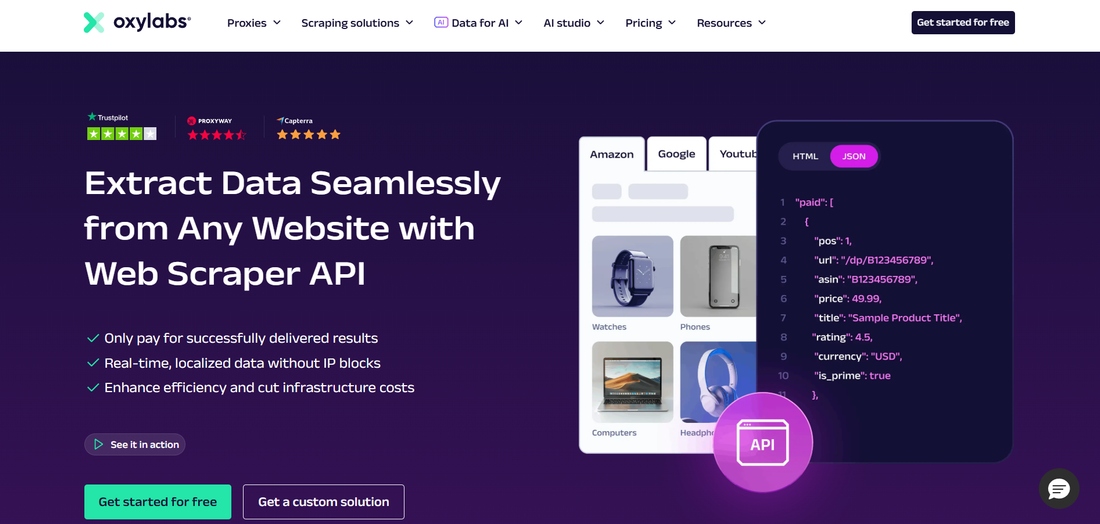
If you’re comparing Amazon data providers, Oxylabs’ Web Scraper API (Amazon Scraper) stands out as one of the strongest Rainforest API alternatives. It offers real-time scraping, built-in unblocking, powerful automation features, and a polished developer experience. For teams that need clean Rainforest API alternatives, Oxylabs consistently performs better than Rainforest API in certain cases.
Why Choose Oxylabs Among Other Rainforest API Alternatives?
Here’s why to choose Oxylabs over Rainforest API if you’re searching for Rainforest API alternatives.
1. Built-in Unblocking means Faster, More Reliable Results
One of the biggest complaints sellers have with Rainforest API is the instability during peak scraping periods. They experience spikes in response time, or sometimes they speak about unexpected failures, whenever Amazon tightens its anti-bot systems.
Oxylabs solves this by pairing its Amazon Scraper with its 177M+ proxy pool, automatic IP rotation, CAPTCHA handling, and optional JavaScript rendering. This means no need for proxy management, no CAPTCHA handling, or manually retrying failed requests. In a way, nothing is slowing you down.
Rainforest API sometimes struggles with JS-heavy listings or scraping through frequent Amazon layout changes. Oxylabs loads the whole webpage (including JavaScript), processes all the content, and then gives you the cleaned, structured JSON output immediately, no lag, without you having to parse anything yourself.
Also, with Oxylabs, successful requests are the default, and you only pay per successful result, not failed or rate-limited ones. This is a meaningful step to preserve the cost and time advantage for sellers, repricers, and analytics tools, whoever is using Rainforest API alternatives to scrape product data on Amazon.
2. Purpose-Built for High-Volume Scraping & Automation
Oxylabs supports 5,000 URLs per request. It additionally offers native scheduling tools, something Rainforest API simply doesn’t match at the same scale. Oxylabs handles requests by bulk batching, automatic retries, large concurrency, multiple delivery options (S3, GCS, API, etc.), making it ideal for enterprise to mid-market sellers or those in their growth stage, helping them build automated pipelines.
3. More Flexibility for Technical and Non-Technical Teams
Where Rainforest API mainly offers a single API workflow, Oxylabs gives you multiple ways to work, which includes, API-based Amazon Scraper, Web Scraper API Playground where no setup or coding is required, OxyCopilot, its AI assistant that can help you to auto-generate scraping queries & parsing logic, custom parser to define CSS/XPath rules without maintaining your own parser along with scheduler for recurring tasks and multiple output delivery formats.
Why is this useful for sellers seeking Rainforest API alternatives? Oxylabs’ Web Scraper API thus makes Amazon scraping easy and accessible to the entire team.
4. Richer Data Coverage Right Out of the Box
Rainforest API’s structure is limited for complex workflows, but Oxylabs’ Web Scraper API pulls everything expected from an Amazon listing and adds Product scraping via ASIN, search results scraping, seller-based scraping, pricing-only endpoints, bestseller list scraping, Q&A scraping, and localized content scraping from any Amazon GEO. So, if you want U.S., Germany, and Japanese listings of the same ASIN with local price points, Oxylabs generates structured JSON for each with a single API format.
5. Compliance, Scalability & Enterprise-Level Support
One of Oxylabs’ biggest differentiators is its enterprise-grade compliance and support ecosystem with GDPR & CCPA alignment, 24/7 support, and legal-safe proxy infrastructure.
Many enterprise ecommerce teams choose Oxylabs over other Rainforest API alternatives because their workflows require legal review. Oxylabs generally passes these compliance checks faster, reducing risk and speeding up integration.
Thus, we can call Oxylabs more stable, all-encompassing, and scalable with superior unblocking, higher success rates, rich structured output, built-in scheduling, AI-assisted query creation, and global marketplace coverage.
Final Thoughts
Choosing the right Rainforest API alternatives isn’t just about cost alone; the major goal here is to protect your data reliability and growth. The market now offers stronger options than ever, from fully-managed scraping engines to seller-intelligence platforms to official data pipelines. These Rainforest API competitors deliver better uptime, more consistent parsing, faster support, and infrastructure built for scale.
Rainforest API still serves a segment of users, but for fast-growing brands, SaaS platforms, and data-heavy teams, it may no longer meet the bar. Evaluate each alternative for Rainforest API based on your workflow, automation requirements, and long-term data strategy.
Looking for a free Rainforest API alternative? SellerApp bridges the gap between Amazon’s official SP-API (authorized seller data) and third-party market intelligence (competitor insights, sales estimates). The 100 free API tokens let engineering teams validate response schemas, test rate limits, benchmark data accuracy, and verify the API integrates with your existing data pipelines, CI/CD workflows, and monitoring stack. Use the free trials to validate fit in staging, not production. So, sign up for the free 100 tokens at Sellerapp and run integration tests, check schema compatibility, measure latency under load, and confirm error handling matches your observability setup.