

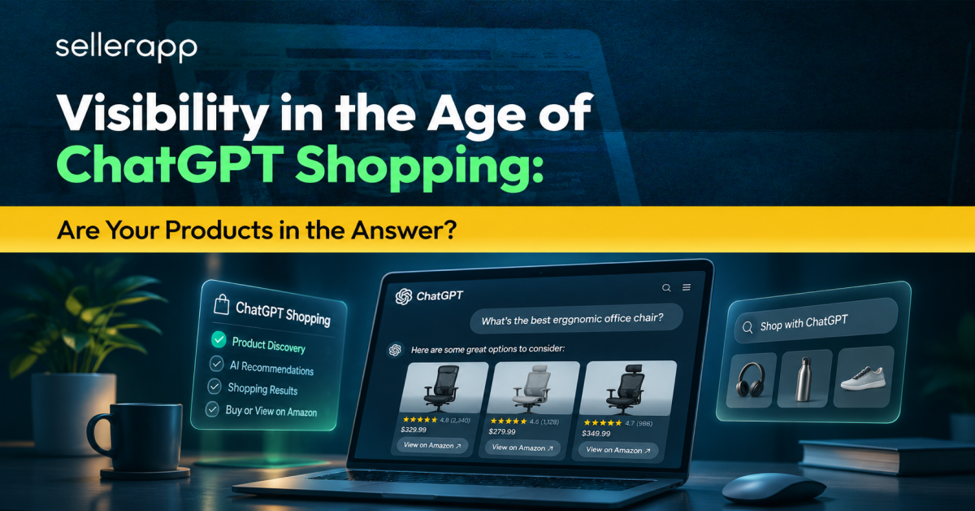
ChatGPT shopping is OpenAI’s product discovery experience inside ChatGPT, where shoppers describe what they want, compare products side by side, and finish the purchase on the merchant’s own site or app.
It runs on product data that merchants send to OpenAI, and Amazon listings sit outside it because Amazon blocks OpenAI’s crawlers. Sellers can reach it three ways, through organic placement from product feeds, through paid placement in ChatGPT Ads, and, for a limited group of Amazon advertisers, through ads bought in Amazon DSP.
Spend an hour in Shopify’s merchant community, on LinkedIn threads from marketplace analysts, and in the YouTube videos aimed at Amazon sellers, and you will hear the same handful of questions on repeat. Is anybody actually clicking? Am I showing up? Amazon blocked it, so am I done? Do I need a feed, an application, an ad budget, or all three?
Most articles on ChatGPT shopping answer those questions with a checklist and a pep talk. We went at it differently and read the data instead of the hype. We conclude that ChatGPT shopping is not one channel. It is three doors, and each has a different price of admission, a different payoff, and a different set of sellers who can walk through it.
Once you know which door you are standing at, the next move gets a lot clearer.
Quick Guide
Where ChatGPT shopping stands in November 2026
Between September 2025 and September 2026, ChatGPT shopping moved from an in-chat checkout experiment to a discovery channel built on merchant product feeds.
The timeline below traces that shift and what each change means for sellers.
| When | What happened? | Why a seller should care |
| Sep 29, 2025 | OpenAI launches Instant Checkout with Etsy, Stripe, and the Agentic Commerce Protocol | The first promise of buying inside the chat |
| Nov 24, 2025 | Shopping Research launches, and Amazon blocks ChatGPT-User and OAI-SearchBot in its robots.txt that same week | Amazon listings drop out of ChatGPT’s view |
| Mar 24, 2026 | OpenAI steps back from standalone Instant Checkout and focuses on discovery and merchant-owned checkout | The sale now happens on your site |
| Jun 2, 2026 | Product feed management moves into ChatGPT Ads Manager, as observed by analyst Juozas Kaziukėnas on LinkedIn | Feeds start doing double duty |
| Sep 4, 2026 | Kaziukėnas reports that shopping results appear to come only from brands that send feeds | Feeds look like the entry ticket |
| Sep 10, 2026 | Amazon opens a U.S. pilot that lets select advertisers buy ChatGPT ads through Amazon DSP | The locked door gets a side entrance for ad budgets |
The development most often cited is the limited uptake of Instant Checkout. Forrester analyst Emily Pfeiffer, as cited in trade coverage, counted only about 30 Shopify merchants live by February 2026, against the million-plus once promised.
Walmart’s numbers explain more. Walmart reportedly saw in-chat purchases convert at roughly a third of the rate of shoppers who clicked through to its own site, and the explanation that keeps coming up is bad data. Wrong inventory and wrong shipping costs meant the agent could not trust the feed, so the shopper could not trust the agent.
The practical takeaway is that ChatGPT shopping tests data accuracy before anything else. A seller whose price, stock, and shipping figures match reality earns the click, and a seller whose figures do not match is filtered out without notice.
Checkout has also moved off the platform for most sellers. OpenAI said merchants can still offer checkout through apps inside ChatGPT, and Walmart has moved its Sparky assistant into ChatGPT, but that route suits retailers of Walmart’s size. For everyone else, the merchant’s own checkout is the realistic endpoint, so effort belongs in discovery.
How sellers can reach ChatGPT shopping: organic, paid, and Amazon
Visibility in ChatGPT shopping depends on where your products are sold and what product data OpenAI can read. There are three routes, and most sellers are eligible for one or two of them
Organic placement through product feeds
Organic placement is available to any merchant whose product data reaches OpenAI. Shopify and Etsy catalogs are already connected. Other merchants apply through OpenAI’s merchant program and send a product feed.
OpenAI says shopping results are selected independently and are not ads, and its guidance tells merchants who want to be found not to block its crawlers. The cost is feed and catalog work rather than ad spend.
Paid placement through ChatGPT Ads
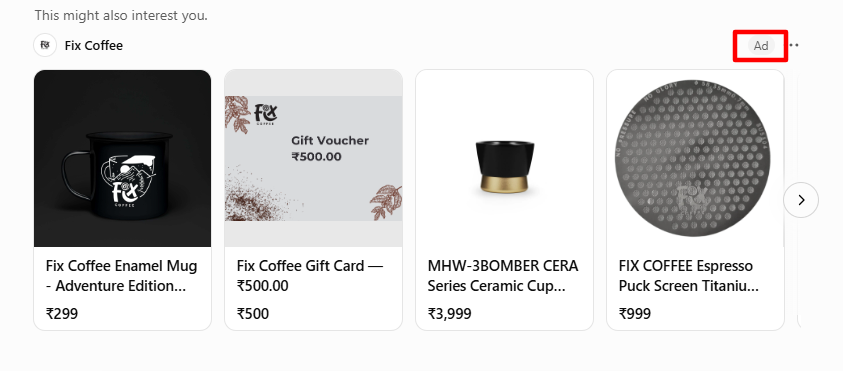
ChatGPT Ads appear below the organic answer and carry a sponsored label. Since June 2026, merchants can connect a catalog in Ads Manager and let the platform build product ads from it.
According to PPC Land, a free ChatGPT Ads app reached the Shopify App Store for U.S. merchants in September. The cost is ad budget plus a clean catalog.
Amazon listings: blocked organically but available through a paid pilot
Amazon listings are not readable by ChatGPT. The block went in during November 2025, and recent checks show it holding, with more AI crawlers added since.
Amazon has since opened a September pilot that lets select U.S. advertisers extend Amazon DSP campaigns into ChatGPT as a managed service. OpenAI still decides what shows and where, placements sit beneath answers with a sponsored label, and reporting detail is thin.
For Amazon sellers, this creates a split. An Amazon catalog cannot earn an organic mention in ChatGPT, but eligible advertisers can buy a paid one. Organic visibility depends on having products on a connected channel, such as a Shopify store.
How much traffic ChatGPT shopping sends compared with Amazon and Google
ChatGPT shopping is early, and the data reflects that. The figures below come from OpenAI, academic research, analytics firms, and trade reporting.
Read together, they describe a small channel that is growing quickly.
| Source | Finding | What it means for a seller |
| OpenAI research | About 2.1% of ChatGPT conversations involve purchasable products | Shopping intent is a small share of total usage, so volume is limited for now |
| University of Hamburg and Frankfurt School working paper (Aug 2024 to Jul 2025) | Google organic traffic was roughly 200 times bigger than ChatGPT referrals, and ChatGPT converted worse than nearly every channel except paid social | ChatGPT is an additional traffic source, not a replacement for search |
| Same working paper | Conversion and revenue per session climbed through the study period | Traffic quality was improving, so the trend matters more than the starting point |
| Datma, posting in Shopify’s community | ChatGPT sessions across hundreds of Shopify stores rose from 115 in January 2025 to 33,548 in August | Growth is steep, from a very low base |
| Similarweb data | ChatGPT was about a fifth of Walmart’s referral traffic in August 2025, roughly 1% of Walmart’s overall traffic | Even at a large retailer, the absolute share is small |
Two other data points frame the competition for attention. Marketplace Pulse reports that Amazon sellers paid $56.2 billion for advertising in 2024 because unpaid visibility had become scarce and argues that ChatGPT may offer something Amazon stopped providing, which is organic discovery at scale.
Marketplace Pulse also reports that Andy Jassy credited Rufus, renamed Alexa for Shopping in May 2026, with $12 billion in incremental sales in 2025, so Amazon’s own assistant already carries meaningful volume inside its store.
A reasonable reading is that ChatGPT shopping deserves a defined monthly allocation of time and its own line in analytics, not a restructuring of channel budgets. Setup is cheap, returns are slow, and starting late is costly. Shoppers who arrive have usually narrowed their options already. Reviewing referral data monthly will show how much more attention the channel has earned.
Why does product data accuracy decide visibility?
A feed is only useful if the agent can trust it. When the price, stock, or shipping cost in a feed differs from what the shopper sees on the product page, the recommendation loses credibility, and as the Walmart conversion gap shows, the click does not turn into an order.
Consider a hypothetical seller of insulated tumblers who lists the same SKU on Amazon, on a Shopify store, and in a feed. The Amazon price is $34.99 during a promotion, the Shopify price is $39.99, and the feed, last refreshed three weeks ago, shows $29.99 and in stock.
A shopper asking ChatGPT for the best insulated tumbler under $40 sees the product, clicks, and finds a different price and an out-of-stock message. That is the same failure that reportedly hurt Walmart’s in-chat conversion: wrong inventory and wrong shipping costs.
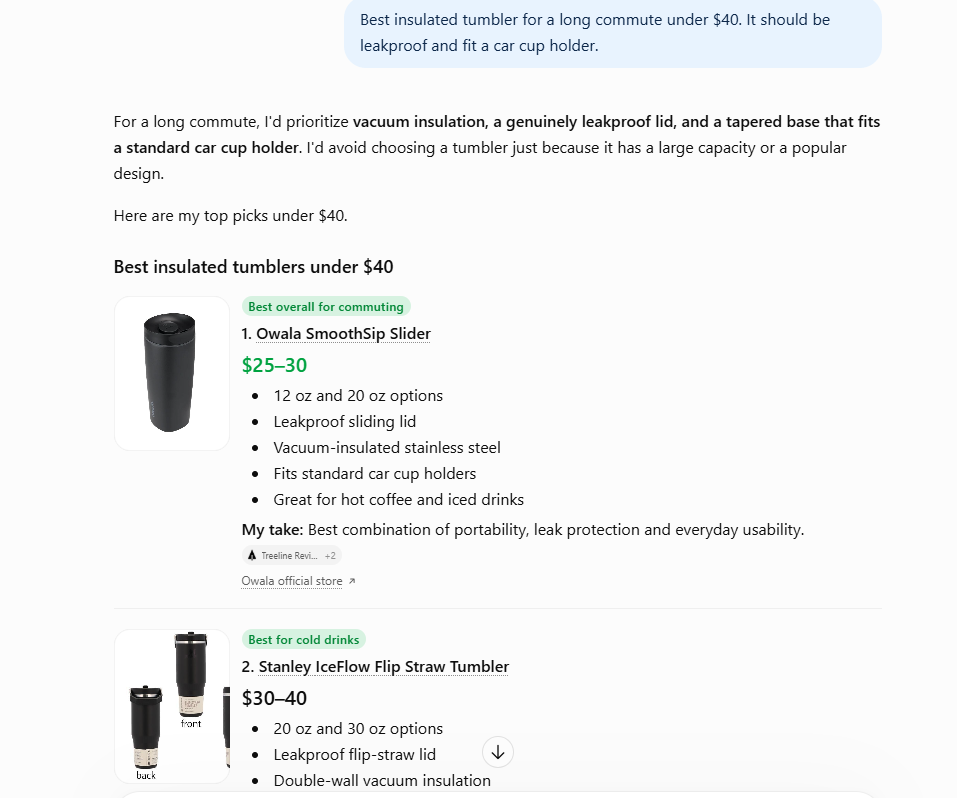
These are the fields to reconcile first, in order of how often they drift.
| Data field | Where it typically drifts | What to align |
| Price | Amazon promotions, site discounts and feed refresh lag | One pricing logic across Amazon, the site and the feed, with the feed refreshed on the same schedule as the site |
| Stock | Inventory split between FBA and a separate warehouse | Feed availability driven by live inventory rather than a manual toggle |
| Shipping cost | Free-shipping thresholds that differ by channel | The shipping cost the shopper will actually see at checkout |
| Returns | Marketplace policy versus own-site policy | One stated returns policy on the product page and in the feed |
| Identifiers and variants | Missing GTINs, inconsistent brand names and variant structure | The same GTIN, brand and variant structure everywhere, since GTINs help match your product across sellers |
How to check whether your products appear in ChatGPT
Before changing anything, establish a baseline. These three checks take under an hour.
| Check | How to run it | What to look for |
| Shopper prompt test | Ask ChatGPT the way a shopper would, using use-case phrasing such as “best insulated tumbler for a long commute under $40”. Run prompts for each of your main product types and record who appears | Which brands and retailers are named, and whether yours is among them |
| Page source test | Open your top product page, choose View Page Source and search for your price. An e-commerce auditor described this test in Entrepreneur | If the price is missing from the raw HTML, most AI systems cannot see it either |
| robots.txt review | Open your site’s robots.txt and search for OAI-SearchBot | OpenAI’s guidance says merchants who want discovery should not block it |
Interpret the prompt results with care. Being mentioned in an answer is not the same as landing in a product carousel, and one vendor’s study of 8,520 shopping prompts found only about 59.5% triggered a carousel at all.
Record mentions and carousel appearances as separate lines in the baseline, so later changes can be tied to specific fixes.
When ChatGPT Ads make sense
Product data should come before paid spend. According to Marketing Dive, ChatGPT Ads currently run on the free and cheaper Go tiers. OpenAI has built a pixel, a Conversions API, and conversion-optimized bidding for product feed campaigns.
The measurement gap sits on the Amazon side. PPC Land and Trellis both note that Amazon has published no detail on how a ChatGPT click is attributed or deduplicated against the rest of DSP reporting, and the pilot is invite-only.
What Amazon-only sellers can do about off-Amazon visibility
The robots.txt block does not put Amazon sellers out of the picture yet. Juozas Kaziukėnas of Marketplace Pulse, who first spotted the change, told Modern Retail that sellers were unlikely to feel meaningful effects yet, since AI shopping adoption still trails traditional e-commerce
Amazon shoppers are being served by Amazon’s own assistant. The longer-term exposure is that an Amazon-only brand has no organic footprint in a channel where people research before they open Amazon.
ChatGPT’s recommendations will come from other retailers and from what the wider web says about the category. Analyses from Seller Labs and Onely both report that ChatGPT treats independent sources such as Reddit threads and review sites as more objective than brand pages, so your reputation off Amazon becomes part of your listing.
A tumbler brand sold only on Amazon, for example, would not earn an organic mention for “best insulated tumbler under $40,” while a competitor with a Shopify store and an active presence in independent reviews could.
Three actions follow from this.
- Audit independent sources. Search your category on Reddit and major review sites, and note whether your brand appears and whether what is said matches your listing.
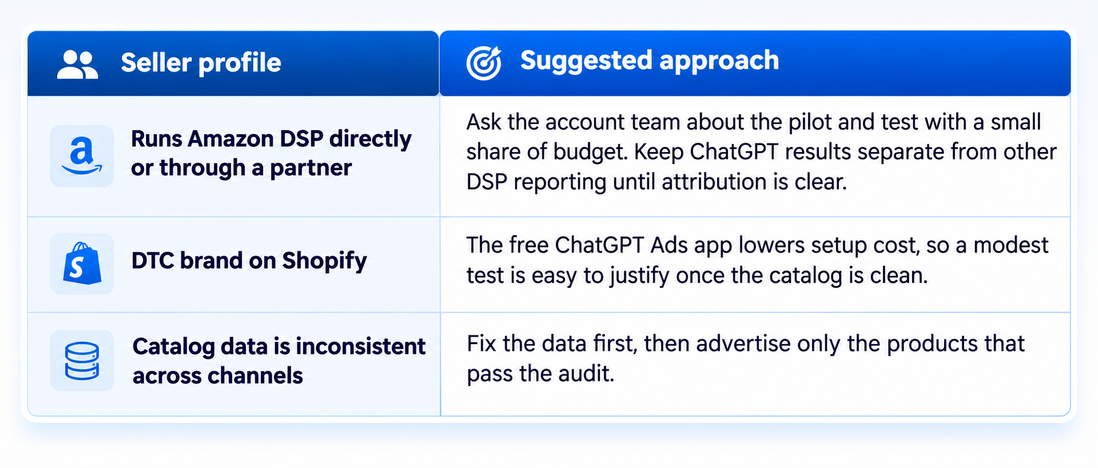
- Open a connected channel. A Shopify or Etsy store connects to ChatGPT without extra work, and the seller-type table below shows where each route applies.
- Use the paid route selectively. If you already spend on Amazon DSP, ask about the ChatGPT pilot and test with a small slice.
Using Amazon search data to write product content, ChatGPT can match
Shoppers talk to ChatGPT in full sentences that describe a use case and a budget. Amazon search terms are the closest record available of how the same shoppers describe a need, which makes them a practical input for titles, descriptions, and comparison copy on your own site.
- Collect category terms. Review the terms that matter in your category in Keyword Explorer and group them by use case.
- Identify the attributes shoppers name. Suppose a tumbler seller finds terms like “leakproof” and “fits car cup holder” recurring across the category. Those are the attributes shoppers care about.
- State them plainly. Put those attributes in titles, descriptions, feed fields, and comparison pages, provided the product can back each claim.
Not every SKU deserves a feed-ready page. Product research can size demand and competition across the catalog, so the first round of effort goes to products with room to win.
That includes a hard look at Amazon-heavy categories where advertising costs take a large share of margin, since a DTC route combined with ChatGPT shopping may be the cheaper way in. Treat that as a judgment call and check the numbers before committing to a budget.
ChatGPT Shopping Implementation Roadmap
The work below fits inside a month with an existing team.
Each week has one objective and a defined output, so progress can be reviewed rather than assumed.
| Week | Objective | Tasks | Output |
| 1 | Baseline and prioritization | Run the three visibility checks and record the results. Shortlist the first five to ten products using demand and competition data | Baseline record with screenshots and a priority SKU list |
| 2 | Data reconciliation | Align price, stock, shipping and returns across Amazon, the site and any feed. Add GTINs, brand, variants and clean images | One source of truth for the priority SKUs |
| 3 | Content and access | Rewrite titles and descriptions using category language. Confirm the Shopify or Etsy connection, or apply at chatgpt.com/merchants. Confirm OAI-SearchBot is not blocked | Updated listings and a confirmed connection or application |
| 4 | Measurement | Tag ChatGPT referral traffic in analytics. Rerun the prompt test and compare it with the week 1 baseline. Set a monthly review | Tracking in place and a before-and-after comparison |
What you should track after day 30
- Referral sessions. The number of ChatGPT referral sessions, month over month.
- Conversion and revenue per session. Conversion rate and revenue per session against other channels. The Hamburg research found both rising over time, so the trend is the signal.
- Visibility. Brand mentions and carousel appearances on a fixed set of prompts, recorded separately.
- Data quality. The number of price, stock or shipping mismatches found in each audit.
- Where to start by seller type
The right first move depends on which routes your catalog can use.
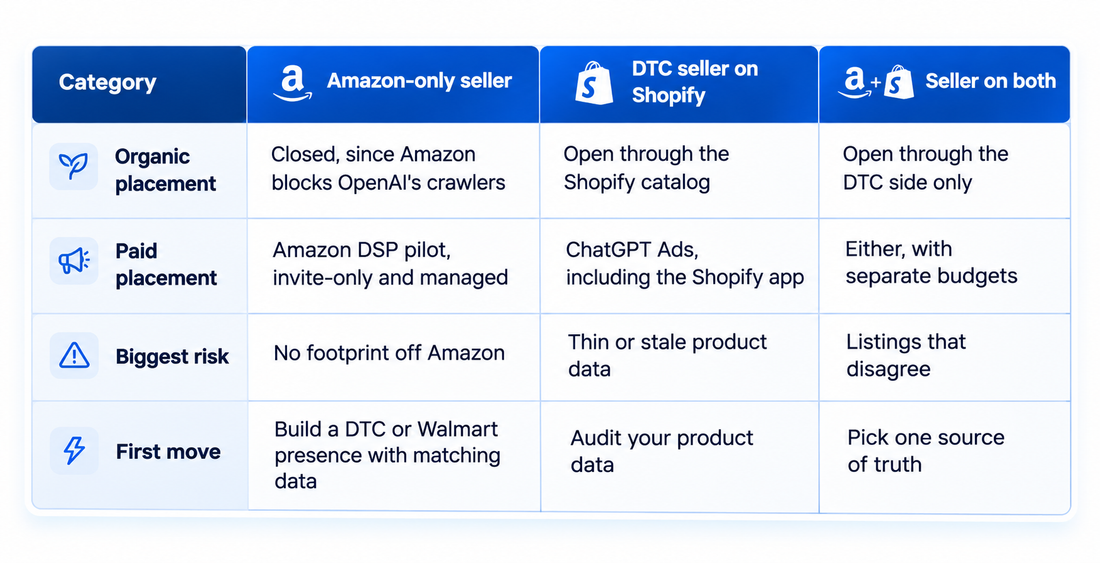
Final Thoughts
The long and short of it is that ChatGPT shopping rewards sellers who show up with honest data and clear comparisons, and it does so through three different doors. DTC sellers have a data-quality job.
Amazon sellers have a footprint problem and a paid workaround that is still in pilot. Everyone gains from knowing how shoppers phrase what they want. Policies here are a moving target, so keep your off-Amazon data tidy, and you will be ready whichever way the wind blows.
If you want to see how shoppers phrase searches in your category before you build anything, start with SellerApp’s Keyword Explorer, then use Product Research to pick the products worth the work.
FAQs
It is OpenAI’s product discovery experience in ChatGPT. Shoppers get visual results and side-by-side comparisons, then finish the purchase on the merchant’s site or app.
Not through Instant Checkout, which OpenAI moved away from in March 2026. Some retailers offer purchase flows through apps inside ChatGPT.
Not through Amazon listings, since Amazon blocks OpenAI’s crawlers. Products can appear if you also sell through a connected channel such as a Shopify store, and a limited group of Amazon advertisers can buy ChatGPT ads through Amazon DSP.
OpenAI says shopping results are selected independently and are not ads. ChatGPT Ads are a separate program, shown below answers with a sponsored label.
Shopify and Etsy merchants are connected through their platforms. Other merchants apply through OpenAI’s merchant program, send a structured feed, and keep OAI-SearchBot unblocked.