

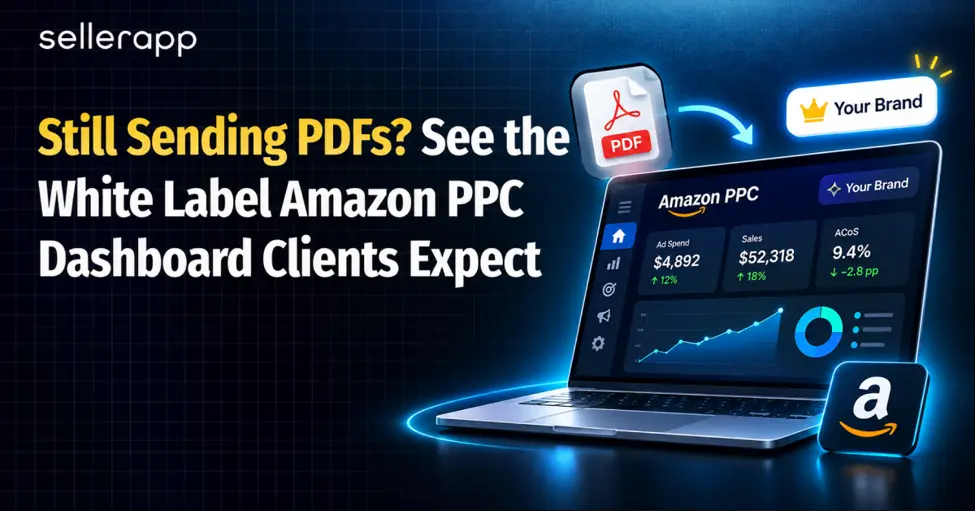
Your client believes you run their Amazon ads in-house. Your vendor believes you are reselling their work. Somewhere between those two assumptions sits the real price of any white label Amazon PPC agency arrangement, and most agencies only find it after the contract is signed.
Ask ten agency owners what “white label” means, and you will get four different answers. For some it is a logo on a dashboard. For others it is a vendor quietly running campaigns behind their brand. And the second a client asks, “Can you handle DSP too?” The answer gets fuzzier still.
That gap is why picking a white-label Amazon PPC agency setup, or the Amazon agency software behind one, is harder than the vendor websites make it look. Most pitches sound identical until you ask three plain questions. What login URL does my client see? Does the report show TACoS, or only ACoS? And what exactly do I get on white-label Amazon DSP?
This article is built around those questions. We ranked six options on custom domain, client reports, multi-account management, DSP, and price, and we kept the “confirm before you sign” flags in because pricing and tier rules move faster than blog posts do.
Quick Guide
White Label Amazon PPC Agency Options at a Glance
Some options below are software you operate, and others are service partners that run campaigns for you, so check the how you work with them column to see who keeps the strategy and who takes over execution.
| Firm | Best for | Core services | How you work with them | Why it’s included | |
| 1 | SellerApp Agency Solution | Agencies that own strategy and need reporting that looks like theirs | White label dashboards, multi-account management, campaign optimization, AMC, DSP | Software you operate | Built around keeping long data histories across many client accounts |
| 2 | AdLabs | Agencies that want approval-based bidding and live dashboard links | Bid optimization, keyword harvesting, n-gram analysis, in-app DSP and AMC, white label dashboards | Software you operate | Publishes agency features and starting prices more openly than most |
| 3 | Adbrew | Agencies that want automation depth across Amazon and Walmart | PPC automation, AMC, DSP, dashboards | Software you operate | Broad automation feature set with add-on pricing |
| 4 | Optmyzr | Agencies running Amazon next to Google and Microsoft | Cross-platform reporting, rule-based automation, white label reports | Software you operate | One tool and one branded report across several ad channels |
| 5 | Data4Amazon | Agencies that need execution capacity | PPC management, DSP, SEO, A+ content, account management | Managed service | Large team with a stated white label PPC offer for agencies |
| 6 | Ecom Gliders | Agencies that want a U.S.-based, Amazon-only execution team | PPC audits, campaign management, negative keyword work | Managed service | U.S.-based Amazon agency that says it serves agencies and aggregators |
What a White Label Amazon PPC Agency Does and Doesn’t Do
The phrase covers three different businesses, and mixing them up is the quickest way to lose a quarter. With software, your team runs the campaigns and the vendor supplies tooling branded as yours. With fulfillment, the vendor’s team runs the campaigns, and your client never hears their name. A hybrid sits between the two, usually software plus a specialist you call when an account gets messy.
1. Choose the model
Software keeps strategy and the client relationship in your hands. Fulfillment buys capacity, and you pay for it in margin and control. Neither is better by default, so start with where your agency is short.
2. Brand the client-facing layer
Dashboards and PDF reports are easy to brand almost everywhere. The custom domain and the notification emails are where plan tiers start to matter, and they are what clients actually notice. A report with your logo that arrives from the vendor’s email address still tells the client who is doing the work.
3. Run the campaigns
Under a software model, your team owns bids, budgets, and search terms. Under fulfillment, the vendor’s team does the daily work, and you review the results. Either way, one person at your agency should own each client’s strategy.
4. Report and review
ACoS shows how efficient the ads were, and TACoS shows whether advertising is actually growing the business. A report that stops at ACoS flatters a good month and can make a slow organic month look like your fault.
A white label setup does not hide Amazon. The Amazon DSP console stays Amazon’s, and Amazon’s own permission system should still control who has access to each client account.
When Software Beats a Service Partner
The decision comes down to what your agency is missing.
Software or Service Partner, Based on Where Your Agency Is Today
| Factor | Choose software when | Choose a service partner when |
| Team strength | Your media buyers can run the campaigns | You lack Amazon expertise in house |
| Growth bottleneck | Reporting, account switching and polish slow you down | You are turning away clients because nobody is free |
| Margin | You want to keep the margin | You accept lower margin in exchange for speed |
| Control | You want to own strategy and the client relationship | You are comfortable sharing strategy |
| Switching cost | Low, because clients rarely notice a tool swap | High, because the vendor knows your accounts |
If you already have two media buyers running accounts full time, you need better reporting, not a second team.
Many agencies end up with software plus a service partner on the hardest accounts. The trap is two vendors with two ideas of what the client sees, so pick one as the front door and keep the other invisible. If execution is the bigger problem, our ecommerce agency page explains when outsourcing makes more sense.
6 Best White Label Amazon PPC Agency
The first four are software you operate. The last two are service partners that run campaigns for you.
SellerApp
We built an agency solution around a problem that kept coming up on agency calls. You manage fifteen client accounts, every client wants a clean view of their own numbers, and Amazon’s advertising reports only reach back a limited window, 60 days for many report types.
Someone asks in March how Q4 compared with the year before, and you lose an afternoon stitching exports together. Our white-label dashboards and multi-account management sit on top of data we retain beyond that window, so the year-over-year question has an answer.
The scale behind it matters. SellerApp has managed more than $3 billion in ad spend across 33,000+ brands since 2017 and is an Amazon Ads Advanced Partner. Our strategy work looks past ACoS to TACoS and contribution margin, so clients see whether advertising is growing the business.
Agency Solution auto-generates white-labeled reports and uses Amazon Marketing Cloud data for attribution beyond the last click, which is context clients rarely get from a standard export.
If your team later needs more hands, there is a second route. SellerApp also runs a managed services tier where our team handles Amazon PPC, DSP, and listing optimization, so a growing agency has both options with one vendor.
AdLabs
AdLabs offers white-label dashboards that clients open through a link, built in a drag-and-drop dashboard builder, with no export step. That suits a mid-month check-in, because nobody waits for you to build a deck. AdLabs says it is built for agencies, with unlimited seats and multi-account management, and it lists in-app DSP management and AMC audiences.
Software directories list AdLabs Core at $40 a month plus 1% of ad spend and AdLabs Pro at $40 a month plus 2%. Custom domain support was not clearly published, and some listings place custom white label dashboards on a higher plan, so ask which plan includes them.
A shared link works well for a quick look. Where our Agency Solution differs is history. Our white label dashboards sit on data retained beyond Amazon’s reporting window, which matters the first time a client asks for a year-over-year view.
Adbrew
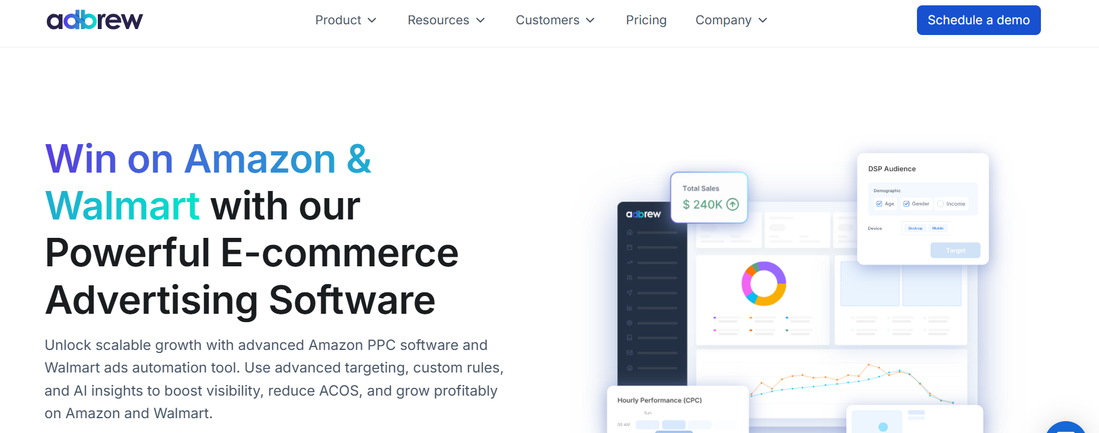
Capterra and Software Advice list Adbrew’s Standard plan at $799 a month or a percentage of ad spend, whichever is greater, and Adbrew’s help center cites 2 percent for the percentage. DSP, AMC, and shareable dashboards are paid add-ons, so the real monthly number runs above the headline. The custom domain sits in the Enterprise tier, which Adbrew describes as accounts spending above $500K a month.
Pricing here has moved before. Older listings still show $499 and even $249 entry points, so check the live pricing page before you build a margin model. Adbrew says more than 5,000 brands, sellers, and agencies use its platform, which is a company-reported figure.
A spend-based tier with a domain locked behind $500K can feel like paying for a door you cannot use. Our Agency Solution is built around managing many client accounts in one place with white label dashboards, so ask both vendors for quotes and compare cost per client instead of the headline price.
Optmyzr
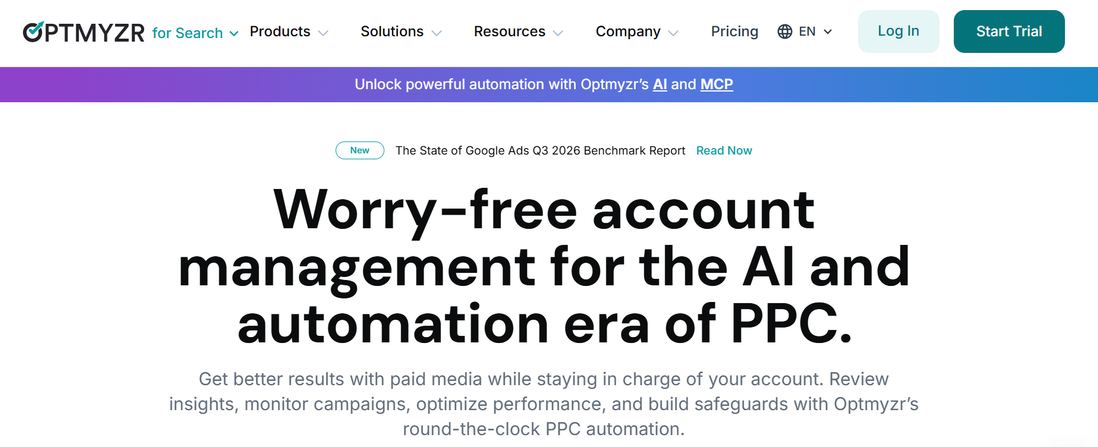
Optmyzr produces white-labeled Amazon Ads reports with your logo and a delivery schedule you set, and it can share a live, white-labeled dashboard with clients. Its help center says the sender domain can be white-labeled on Enterprise plans, so reports arrive from your own domain. Multi-account reports cover Google, Microsoft, Meta, Amazon, and LinkedIn Ads.
Optmyzr describes itself as a tool for marketers rather than a marketing service provider, so for Amazon you are buying software only. Its pricing page lists a PPC toolkit from $208 a month, so confirm the Amazon plan separately.
Optmyzr’s strength is breadth across channels. Ours is depth on Amazon, including data retained beyond Amazon’s reporting window, which is why agencies that live in Amazon tend to lean toward us and cross-channel shops tend to lean toward Optmyzr.
Data4Amazon
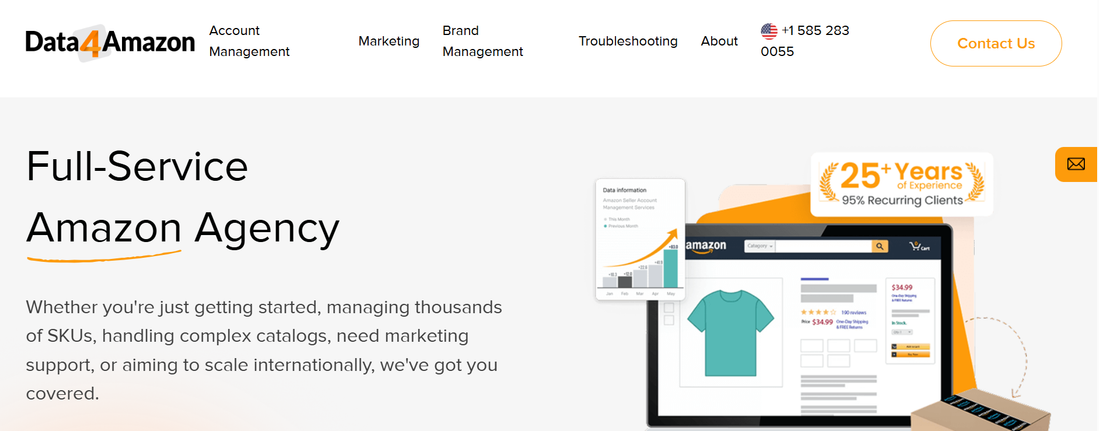
Data4Amazon says it has operated since 1999 and lists more than 500 Amazon experts and 3,500+ stores managed. Those are company-reported figures, but they point to real bench strength.
It publicly states that it provides white-labeled PPC services to digital agencies and lists Amazon DSP advertising among its services, though the white-label scope is not spelled out. The budget is listed as inquire, so there is no number to model until you talk to sales.
This is the other side of the software versus service trade. With Data4Amazon, their team executes. With us, you execute and keep both the strategy and the relationship with the client.
Ecom Gliders
Ecom Gliders is a U.S.-based Amazon agency, and it says it provides white-label Amazon PPC management to agencies and aggregators. Its published services include PPC audits, campaign management, and negative keyword work.
We found no published detail on DSP coverage or report formats, and a directory listing shows an average rate of $75 an hour, so get the DSP scope, a sample report, and the real pricing in writing.
Where a service partner like Ecom Gliders adds execution capacity, our agency solution adds visibility. Your team keeps the strategy, and our multi-account management and white label dashboards put your brand on what each client sees, which is the part a service-first partner may deliver as a spreadsheet.
Also Worth a Look
A few options did not make the main six but come up in agency conversations often enough to cover.
Perpetua and Pacvue make sense once your client roster and budgets justify enterprise pricing, and neither is built for an agency with eight accounts.
| Provider | Best for | Key services | Pricing |
| White Label Amazon PPC (WAP) | Agencies wanting PPC-only fulfillment | Amazon PPC management | Not published |
| EcomRanker | Agencies bundling PPC with SEO | PPC and SEO under your branding | Not published |
| Perpetua | Larger agencies running DSP and Sponsored Ads | White label dashboards covering Amazon DSP and Sponsored Ads | Enterprise end |
| Pacvue | Agencies handling broad retail media | Retail media management | Enterprise end |
When to Bring in a White Label Partner
Bring in a partner when a specific gap is costing you clients or margin, not because a vendor pitch sounded good.
Reporting Eats Your Week
If your team spends hours each month stitching exports into client decks, software with white-label dashboards is the cheaper fix. Amazon’s own advertising reports reach back a limited window, 60 days for many report types, so history is the first thing agencies lose.
Clients Start Asking About DSP
SellerApp’s 2026 benchmark report shows DSP’s share of Amazon ad spend rose from 17.7% to 23.4%, so the question will reach your clients sooner or later. Before you promise anything, find out whether your vendor offers execution, reporting, or seat access.
You Are Turning Away Clients
If nobody is free to run a new account, a service partner turns that around faster than hiring will. You trade margin for speed, which is fine as long as you price for it.
What You Can Actually White Label on Amazon DSP
This is where the label gets stretched furthest, so it is worth slowing down.
Execution, Reporting, and Seat Access
Execution means someone builds and runs the DSP campaigns. Reporting means you get branded reports on them. A seat means you hold access to the DSP itself. Vendors use white-label Amazon DSP to describe any of the three, and the three are not interchangeable.
The entry cost explains why this matters. Amazon Ads states that its managed service typically requires a $50,000 minimum, and that figure varies by country. Self-service is less settled.
Several agency write-ups say Amazon removed the self-service minimum at unBoxed, while Digiday’s coverage of the same announcement said the DSP still carries its existing minimum spend requirements. Check the current terms with Amazon or your partner before you quote a client.
In practice, agency guidance on a sensible starting budget through a partner with a DSP seat commonly lands between $5,000 and $15,000 a month. An agency that resells DSP is selling access to that lower door, so the question for any vendor is which of the three it actually provides.
What Branding Applies to DSP Work
The DSP console itself belongs to Amazon, so what gets branded in practice is the reporting layer and your own communication around it. Do not promise a client a fully white-label Amazon DSP experience unless a vendor shows you one.
| DSP Arrangement | What You Get | What Stays Unbranded | Questions to Ask |
| Execution | Vendor builds and runs campaigns | Often the vendor’s trading process | Who is on the account, and what do clients see? |
| Reporting | Branded DSP reports | The DSP console | Do reports include cross-channel context? |
| Seat access | You operate the DSP | Amazon’s console | Who holds the seat, you or the vendor? |
Access, Ownership, and Exit Checklist
Nobody raises these questions in a sales call, and everybody wishes they had when a vendor relationship ends badly.
Client access should flow through Amazon’s own permission system, so the client can see who has it and revoke it. If a vendor asks for a shared login, treat that as a warning sign and not a shortcut.
| Checklist Item | What to Ask the Vendor | Red Flag |
| Account access | How is access granted and revoked? | Shared logins |
| Data ownership | Can I export full history if I leave? | Export fees or no export |
| Historical performance | How far back is data retained? | Nothing beyond Amazon’s own window |
| Exit | What happens to live campaigns? | Campaigns tied to the vendor’s structure |
A good exit leaves the campaigns running and the account in the client’s hands. A bad one means rebuilding the structure from screenshots.
Final Thoughts
The best white label Amazon PPC agency partner is the one that fills the gap in your agency. If you are short on capacity, a service partner earns its fee. If you are short on polish, reporting, and account control, software wins, and you keep the margin and the client.
Good white label Amazon PPC agency options should solve a specific gap, not duplicate work your team already does. Start with the problem, then choose the model that fits.
For agencies that want to keep the strategy and the client relationship, SellerApp’s Agency Solution combines white-label dashboards, multi-account management, and retained data. Book an agency solution demo and bring the three questions from the start of this guide. You can read more on our ecommerce agency page, and our post on how agencies resell Amazon programmatic covers the DSP side in more depth.
FAQs
A white label Amazon PPC agency delivers Amazon advertising management under another agency’s brand. The client sees the reseller’s name on the reports and the login, while the vendor either supplies the software or does the campaign work.
Software gives your team the tools to run campaigns under your brand. A service means the vendor’s people run the campaigns for you. Software keeps strategy in house, and a service adds capacity.
You can resell DSP execution and branded reporting, but the DSP console itself remains Amazon’s. Confirm whether you are getting execution, reporting, or a seat before you promise a client anything.
Not always. Some vendors reserve the custom domain for higher tiers, and Adbrew’s Enterprise plan is one example. Ask for it by name in the demo.
Software can start in the hundreds of dollars a month with add-ons on top, while service fees are usually quoted per client or as a share of spend. Ask for the full price sheet, including add-ons, before you compare vendors.