

If all you heard was that Amazon swapped Rufus for Alexa, you missed the part that matters.
The Amazon AI shopping assistant that took over on May 13, 2026 sits in the search bar every shopper already uses, and it changes what you pay for, what shows up in your reports, and what price a customer might buy at. Rufus lived in a side chat window.
Its successor lives in the search bar every shopper already uses.
Alexa for Shopping, the Amazon AI shopping assistant that replaced it, sits in the main search bar, remembers what shoppers told Alexa in the kitchen, and will happily place an order the moment your price dips below a number you never got a vote on.
For a seller running hundreds of SKUs, three things landed at once. The assistant moved from a side chat into the results page, it can transact without a human at the decision point, and ads inside it became billable in March. The off-Amazon story changed too. Much of what was published about AI shopping agents in January no longer holds.
This article covers what the Amazon AI shopping assistant does, how it likely decides what to recommend, where your ad and pricing exposure sits, and which numbers in circulation deserve your trust.
Quick Guide
What the Amazon AI shopping assistant that replaced Rufus actually does
Alexa for Shopping is Amazon’s agentic AI shopping assistant. It merged Rufus and Alexa+ on May 13, 2026, appears in Amazon search results pages and product detail pages, and is free for any signed-in U.S. customer with no Prime membership or Echo device required.
Amazon says Rufus reached more than 300 million customers in 2025. On the Q2 2026 call, Andy Jassy, the president and CEO of Amazon, said more than 350 million shoppers had used Alexa for shopping over the trailing 12 months, with active users nearly doubling in the quarter.
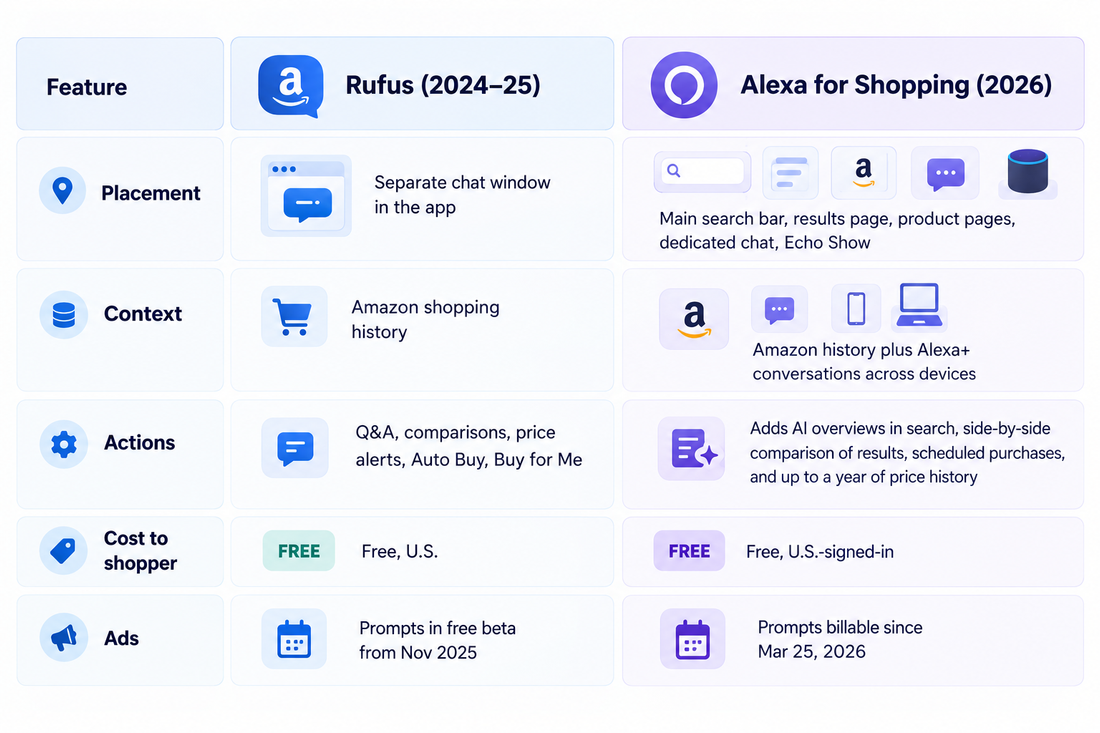
The placement change matters more than the rebrand. A feature that sat beside the shopping path now sits in the middle of it.
What agentic commerce can now do for shoppers?
The shopper-side capabilities are mostly straightforward, and every competitor has covered them. Four of them touch your P&L, so they get the detail here:
Price alerts and auto-buy
A shopper sets a target price, and Amazon orders at or below it using the default payment method. Amazon’s help page lists Auto Buy as available only for items Fulfilled by Amazon.
Press coverage also reports that Auto Buy requires Prime and that coupons and promotional discounts don’t apply to it. The shopper can cancel within 24 hours of the order.
Price history
Shoppers can see up to a year of price history, Amazon extended the tracker to 365 days on June 30.
Recurring and scheduled purchases
This is for repeat-buy categories, plus reordering from past purchases.
Buy for Me
For products Amazon doesn’t sell, Amazon’s agent completes the purchase on the brand’s own site. It sits on top of Shop Direct, which Amazon says now indexes over 100 million products from more than 400,000 merchants, with tens of millions buyable through Buy for Me.
That last item deserves a look from any brand with a DTC store. Shop Direct products appear in Amazon searches whether or not you set anything up. Amazon states there’s no referral fee today, and brands that want out have to request removal by email.
Search your top brand terms on Amazon and check what’s already there and at what the price is. If your DTC price and your Amazon price diverge, the assistant can see both.
Where Copilot, ChatGPT, and Google fit into this
The off-Amazon picture split into three different bets, and one of them already failed.
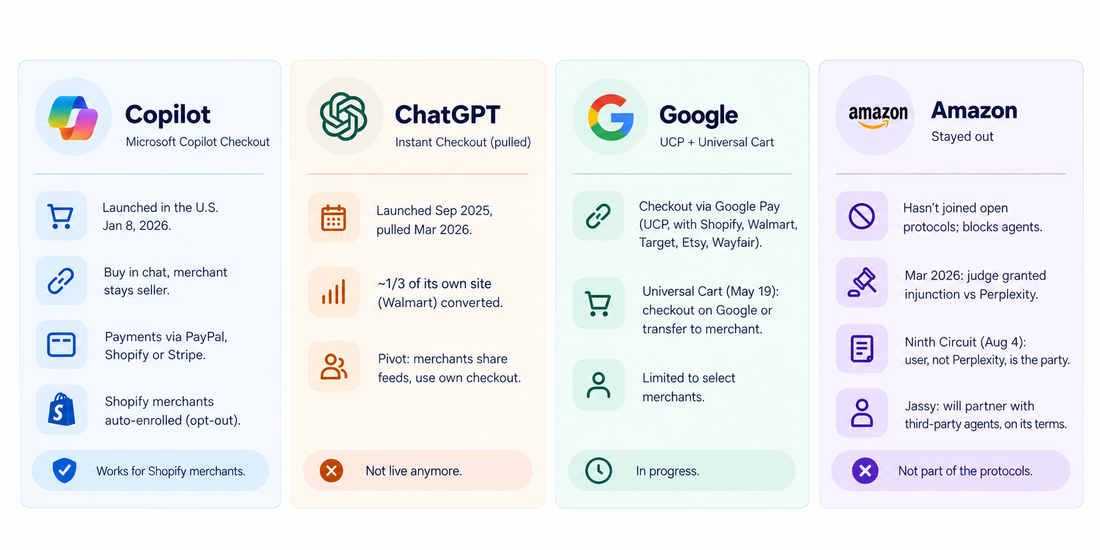
Microsoft Copilot Checkout
launched in the U.S. on January 8, 2026. Shoppers buy inside the Copilot chat, the merchant stays the seller of record, and payments run through PayPal, Shopify, or Stripe. Shopify merchants are enrolled automatically after an opt-out window. This is the Copilot Microsoft shopping route that matters for anyone on Shopify.
ChatGPT
is the cautionary tale. Instant Checkout launched in September 2025 and was pulled in March 2026. Forrester counted only about 30 Shopify merchants live by February. Walmart said at Shoptalk that ChatGPT checkout converted at roughly a third of its own site.
OpenAI’s stated pivot: merchants share product feeds and use their own checkout, while ChatGPT focuses on discovery. Walmart’s response was to embed its own assistant, Sparky, inside ChatGPT and Gemini, with the purchase completed in Walmart’s system and not OpenAI’s.
This is where in-chat checkout is still moving. The Universal Commerce Protocol (UCP), co-developed with Shopify, Walmart, Target, Etsy, and Wayfair, powers checkout on Google surfaces through Google Pay for participating merchants.
Universal Cart, announced at I/O on May 19, lets shoppers pick checkout on Google or transfer the cart to the merchant’s site. The brand stays merchant of record either way. Google’s own help page says the checkout feature is limited to select merchants.
Amazon has stayed out
It hasn’t joined the open protocols and has moved to block outside agents. In March, a federal judge granted Amazon a preliminary injunction against Perplexity’s Comet agent.
The Ninth Circuit vacated it on August 4, holding that the user, not Perplexity, is the party accessing Amazon under the Computer Fraud and Abuse Act.
Reporting says the court has since rejected Amazon’s request to reconsider, and the underlying lawsuit continues. Jassy has said Amazon expects to partner with third-party agents over time, on its terms.
The Amazon-only blind spot
If you sell only on Amazon, your offers aren’t transactable inside those agents, because Amazon hasn’t joined those protocols. If your brand also has a Shopify or Walmart presence with clean feeds, you’re eligible for discovery there. If it doesn’t, someone else’s product fills the recommendation.
Margin box: what the off-Amazon fees actually look like
Assumptions: $100 order, 2.9% + $0.30 payment processing (a common Shopify Payments rate; check your own).
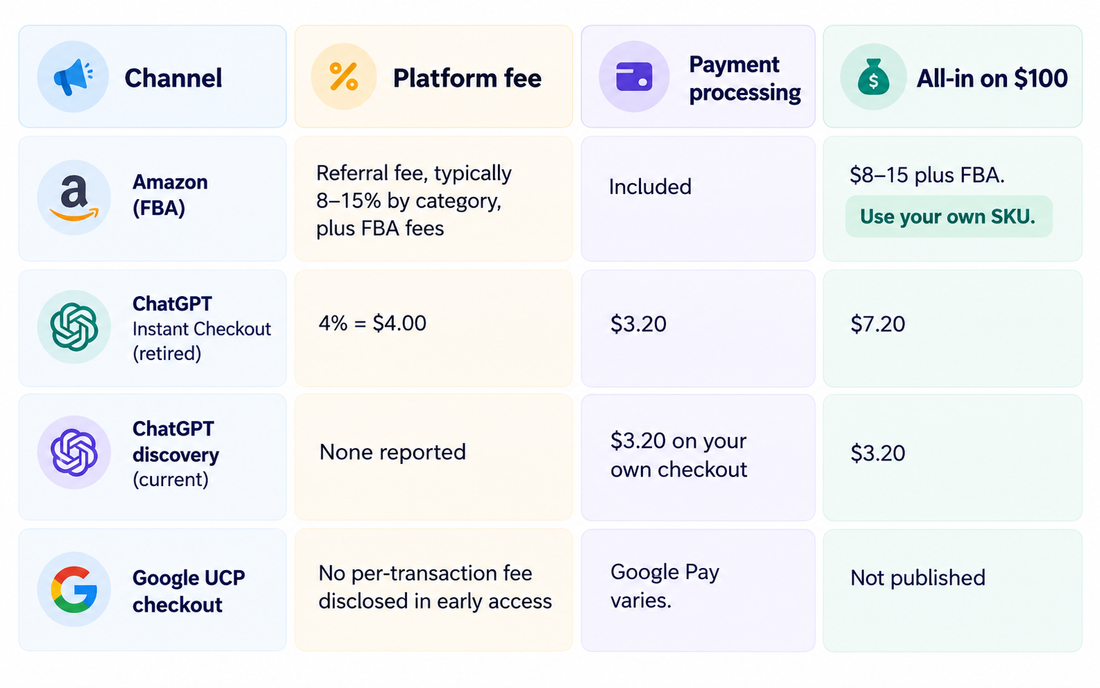
The $7.20 figure is still a useful ceiling for what an AI-owned checkout might charge, but the channel it described no longer exists.
Take one of your top-revenue SKUs and fill in the Amazon row with real referral and FBA fees.
Most enterprise teams find the gap is smaller than they assumed once returns and ad costs sit on the Amazon side.
AI shopping assistants: who runs them and what each means for a seller
Most coverage treats AI shopping assistants as one category. They aren’t.
The useful split is who controls the assistant, because that decides who controls checkout, the customer data, and the fees. For a seller, it also decides whether you can influence the recommendation at all.
| Assistant | Owner | How purchase works | What it means for sellers |
| Alexa for Shopping | Amazon | Buys inside Amazon (Auto Buy, scheduled orders); Buy for Me completes purchases on other brands’ sites | Your listing, reviews, price history, and ad spend all feed it. Closed to outside agents. |
| Sparky | Walmart | Lives in Walmart’s app and site, and inside ChatGPT and Gemini; purchases complete in Walmart’s own system | Walmart Marketplace sellers get distribution beyond walmart.com without a separate integration. Listing data quality carries over. |
| ChatGPT Shopping | OpenAI | Discovery-first since March 2026; checkout on the merchant’s site or app. Instant Checkout is retired | Eligibility runs through product feeds. No platform fee has been reported on discovery. |
| Google AI Mode, Gemini, Universal Cart | UCP checkout with Google Pay for participating merchants, or transfer to the merchant’s site; merchant stays seller of record | Requires Merchant Center feed work and UCP onboarding. Checkout is limited to select merchants for now. | |
| Microsoft Copilot | Microsoft | Copilot Checkout: buy in chat, merchant is seller of record, payments through PayPal, Shopify, or Stripe | Shopify merchants are enrolled automatically after an opt-out window. Others apply. |
| Perplexity (Comet agent) | Perplexity | Agent browses and buys on the shopper’s behalf through their logged-in accounts | Amazon is litigating against it. Treat access to Amazon as unsettled. |
| Retailer apps inside ChatGPT | Target, Instacart, Expedia, Etsy, and others | The retailer controls the experience and checkout | Shows where large retailers are heading: their own assistant, on someone else’s surface. |
| Shopify Agentic Storefronts and Brand Agents | Shopify, Microsoft | Storefronts syndicates one catalog to ChatGPT, Copilot, Gemini, and others; Brand Agents is an assistant on your own store | Infrastructure that makes DTC catalogs reachable by every assistant above. |
Three patterns worth planning around:
The strongest assistants are retailer-owned
Amazon and Walmart both keep the agent close to their own catalog, reviews, inventory, and delivery data. Amazon keeps it inside its walls. Walmart sends it out. If you sell on both, you’re feeding two assistants with different reach and different rules.
Discovery is winning over in-chat checkout for now
ChatGPT pulled back from checkout, Walmart kept the purchase in its own system, and Google still lets merchants choose between Google Pay checkout and a handoff. The shared lesson: get your product data right everywhere, and don’t assume the assistant will own the sale.
Presence depends on your channel mix
An Amazon-only brand appears in Alexa for Shopping and nowhere else in this table. A brand with Amazon, Walmart, and a Shopify or DTC store with a clean feed appears in most of them. Feed accuracy (identifiers, variants, prices, and stock) is the common requirement across every row.
For a mid-market or enterprise U.S. seller, the practical set to track is Alexa for Shopping, Sparky, ChatGPT, Google, and Copilot. Perplexity and the Shopify tooling matter mainly as signals of where the infrastructure is going and how DTC catalogs reach these assistants.
How the Amazon AI shopping assistant decides what to recommend
Amazon doesn’t publish how its AI shopping assistant ranks and recommends products, so everything here comes from testing and inference.
The working model most practitioners use has two layers. Amazon’s core search system, A9, decides which products are eligible and how they rank. (“A10” is community shorthand for observed changes; Amazon has never announced an algorithm by that name.)
On top of that sits the AI layer. The assistant, plus COSMO, an Amazon research system that maps commonsense links between products and shopper intent, described in a 2024 SIGMOD paper. The paper documents COSMO in search navigation. Practitioners infer that it also shapes the assistant’s answers, but Amazon hasn’t said so.
In practice, classic ranking gets you into the candidate pool. The assistant then appears to match shopper intent against structured attributes and to treat your detail page as a set of claims it cross-checks against your reviews and Q&A.
Signals that appear to matter:
- Attribute completeness. Missing or generic backend attributes (material, use, audience, dimensions, and compatibility) can remove a listing from consideration before the query is parsed.
- Review quality and recency, not only star average. A claim in your bullets that your reviews contradict is a liability.
- Listing clarity. Bullets that state specific, checkable facts.
- Price competitiveness, which the assistant can see, including history.
Sellers commonly report a lag of roughly one to two weeks between attribute changes and visible movement. Treat it as an observation, not a rule. It affects how you test: change one variable per ASIN group and wait.
How Ads work with AI shopping experience
Sponsored Products and Sponsored Brands prompts exited beta and became billable on March 25, 2026. Campaigns were auto-enrolled. Clicks bill at the parent campaign’s CPC; there’s no separate bid or budget line. You can pause prompts (campaign level, individual prompt, or via API), but you can’t write the questions. Amazon generates them from your listing content.
Amazon’s headline claim, from Jassy on the Q2 call as reported by the trade press: shoppers who click a sponsored prompt convert 48% more often and spend 21% more. Amazon hasn’t published how that was measured.
One newer development to watch: Amazon has introduced Branded Conversations, a format where advertisers submit a brief that shapes the conversation, with sponsored labeling and prompt-level reporting. Press reports say it launches in the U.S. in January. If that holds, “you can’t write the questions” stops being fully true.
The attribution trap is when a shopper clicks your Sponsored Products ad, lands on your page, and then taps a sponsored prompt. Practitioners report that the resulting sale may show up in the Prompts report and not in the originating campaign. Your campaign looks worse. You cut it. Sales drop.
What to do:
- Don’t cut campaigns on ACoS alone for the first 60 days.
- Pull the Prompts report (Ads Console, Reports, Sponsored Products, Prompts) on the same cadence as your placement reports.
- Watch branded search volume and branded-term ACoS as a cross-check.
- Use a holdout ASIN if you have one: pause Prompts on a comparable ASIN and compare against a matched one for a fixed window. Teams that already run AMC or a commerce intelligence platform such as SellerApp can build that comparison from ad and order data rather than from the Ads Console alone.
Reporting for these placements is still limited. Brands can’t yet see which ads appeared inside a given Alexa conversation. Plan for uncertainty in the read.
Your price history is now an ad
Shoppers, and the assistant, can see up to a year of price history. A fake markdown, a “was” price that never held, or a post-deal bounce back to the list is visible on the page.
Auto Buy hands shoppers control over the price floor. A shopper who sets a target at $35 on a $39.99 item is telling Amazon what they’ll pay, and Amazon transacts against the offer that meets it.
Practical moves:
- Run promos you can afford to repeat. A deal price that hurts margin becomes the number people wait for.
- Avoid sharp bounce-backs after events.
- Decide deliberately between a price cut and a coupon. Per current reporting, coupons don’t apply to Auto Buy. A coupon-driven promo won’t fire alert-triggered orders at the discounted price; a real price cut can. That’s our inference from Amazon’s rules, so test it on one ASIN before building an event plan around it.
- Check contribution margin per SKU before deal events, including ad cost and returns. Auto Buy plus visible history makes underpriced offers cost more than they used to.
- Watch unauthorized sellers. One vendor analysis argues Auto Buy raises the cost of hijackers because alert holders can be filled automatically at the lower price. Amazon hasn’t published data on this. Read it as “watch for this,” not “this will happen.”
Final Thoughts
The Amazon AI shopping assistant didn’t change what wins on Amazon. It changed who’s watching while you do it. The assistant reads your listing, your reviews, and your Q&A together. It sees your price history. It can transact without a human at the decision point. And it now sells ad placements inside the conversation, with reporting that’s still catching up.
The sellers who handle this well won’t be the ones who chase every new format. They’ll be the ones who know their attribute coverage, their contribution margin per SKU, and which campaigns are actually driving sales when the Prompts report and the campaign report disagree. That’s a data problem before it’s a creative one.
That’s where a commerce intelligence platform earns its place. SellerApp brings Amazon Advertising, DSP, and AMC data together with product-level analytics, Product Intelligence, and Walmart, so teams can compare ad performance against listing quality, price movement, and margin in one place instead of five tabs.
If you’re trying to work out whether prompts are helping or quietly eating attribution, or which of your top ASINs have attribute gaps, book a walkthrough with SellerApp and bring your own account questions.
FAQs
It retired the standalone chatbot on May 13, 2026. Amazon says Rufus’s recommendation features and shopping history carried into Alexa for Shopping, which merges Rufus and Alexa+.
No. Keyword search and traditional ranking still bring most sales and still decide who gets into the candidate pool. The assistant adds a second evaluation on top: structured attributes, review consistency, and listing clarity.
Shoppers don’t need Prime to use Alexa for Shopping, but Auto Buy requires it. On the seller side, Amazon’s help page says Auto Buy currently works only on FBA items, so FBM offers aren’t eligible for automatic orders. Amazon hasn’t published a Prime requirement for being recommended.
Not before they start; campaigns were auto-enrolled. You can pause prompts at the campaign level or pause individual prompts, and you can track their spend in the Prompts report. You can’t opt out of appearing in Alexa for Shopping’s organic answers.