
Have you felt the pressure of running Amazon video ads for more than five minutes? The cost per click is increasing every quarter, and static images that used to generate clicks are now being overlooked. Meanwhile, your competitors are filling every ad slot with identical visuals.
Amazon, however, has significantly expanded the system. Video now lives everywhere inside search results, on product detail pages, across Sponsored Brand and Sponsored Display units, and far beyond Amazon.com through DSP placements on apps, websites, and even Prime Video and Fire TV.
It’s the first time Amazon has truly blended “commerce video” with “streaming video,” letting sellers reach shoppers in more places than ever before.
Amazon’s new Video Generator, an AI-powered creative tool, is rolling out widely, enabling advertisers to generate video concepts in minutes. That means more brands, more video volume, and more creative noise.
The sellers who win in this new era won’t be the ones who produce more videos; they’ll be the ones who produce smarter videos, faster, with testing loops that cut through the incoming clutter.
Quick Guide:
5. How to Use Amazon Video Ads: A Practical, Step-by-Step Guide for Sellers
6. Final thoughts
We have noticed that most sellers think that Amazon video ads are only one thing. But in reality, when you use Amazon video ads, they show up in different places, and each place changes how shoppers react to them. Moreover, the gap between strong ROAS and wasted spend has less to do with how refined the Amazon ad video looks and more to do with where exactly Amazon shows it and when shoppers see it.
Each one behaves differently, and if you don’t understand the layout, you’ll end up wasting budget on formats that don’t match your product or buying cycle.
Inside Amazon, sponsored brand video remains the most commercially efficient video format available to sellers. These videos appear directly within the search results and autoplay quietly as buyers scroll, which indicates that, as a seller, you are competing for attention before pricing, reviews, or brand familiarity enters the decision-making process.
Now you must be wondering why this placement matters. It is because search is the only moment when shoppers are both aware of their need and also actively narrowing down their choices. With modest daily budgets, SB video can handle spending fast and convert profitability, especially with high-intent keywords. The impact is immediate and measurable, which is one of the reasons why it outperforms more advanced formats for sellers who focus on revenue rather than awareness.
Then there is the sponsored display video, which appears similar on the surface but functions differently when you figure out where it appears. Instead of owning a single moment in search, it appears deeper in the process on product detail pages, inside recommendation displays, brand stores, and other high-context placements where shoppers are already comparing or validating decisions.
Here, the budget requirements are slightly higher because delivery depends on audience and product signals rather than keyword demand. Display video rarely gains attraction on first-click attribution because its real value is interrupting comparison behavior and pulling attention away from competing ASINs at the exact point of hesitation. This is where sellers with higher price points or longer consideration periods start to see greater impact.
Once you step outside this, Amazon DSP is where video advertising stops being commercial and starts behaving like media, which means DSP video doesn’t wait for shoppers to search; it follows them based on what Amazon already knows about their buying behavior. Streaming apps, Fire TV inventory, IMDb placements, and third-party sites all become surfaces where your product re-enters the conversation.
The budget threshold rises because DSP operates on CPM models and requires enough spending to generate frequency, but the payoff is reached with relevance. For brands that have already saturated retail placements, DSP video becomes the lever for scale, less about immediate conversion and more about ensuring your brand is the one shoppers recognize when they eventually return to Amazon.
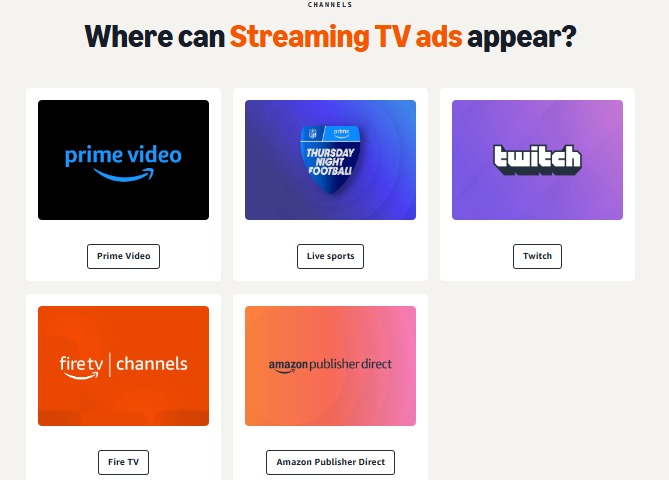
Finally, Amazon itself owns a streaming system. Prime Video, Fire TV, and Twitch are no longer just entertainment platforms, as they’re premium ad inventory fueled by Amazon’s commerce data. Accessibility has changed recently. These placements were once exclusive to enterprise advertisers, but now sellers can test connected-TV and OTT campaigns with limited budgets.
Consider Amazon video ads as a system rather than a single tactic, and the structure becomes clear. Simply put, sponsored brand video captures demand, while sponsored display video influences decisions. In contrast, DSP video extends presence beyond the marketplace, and streaming video builds brand impact.
Your video will not drive sales just because it “looks good.” It will only convert if it communicates correctly inside the first three seconds and reflects the way Amazon shoppers shop.
In this section, we’ll look at the creative principles that consistently produce results for audiences.
We’ll go over how to create your value proposition so it stands out in a crowded market, how to order the opening shot so it stops scrolling on both mobile and desktop, and how to add product evidence into the narrative without making it feel like an advertisement.
We have come to understand that every seller eventually learns the same lesson. Amazon Video ads aren’t about being flashy; they’re about being clear, fast, and immediately useful to someone who is shopping with a purpose.
A shopper scrolling through search results gives you a few silent seconds, or maybe two, to earn their attention. If you don’t attract them instantly, they move on to the next brand willing to show its product more confidently.
You need to start with the technical restrictions because your creativity does not matter if the video fails to meet Amazon’s requirements.
Moreover, Amazon placements work best with tight, looping clips that run up to around twenty-one seconds.
Silent autoplay dominates the experience, which means your story has to land without a single spoken word.
Clean visuals and a natural brand presence matter more than fancy transitions; shoppers should instantly know what they’re looking at.
The most reliable structure for these short videos is a simple three-part arc.
Begin with instant context in the very first seconds; show the product in its natural use scenario so the shopper knows immediately whether the ad is relevant. Move quickly into the benefit moment, the stretch where you demonstrate the transformation your product creates.
Hands in frame, real movement, and clear problem-solving visuals matter here. Close with a quick hit of social proof and a clean call to action. A rating snapshot or a line like “Trusted by thousands” can prompt a viewer to click through.
Amazon’s on-site spots automatically play on silent, so your graphics must do the heavy lifting. However, many Fire TV, Prime Video, and Twitch viewers have sound turned on.
That’s why the brightest U.S. marketers create videos that make great sense silently but incorporate micro audio cues, a sharp product sound, or a short voiceover line to improve the experience for sound-on viewers. First, be silent; then, enhance.
Now, Amazon’s Video Generator has increased the speed of creative experimentation. The idea is to not rely on AI for the ultimate result. Instead, utilize it to quickly produce variations and pressure-test your messaging for a cheap cost.
Top-performing brands produce six or more concepts, watch performance patterns, and then re-shoot the winning idea with real hands, real lighting, and real movement. AI provides the quantity; a human-crafted version provides the conversion lift.
When results fluctuate, many vendors believe they must redesign entire films. In actuality, tiny details such as the brightness of the thumbnail, the clarity of the first second, and the language of the CTA frequently make the largest difference.
Testing openings separately from demos, demonstrations separately from closings, and CTAs apart from everything else indicates what truly drives US consumers. They make decisions quickly; your testing strategy should reflect that.
The ability to combine three important parts, including inexpensive AI tests, Amazon’s granular data insights, and polished, human-shot movies, gives US vendors a distinct advantage. With this layered strategy, even small teams may behave like modern brands.
Rapid testing determines the winning message, and real film turns that message into long-term conversion power.
At the end of the day, effective Amazon video creative isn’t about cinematic flare; it’s about providing straightforward information in under 20 seconds.
If the opening few seconds entice the buyer, the middle demonstrates the value, and the finish reassures them with authenticity, you have created a film that not only looks good but also sells.
Most sellers don’t lose money on video ads because the video is bad; they lose money because it’s reaching people who aren’t ready or even thinking about buying yet.
Amazon’s video ads reward intent, and the gap between a profitable campaign and a money drain usually comes down to whether your audience mapping reflects how people actually shop on Amazon. Like, Maybelline runs short, straight-to-the-point videos in Amazon search for shoppers who are ready to buy, then switches to relaxed, routine-style videos on streaming and DSP so the brand feels familiar when those same shoppers come back later
This section breaks down how top brands approach audiences.
Every seven-figure seller we have dealt with begins with the individuals who are most likely to make a buy.
This indicates that customers are already deep in your category on Amazon, skimming through competitor listings, entering relevant search phrases, or alternating between similar ASINs without making a purchase.
These customers are considered “hot” by Amazon’s algorithm, as their click-through and viewing habits indicate that they intend to make a purchase even before they put anything in their cart.
Due to the instant payout, sellers who rely largely on video tend to focus on this area first. Because Amazon’s ranking system promotes advertisements that convert immediately, it recognizes your campaign as “high-quality traffic” when your video reaches consumers who are already comparison shopping. This lowers effective CPCs and improves placement density.
Top sellers are fixated on indicators such as recurring views of your detail page, add-to-list activity, or customers who looked at your A+ content but did not make a purchase. These are “warm but undecided,” in their opinion. A brief, clear video, particularly one that shows the product in operation, frequently tips the scale since it provides the customer with the sensory confirmation that static photographs were unable to provide.
Because it resolves indecision more quickly, the computer finds this appealing and raises your relevance score across sponsored advertisements.
Skilled vendors don’t use DSP until they have reached the maximum amount of high-intent consumers on Amazon. DSP becomes the scale expansion valve once that is steady. Not because DSP is “premium,” but rather because it gets to customers before they begin their search.
The real DSP advantage is Amazon’s behavioral identity graph, everything from Prime purchase habits to watch patterns on Fire TV. For example, if Amazon sees a shopper bingeing DIY home content on Freevee and also buying tools and organizational gear, your brand suddenly has a path into that person’s daily streaming environment.
DSP is used by sellers to conduct “pre-intent warming,” whereby the brand is introduced to customers while they are at ease rather than rushing through Amazon search results. Smaller sellers ignore ZIP-level targeting, whereas seven-figure brands pursue it.
A product’s creative is dynamically switched to suit the weather, local slang, or hyper-local promotions if it has regional seasonality (winter gear, allergy products, yard equipment, etc.). Over time, the system reduces CPM by rewarding this customization with higher engagement rates.
Many vendors undervalue contextual streaming. There is a contextual streaming part that works well with your visual narrative if your product relieves stress, convenience, parenting turmoil, or home renovation.
The biggest difference between average sellers and 7-figure sellers is how they connect with audiences. Most smaller sellers treat audiences like toggles, turn on, turn off, and hope for the best. Large sellers treat audiences like a funnel with timed pressure points.
They often run a two-week DSP flight targeting top-of-funnel lifestyle or contextual segments (parents, fitness enthusiasts, home organizers, and tech upgraders) while simultaneously running Sponsored Brand Video and Sponsored Display Video toward people who viewed the product or added it to their cart but stalled.
This funnels warm traffic back into Amazon with a sense of familiarity. The DSP exposure creates a subtle recognition effect; shoppers feel like they’ve “seen the brand before,” even if they can’t place where. That recognition lowers conversion friction.
The algorithm responds to this by improving your click-through rates because warmed shoppers behave more decisively. Higher CTR feeds back into your relevance score, which reduces cost pressure across search-based auctions. This is one of the quiet loops top advertisers exploit.
And the smartest sellers measure the uplift through A/B controlled holdouts, not just by watching ROAS. They look at branded search lifts, increases in detail page views, and incremental add-to-carts during the DSP window. These are real indicators of awareness pushing into intent.
Big sellers don’t start with DSP-heavy budgets. They take a 60/40 approach, about sixty percent toward on-Amazon video ads and forty percent toward DSP, because Amazon’s auction system favors ads that convert frequently.
On-Amazon video ads give them the fastest signal to Amazon’s algorithm that their product drives sales.
Over time, once they build consistent view-to-conversion benchmarks, they shift budgets only when DSP proves it can drive new-to-brand orders at a sustainable CPA.
The real rule most sellers follow is simple: DSP shouldn’t replace sponsored placements; it should lift them.
If DSP widens the top of your funnel but your sponsored placements don’t see improved CTR, improved CVR, or increased branded searches, then DSP isn’t functioning as intended. Large sellers treat DSP as a booster, not the engine.
And they’re ruthless about cutting DSP spend when CPA spikes or when frequency caps drift too high in U.S. markets, leading to creative fatigue.
Most sellers believe localized video ads are for big-box brands, but ZIP-based personalization is one of the most underutilized levers for mid-market sellers in the U.S. If you have even slight seasonal patterns, events, or regional variations, you can outperform national creative with incredibly simple tweaks.
Most sellers use ZIP-based variants to tailor messaging around pickup options, dealer availability, local climate, or cultural cues.
A video targeting Phoenix shoppers, referencing heat-proof durability, hits differently than the same ad targeting Boston shoppers shoveling snow. DSP allows you to deliver these creatives dynamically without rebuilding your whole campaign.
Marketplace data shows that U.S. shoppers respond dramatically to content that feels regionally aware. Engagement jumps, skip rates drop, and CPM efficiency improves because Amazon’s system learns you’re delivering relevant content in pockets where it performs well.
Most competitors, however, won’t do this because they believe it’s too complicated. It isn’t.
That’s why localized creative becomes a quiet moat, especially when used during Q4, Prime Day, or regional seasonal peaks.
Most sellers look at video ads through the wrong lens. They obsess over how “good” a video looks, or they refresh CPC as if it were still 2019. However, the sellers who scale video profitably know that video performance lives and dies by one thing: the relationship between what someone sees and what they eventually do.
Video is rarely a one-touch conversion driver. It’s a momentum builder. And if you don’t measure that momentum correctly, you’ll either overinvest in vanity metrics or kill campaigns that were actually working.
The first step of measurement is understanding the KPIs that actually tell you what your video is accomplishing. For upper-funnel placements like DSP streaming, Fire TV, and some Sponsored Display videos, the number that matters most is viewable CPM, or VCPM. This isn’t just about cost; it’s a signal of efficiency.
Amazon counts an impression as “viewable” when the shopper actually had a fair chance to see it. Sellers track VCPM not because they care about branding as an abstract concept, but because a lower VCPM with a consistent audience match means they’re buying attention from the right people at the right cost.
View-through rate is where things start getting real. VTR tells you whether your creative is doing enough in the first two seconds to stop a scroll, hold a glance, or keep someone from skipping. A high VTR paired with a low click-through rate usually means people liked watching the ad but didn’t feel compelled to act, which is a messaging issue, not a targeting one.
A low VTR paired with low CTR means the video never hooked them in the first place. High-level advertisers don’t get emotional about their creative. They watch VTR like a heartbeat monitor and adjust openings constantly because small changes, different product angles, different openers, and different lighting can dramatically shift downstream performance.
Once a shopper hits your detail page, everything becomes quantifiable. Add-to-cart rate, detail page CVR, and ROAS are the metrics that determine whether the creative is aligned with what the shopper sees when they land. This is where the best U.S. sellers get brutally honest: if VTR is strong but add-to-cart is weak, the creative set the wrong expectation or highlighted the wrong benefit.
If add-to-cart is high but CVR drops, there’s friction on your listing price mismatch, reviews issue, or unclear product promise. Video exposes weaknesses in your listing more aggressively than image ads do, because video warms the shopper faster. If they are warm but don’t convert, the leak is on the page, not in the ad.
The most misunderstood part of Amazon video measurement is attribution. DSP and streaming impressions rarely show their value in last-click attribution. In fact, if you rely only on Amazon’s default attribution windows, you’ll end up thinking your streaming ads did nothing. But streaming impressions behave differently; they influence subconscious recognition.
When a shopper sees your ad on Freevee or Twitch and then later types in a broad search on Amazon and clicks your Sponsored Brand video, the DSP video actually planted that seed. That’s why most advertisers treat DSP as a lift channel. They measure it through incrementality, not vanity metrics.
Incrementality testing is the only way to know if your top-funnel video is truly working. The playbook is simple: run a clean holdout test. One audience segment gets your DSP video, the other gets nothing. Then measure the difference in branded search volume, detail page views, and conversions between the two groups over a two-week window.
If the exposed group shows more add-to-carts and higher conversion rates on Amazon even if DSP itself shows modest attributed conversions, you’re generating real lift. U.S. brands running national campaigns rely on this because Amazon’s algorithm takes weeks to reward video-driven behavior, and you need data that goes deeper than last-click ROAS.
To make this analysis easier, large sellers build three dashboards that become their north star. First is the creative funnel: VTR to CTR to add-to-cart to CVR. This tells you where the story breaks. Second is audience-level cost per acquisition paired with 14-day and 30-day post-view conversions, because DSP influence often shows up days later, not instantly.
Third is the reach-to-conversion ratio, how DSP impressions correlate to on-Amazon conversions. When you chart those three together, patterns start jumping out. You’ll know exactly which audiences respond to product demos, which ones need proof, and which ones require stronger CTAs.
Once that baseline is set, the smartest sellers test with intention, not chaos. They isolate creative while keeping targeting identical, or they keep creative constant and adjust audiences one segment at a time.
They run clean, creative A/B tests to understand which opener drives VTR. They run targeting-only tests to understand who the message resonates with. And they revisit holdouts every few months because behavior changes, especially in the U.S., where Prime Video and Fire TV inventory grows constantly and shopper patterns shift seasonally.
The biggest mistake sellers make is falling in love with high view numbers. High VTR makes you feel like the video is “working,” but it only matters if that attention translates into cart actions and detail-page conversions. When VTR is high and add-to-cart is low, most sellers don’t tweak audiences; they fix the message.
They tighten the demo, clarify the value prop, re-shoot the product in hand, or adjust their CTA to be more explicit. They know the problem isn’t who saw the video; it’s what the video said.
Video advertising becomes truly profitable only when you measure how a shopper moves through the full path:
saw → paused → clicked → explored → added → bought.
When you can read that sequence clearly, the video becomes a predictable performance engine instead of an expensive guessing game.
Before you spend a single dollar, you need a launch routine that forces discipline. Most sellers skip this part because Amazon makes it easy to “just go live,” but that’s exactly how budgets leak wrong specs, untested creatives, sloppy tracking, or unclear success criteria. A thorough launch checklist is essential.
This section sets the base. It lays out what needs to be locked in before day one: the creative variants that will anchor your A/B tests, the placement mapping that determines who actually sees your ad, and the short test window that gives you an early signal without wasting budget. When you follow this process, your first week becomes a controlled experiment rather than a blind spend.
Creative locked, tested, and export-ready
Every video should be validated against Amazon’s exact requirements before upload, including safe-zone text, loop behavior, and aspect ratios for search vs. detail page placements. Have two variations ready: one optimized for a fast-hit opening and one for a stronger benefit demo. Sellers who skip this step lose 20–40% of deliveries due to silent rejections or bad fit across placements.
Placement map finalized for every ASIN and market
Know exactly where each video will appear. Map a sponsored brand video against your top search terms, a sponsored display video against competitor ASINs you want to conquer, and a DSP video against the specific streaming markets you’re targeting.
U.S. sellers often forget that Amazon’s algorithm won’t “auto-discover” opportunities; manual mapping decides 60% of actual impressions.
Tracking windows, pixels, and post-view settings are correctly configured
If you’re running DSP, confirm your pixel fires on every conversion-related event and your 14- and 30-day post-view windows are aligned with your category’s typical consideration cycle. For consumables, 14 days is enough; for high-consideration items, you’ll miss half your attributed conversions without the 30-day window.
A tight, 3–7-day test budget with daily readouts
Set a controlled budget, split between your two creative variants, and closely monitor the opening 48 hours. If a video doesn’t clear the baseline VTR (usually 18–25% on-site), don’t wait; swap or fix it immediately. U.S. advertisers who “let it run” burn their budget unnecessarily because Amazon optimizes quickly and penalizes weak openers.
A post-test scaling plan is already written before the first dollar is spent
Once testing ends, double or triple spend only on the creative that wins both VTR and CVR, not just one or the other. Pause everything else.
If a variant shows promise but lacks polish, consider reshooting it in better lighting or with a tighter opening. This is the step where 7-figure sellers pull ahead: they treat video like a performance asset, not a one-and-done upload.
Most U.S. sellers don’t struggle with the idea of video ads; they struggle with the setup. Amazon’s interface isn’t always intuitive, specs change often, and the rules for what actually gets impressions vary by placement.
This section walks through the entire process the way a performance marketer would explain it to a teammate: no filler, no fluff, just the steps that matter and why they matter.
Your first decision isn’t creative; it’s about format. Amazon offers Sponsored Brands Video (for search), Sponsored Display Video (for mid-funnel), and Amazon DSP Video (for upper funnel & streaming). Each one reaches shoppers at different levels of intent.
If your product relies on impulse buying, you’ll get the fastest feedback loop from Sponsored Brands Video. If you need to tell a story or educate (skincare, supplements, higher-ticket products), DSP video will give you the reach and frequency you can’t get inside Amazon Seller Central.
Amazon’s video review team is strict. They’ll reject videos with shaky openings, unclear product shots, text violations, off-brand claims, or pacing that doesn’t fit mobile behavior.
U.S. sellers consistently underestimate two things: how fast the first 2 seconds must land and how large on-screen text must be for mobile. Even a strong video won’t deliver impressions if Amazon flags it for certification issues.
The moment your creative clears, upload it into your campaign. Select the ASINs you actually want the video associated with, not your entire catalog.
This step matters because the relevance score dictates how often your video enters the auction. If your ASIN doesn’t match the video messaging (or your bullets don’t reinforce what your video promises), the cost per click will climb and impressions will stall.
Don’t adjust anything for the first three days unless there’s a catastrophic issue (zero impressions, disapproved creatives, broken links). This window gives Amazon enough time to distribute the video across placements and learn who responds to it.
Most U.S. sellers panic too early, lowering bids or pausing keywords before the system has even delivered the video to the right audience.
The majority of sellers fixate on CTR. For video ads, that’s not where the truth sits.
You should be watching:
View-through rate (VTR): Tells you whether the video is compelling.
Detail page views + Add-to-Carts: Indicates whether your video creates buying intent.
14–30 day view-through conversions: Critical for DSP; shows how many shoppers buy after seeing your video without clicking.
If your VTR is strong but Add-to-Carts are weak, the issue is your product page, not your video or targeting.
Video campaigns aren’t “set it and forget it.” Treat them like creative assets that evolve. If your video spikes attention early but drops off halfway, recut the middle section. If Add-to-Carts lag, strengthen the product benefits in your on-screen text.
If impressions are low, adjust bids or align the video more closely with the keyword’s buying intent. Every winning video goes through at least one reshoot or re-edit. U.S. brands that scale on Amazon treat video like a performance asset, not a one-off creative.
The biggest mistake U.S. sellers make is launching too many videos at once.
You only scale when:
• Your VTR is stable
• Your cost per DPV isn’t spiking
• Your Add-to-Cart rate responds positively
• Your 14/30-day view-through conversions show a lift
Once you observe consistent behavior, duplicate the campaign, increase budgets, or transition to DSP to enhance upper-funnel visibility.
Amazon video ads are no longer a “nice-to-have”; they’re one of the few formats that reliably cut through the noise in a U.S. marketplace where static creatives struggle to make an impression. The brands that win aren’t the ones spending the most; they’re the ones that ship better creative, match targeting with buying intent, and read the right metrics instead of chasing vanity numbers.
If you want a smoother workflow, platforms like SellerApp quietly eliminate much of the manual hassle. You still own the strategy, but SellerApp helps you track keyword intent, compare audience performance, and interpret the data that actually moves revenue. Amazon Video ads reward sellers who operate with clarity, not volume.
Having the right operating support matters. SellerApp’s PPC agency helps sellers get the retail side right by structuring Sponsored Brand Video around high-intent keywords, controlling spending, and fixing leaks that quietly drain budget. On the upper funnel, SellerApp’s DSP services help brands extend that same discipline to streaming and off-Amazon placements, using audience data to build demand without guessing or overspending.