
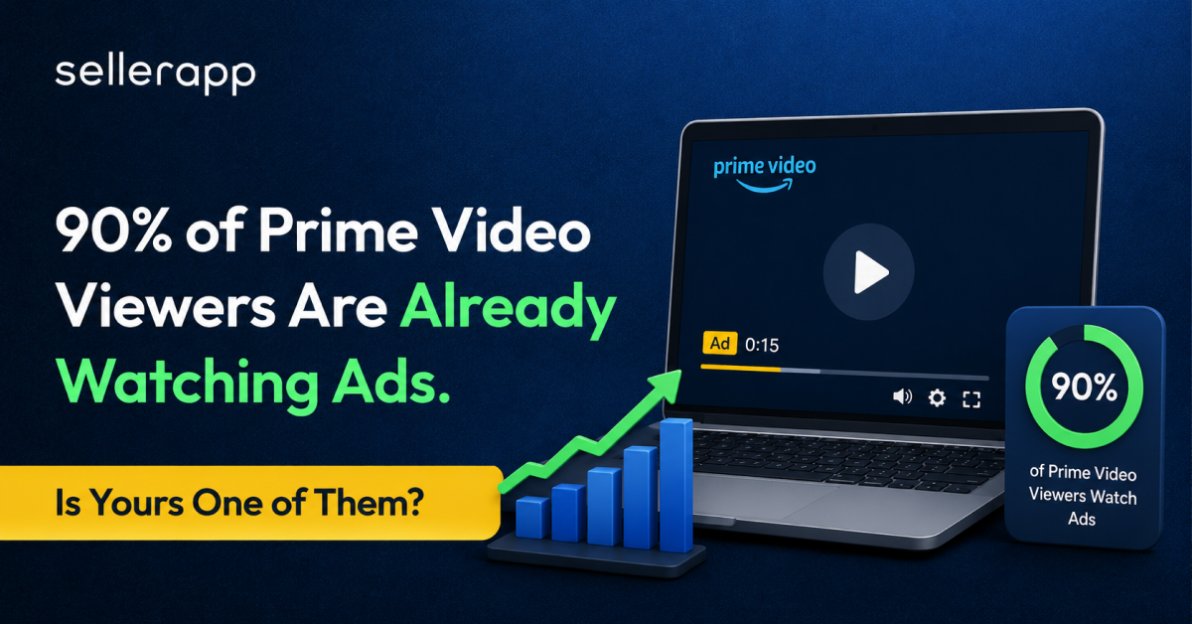
Amazon Prime Video Advertising is now officially called Streaming TV ads. It places non-skippable Amazon video ads across Prime Video, Fire TV, Twitch, and open-web publishers, bought either through the Amazon Ads console with no minimum spend or through Amazon DSP.
Since January 2024, Prime Video runs ads by default, putting hundreds of millions of purchase-data-backed viewers within reach.
If you last looked at this channel a year or two ago, the ground has shifted under it. Prime Video went from an ad-free perk to an ad-supported default. Amazon folded its old “Sponsored TV” product into a single streaming TV offering.
And the $50,000 minimum that kept most mid-market brands out of self-serve DSP is gone.
This guide covers what Amazon Prime Video Advertising actually is today, what it costs, how to buy it, and what has changed in the past 12 months that most guides on this topic haven’t yet caught up to.
Here is what we have covered:
“Over-the-top,” in Amazon OTT Advertising, just describes video delivered straight over the internet instead of through a cable box. Prime Video, Twitch, Fire TV apps, that category of viewing. For years, Amazon sold ad inventory in that environment under a patchwork of names, including Amazon Prime Video Advertising. Amazon DSP handled the programmatic buy for larger budgets.
A separate product called Sponsored TV, launched in October 2023, gave smaller sellers a no-minimum way in through Freevee and Twitch.
That patchwork is gone.
Amazon now sells this inventory, once known as Amazon Prime Video Advertising, under one name, Streaming TV ads, whether you buy it through the Ads console or through DSP. The underlying video product hasn’t changed much.
What changed is who can access it and how much you need to commit to try it, which matters more for most brands than the rebrand itself.
It’s worth separating while we’re on terminology. OTT, CTV (connected TV, meaning the device), and streaming TV get used interchangeably in casual conversation, but Amazon’s own documentation treats “streaming TV ads” as the umbrella term now, with OTT as the older, less precise label.
If you’re comparing against Amazon’s help center or ad specs pages, search “streaming TV,” not “OTT,” or you’ll end up on retired product pages.
This is the part most guides on Amazon Prime Video Advertising get wrong by leaving out the single biggest change in the channel, like how Prime Video has run ads by default since January 2024. Amazon didn’t build a separate cheaper ad-supported tier the way Netflix and Disney+ did.
It moved existing subscribers onto ads and made ad-free viewing the paid upgrade. Because of that, the ad-supported audience was enormous from day one rather than something that had to be grown. Amazon has cited a global monthly ad-supported audience above 315 million viewers, with the U.S. figure alone reported north of 130 million by mid-2025.
Only a small minority of subscribers have opted to pay extra to remove ads. Beyond Prime Video, your Streaming TV budget can also land on:
One quick note if you’re working from older content. Freevee, Amazon’s free ad-supported service, was folded into Prime Video channels in April 2024 and no longer exists as a separate brand. Any strategy doc or vendor deck still treating Freevee as a distinct placement needs an update.
SellerApp’s own benchmark research, drawn from more than $3 billion in managed ad spend, shows DSPs’ share of total Amazon ad spend climbing from 17.7% to 23.4% over the past year, with DSP clicks up 156% year-over-year in Q1 2026.
More than one in three DSP-attributed purchases, 36.5%, come from shoppers who have never bought from the brand on Amazon before, which is exactly the kind of reach Prime Video, Fire TV, and Twitch placements are built to deliver.
The logical takeaway for budget planning is to size your test around where the audience already sits, starting with Prime Video, then lean on DSP’s prospecting strength across Fire TV and Twitch to go after net-new buyers once your creative is validated, rather than splitting a small budget thin across every placement from day one.
The basics of Amazon Prime Video Advertising haven’t changed much from the old OTT days. Amazon OTT Advertising has become full-screen and non-skippable and is sold on a CPM basis rather than cost-per-click because there’s usually nothing to click.
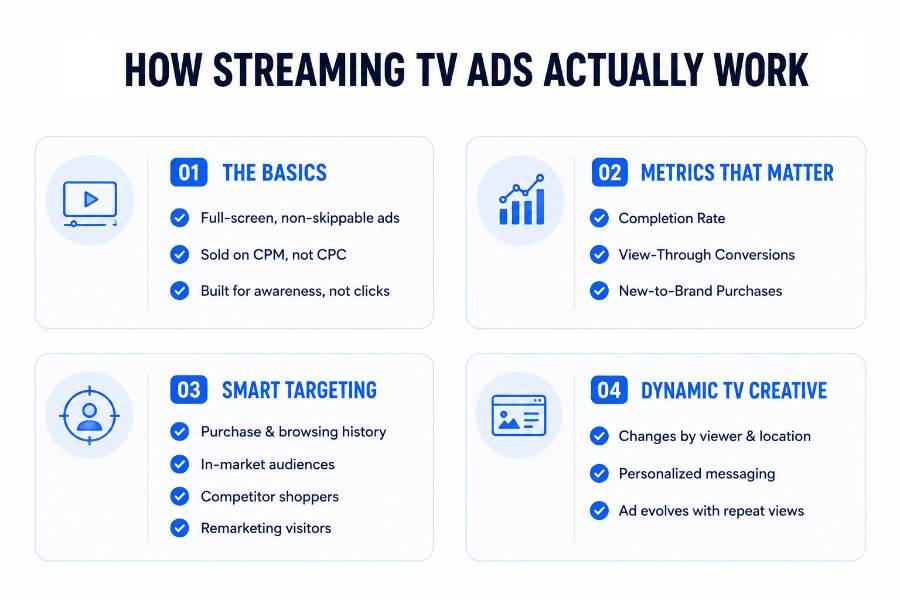
That last part matters for how you set goals, if someone on your team is asking why the click-through rate looks terrible, they’re measuring the wrong thing. Completion rate, view-through conversions, and new-to-brand purchase rate are the metrics that actually describe whether the ad worked.
Targeting runs on the same first-party data that makes the rest of Amazon’s ad stack useful, things like purchase history, browsing behavior, demographics, in-market and lifestyle segments, and Prime membership status.
You can also build remarketing audiences from shoppers who have viewed your detail pages without buying and, notably, target audiences who’ve shown interest in a competitor’s products. That last capability, often called ad conquesting, is still one of the few places in advertising where you can put your product in front of someone who was just looking at a rival’s.
Since the 2026 upfronts, Amazon has added a feature called Dynamic TV Creative, which adjusts messaging within a single ad based on what the viewer is watching, their location, browsing activity, and local product availability, showing a simpler version on first exposure and more tailored messaging on repeat views. It’s an early-stage capability, and not every advertiser has it yet, but it’s a sign of where creative personalization on this channel is headed.
This is the part that determines whether Amazon Prime Video Advertising is realistic for your budget, and it’s also the part that’s changed the most. There are three distinct paths for Amazon OTT Advertising now:
| Buying path | Minimum spend | Where you access it | Best fit |
| Streaming TV via Sponsored Ads console | None | Ads console, self-serve | Brand Registered sellers, vendors, and agencies testing the channel or working with tighter budgets |
| Streaming TV via Amazon DSP, self-service | No official minimum since late 2025; practitioners generally recommend $10,000–$15,000/month before the algorithm has enough signal to optimize well | DSP seat, self-managed or via an agency’s seat | Brands with existing DSP or programmatic experience who want audience-level control |
| Streaming TV via Amazon DSP, managed service | Roughly $50,000/month | Amazon-managed, with a dedicated strategist | Enterprise brands who want genre blocking, audience guarantees, and hands-off execution |
The self-service Sponsored Ads route is the one that changed the game for small and mid-market brands. It requires Brand Registry enrollment (vendors, book publishers, and agencies also qualify), runs with no minimum spend at all, and reaches Prime Video, Fire TV, and Twitch.
You don’t even need to sell on Amazon to use it; Amazon opened Streaming TV to non-endemic businesses in categories like automotive, travel, and hospitality as well.
The DSP self-service minimum is the other major shift. Amazon removed its long-standing $50,000 self-serve floor at its unBoxed conference in November 2025.
It isn’t gone entirely in practice, since $10,000–$15,000 a month is roughly where the AdRelevance model has enough data to optimize meaningfully, but that’s a very different conversation than it was a year ago, when $50,000 was the price of entry for any DSP access at all.
Managed service still exists for brands that want genre blocking (keeping your ad off certain types of content) and audience guarantees, both of which currently remain managed-service-only features in the U.S.
CPMs for Amazon Prime Video Advertising vary by path and by how tightly you target, and the range is wide enough that a single number isn’t useful. Rough benchmarks currently in circulation:
A small test budget goes further here than most advertisers expect. A $500–$1,000 test through the self-serve console can generate tens of thousands of impressions, enough to see early completion rate and reach data before committing real money.
That’s a reasonable way to validate creative and audience fit before scaling into DSP.
Nothing kills momentum on an Amazon Prime Video Advertising launch faster than creative that gets rejected in review. Current Amazon OTT Advertising specs:
| Spec | Requirement |
| Duration | 15, 30, 45, or 60 seconds |
| Aspect ratio | 16:9 |
| Resolution | 1920×1080 minimum |
| Bitrate | 15 Mbps minimum |
| File format | MP4 |
| Interactivity | Optional “click or scan to add to cart” overlay, available on site-served ads only |
| Third-party tracking | Inline VAST 2.0 or 3.0 tags from an Amazon-certified vendor; VPAID and wrapper tags aren’t accepted |
Your logo and brand name need to appear in the video itself, not just as an overlay, and Amazon runs a moderation review before any self-service ad goes live, so build in a few extra days before your intended launch date.
If you don’t have production resources, Amazon’s Creative Agent tool (more on this below) can generate compliant streaming TV creative from a product feed at no cost, which is a genuinely useful option for brands that have never shot video before.
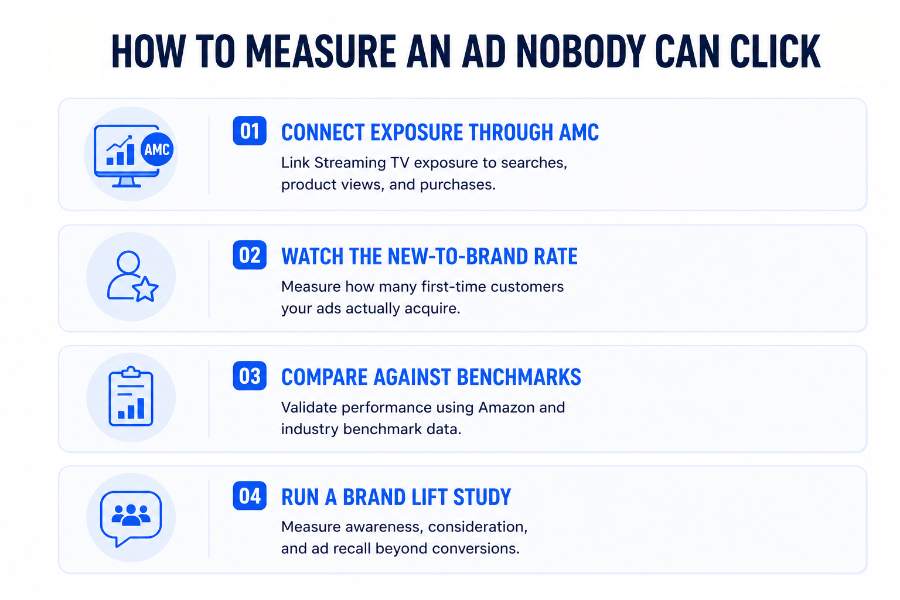
The old objection to Amazon Prime Video Advertising was always measurement because if there’s no click, how do you know it worked? Amazon Marketing Cloud has mostly closed that gap.
AMC lets you connect streaming TV exposure to downstream detail-page views, branded search lift, and purchases, including whether the buyer was new to your brand.
AMC lets you connect streaming TV exposure to downstream detail-page views, branded search lift, and purchases, including whether the buyer was new to your brand.
That last metric tends to be the strongest argument for the channel. One frequently cited analysis from Perpetua’s DSP research found that shoppers exposed to Streaming TV ads converted as new-to-brand customers at meaningfully higher rates than shoppers who’d only seen other Amazon ad types (57% versus 45% in that study).
Amazon’s own case studies point in the same direction. Skincare brand Divi Scalp Care reported an 82.76% new-to-brand conversion rate after pairing Streaming TV with AMC measurement, a result Amazon featured at unBoxed 2025.
Brand lift studies are also available through Amazon for advertisers who want a formal read on awareness and consideration shifts, not just downstream purchases.
Most of the underperformance we see in Amazon Video Advertising traces back to frequency, not creative or targeting. A few patterns show up constantly:
No cap, or one flat cap for every audience
Cold prospecting and warm retargeting audiences need different exposure limits. Treating them the same either starves your cold reach or burns the budget by re-showing the same ad to people who’ve already converted.
Ignoring Frequency Groups across overlapping orders
If you’re running more than one Streaming TV order at once, a shopper can hit your per-order cap on each one individually while still seeing your brand far more often than intended.
Reading device-level frequency instead of person-level
Amazon’s person-level view reflects how often a given shopper saw your ad across their phone, TV, and laptop.
Most practitioner guidance converges on somewhere between 5 and 8 impressions per day as a starting cap, adjusted from there using AMC reach and frequency reports rather than a flat rule.
We go deeper into setting and troubleshooting caps by funnel stage in our Amazon DSP frequency-capping guide if you’re past just wanting a starting number.
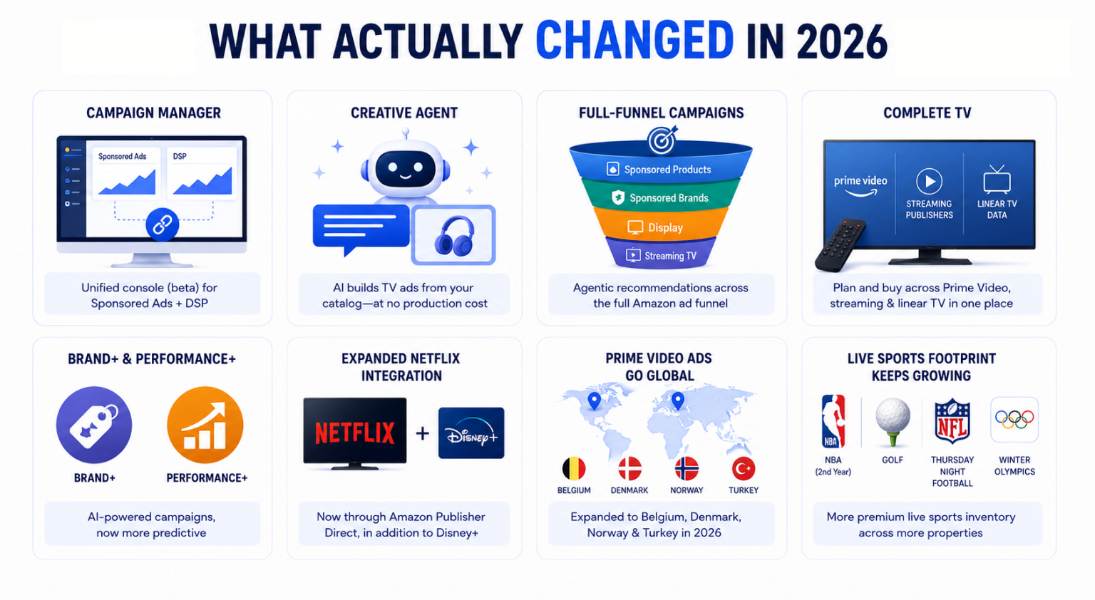
A lot of content on Amazon OTT Advertising is still describing 2024’s version of the channel. Here’s what’s real as of this year, most of it announced at Amazon’s unBoxed conference in November 2025:
Campaign Manager
a unified console (in beta) meant to eventually combine Sponsored Ads and DSP buying into one interface instead of two separate tools
Creative Agent
an AI tool that builds streaming TV creative conversationally from your product catalog, at no production cost, expanded specifically for TV formats at unBoxed
Full-Funnel Campaigns
an agentic tool that recommends a coordinated setup across Sponsored Products, Sponsored Brands, display, and Streaming TV rather than requiring you to build each individually
Complete TV
which lets advertisers plan and buy across Amazon Prime Video, other premium streaming publishers, and linear TV data in one place
Brand+ and Performance+
Amazon’s AI-driven campaign types (not to be confused with Google’s similarly named products), both made more predictive over the past year
Expanded Netflix integration
Through Amazon Publisher Direct, on top of the Disney partnership that arrived in 2025
International expansion of Prime Video ads into Belgium, Denmark, Norway, and Turkey during 2026, on top of existing markets
The live sports footprint keeps growing too. Amazon is heading into its second year of NBA coverage, has added golf inventory, and has picked up Winter Olympics placements, on top of its established Thursday Night Football package.
If reaching sports viewers matters to your brand, that inventory has genuinely expanded, not just been repackaged with new branding.
For an enterprise brand already spending meaningfully on Sponsored Products and Sponsored Brands, Amazon Prime Video Advertising that is now sold as Streaming TV is close to a default addition at this point. You already have the conversion signal in AMC to make sense of new-to-brand reporting, and the managed-service option gives you genre blocking and guaranteed audience delivery if brand safety is a real concern.
For a small or mid-market brand, the calculus changed materially in the past year. The no-minimum Sponsored Ads path removes the old cost barrier entirely, and a few hundred dollars is enough to see whether your audience responds to the format before you commit a real budget.
Honestly, without an existing base of Sponsored Ads conversion data, it’s harder to isolate what Streaming TV specifically contributed, so treat an initial test as a directional read, not a definitive ROAS number.
Streaming TV isn’t a replacement for Sponsored Products, and it never was. It’s an upper-funnel tool that builds awareness and reaches shoppers before they search, which is exactly the gap Sponsored Products can’t fill on its own. Brands that pair the two, using Streaming TV to build the audience and Sponsored Ads to capture the resulting search demand, tend to see the clearest lift in both channels.
If you’re weighing whether your account has the conversion foundation to make DSP or streaming TV worth testing, that’s a conversation worth having with a dedicated Amazon DSP agency that can look at your existing Sponsored Ads data before recommending a budget.
Is Amazon Prime Video Advertising still called that?
Not officially. Amazon now uses “Streaming TV ads” as the umbrella term across both its Sponsored Ads console and DSP products. OTT is still used informally and in older documentation, but if you’re checking Amazon’s current specs or policies, search “streaming TV” to land on the pages that are actually maintained.
Is Amazon Prime Video Advertising the same as Amazon DSP?
Not anymore. DSP is one of two ways to buy Streaming TV inventory. The other is the Sponsored Ads console, which requires no minimum spend and doesn’t need a DSP seat at all. DSP still offers deeper audience controls and off-Amazon reach that the console path doesn’t.
How much does Amazon Streaming TV advertising cost?
CPMs bought through the Sponsored Ads console run roughly $8–$15. Premium Prime Video inventory bought through DSP runs closer to $29–$33 CPM. A test budget of $500–$1,000 can still generate tens of thousands of impressions for early learnings before you commit to a larger spend.
Do I need to sell on Amazon to run Streaming TV ads?
No. Amazon opened the self-service console to businesses that don’t sell in the Amazon store at all, including categories like automotive, travel, and hospitality. You do still need Brand Registry enrollment if you’re a seller using the console path; non-endemic advertisers go through a separate onboarding.
What’s the minimum budget for Amazon Streaming TV ads?
Through the Sponsored Ads console, there’s no minimum. Through DSP self-service, Amazon removed its official minimum in late 2025, though $10,000–$15,000 a month is a more realistic floor for the algorithm to optimize meaningfully. Managed service still runs around $50,000 a month.
How is Amazon Prime Video Advertising measured if it’s not clickable?
Through Amazon Marketing Cloud, which connects ad exposure to downstream detail-page views, branded search lift, and purchases, including whether the buyer was new to your brand. Brand lift studies are also available for advertisers who want a direct read on awareness shifts rather than only purchase outcomes.
What are the creative specs for Amazon streaming TV ads?
Videos need to run 15, 30, 45, or 60 seconds in 16:9 at a minimum 1920×1080 resolution and 15 Mbps bitrate, delivered as MP4. Your logo and brand name must appear in the video itself. Interactive add-to-cart overlays are available but only on site-served ads, not through third-party ad tags.
Can I still target my competitors’ shoppers with Amazon OTT Advertising?
Yes, this is often called ad conquesting, and it remains one of the more distinctive targeting options on the channel. You can build audiences from shoppers who’ve shown interest in competing products and put your ad in front of them, something most other advertising platforms don’t offer at this level of precision.
What actually changed with Amazon streaming TV ads in 2026?
Amazon folded its old Sponsored TV product into one unified Streaming TV offering, removed the DSP self-serve minimum, and rolled out Campaign Manager, Creative Agent, Complete TV, and expanded Brand+/Performance+ capabilities, mostly announced at unBoxed in November 2025. Netflix inventory access also expanded, and Prime Video ads launched in several new international markets.
Should a small- or mid-size brand bother with Amazon Streaming TV ads?
It’s a much lower-risk test than it was a year ago. The no-minimum Sponsored Ads path lets you validate creative and audience response for a few hundred dollars before scaling. The main limitation is measurement: without existing Sponsored Ads conversion history in AMC, it’s harder to isolate exactly what the streaming ads contributed, so treat early results as directional.