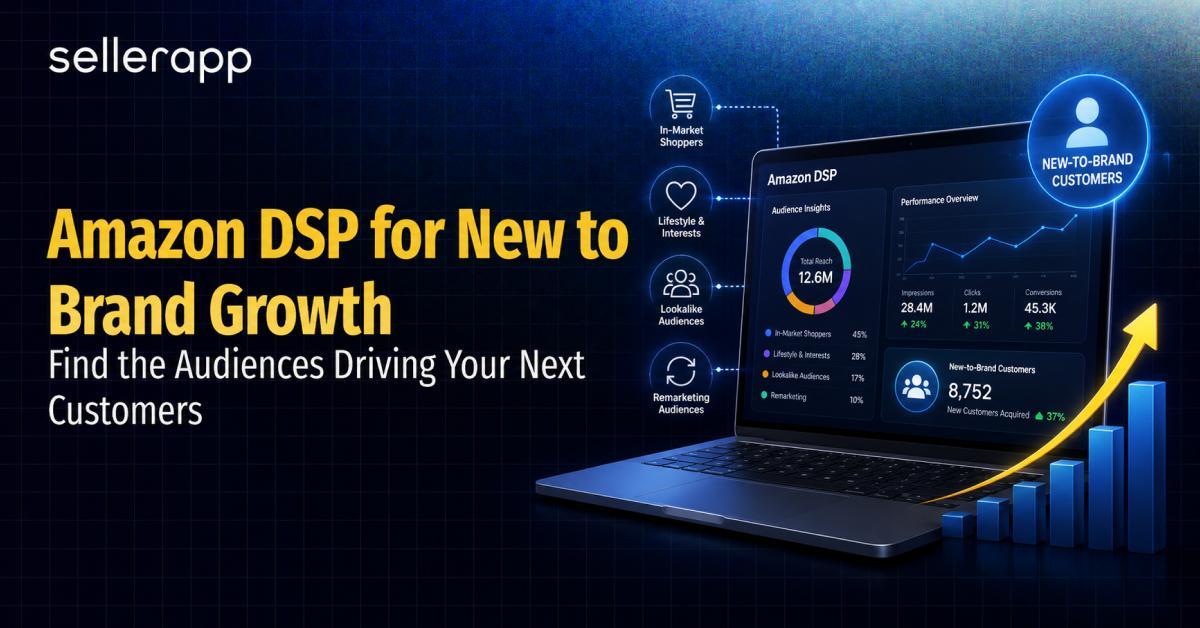


Amazon DSP isn’t reserved for enterprise budgets anymore, but it isn’t free money for every seller with a live listing either. If your Sponsored Products campaigns are steady and your monthly ad spend clears somewhere around $7,000 to $10,000, DSP can genuinely lower your acquisition costs and bring you customers Search advertising will never show you.
Is Your Business Actually Ready?
We’ve watched brands spending $20K a month make DSP work purely because the fundamentals underneath it were solid. We’ve also watched brands spend five times that amount struggling before they came to us because they tried to use DSP to fix problems it was never built to solve.
Before you start thinking about audiences or creatives, sit with a few honest questions:
- Are your hero ASINs already converting well?
- Is your inventory healthy enough to support extra demand?
- Are your Sponsored Products campaigns relatively stable?
- Do you already know which products deserve more visibility and which ones don’t?
If you’re still fixing listings, responding to stockouts, or trying to figure out why your PPC isn’t profitable, DSP isn’t your next move. It’s a distraction dressed up as a solution.
Quick Guide :
Why Brands Even Start Looking at DSP
It usually starts the same way as PPC begins to feel expensive.
You’ve done everything with optimizing bids, testing match types, or cleaning up your search terms report, and yet CPC keeps climbing while growth slows down. At some point it clicks that you’re bidding against everyone else for the same shopper, in the same moment, in the same little box.Before you blame DSP-envy on rising CPCs, pull your last 90 days of Sponsored Products data and check for three specific things:
- Top-of-search impression share on your best keywords is already sitting above 70–80%, and CPC is still climbing anyway. That’s a saturated auction, not an under-bid one, you can’t buy your way to more impressions that don’t exist.
- Your daily SP budget on hero ASINs is exhausting before noon (Amazon’s clock resets at midnight Pacific). More budget on the same keywords won’t lift a demand ceiling.
- TACoS has been flat or climbing for two-plus months, while ACoS has held steady. You’re not losing efficiency, you’ve simply run out of existing shoppers to convert.
What DSP Actually Costs to Do Well
Here’s SellerApp’s 2026 benchmark report, collected from managed spend across 55,000+ brands, splits Amazon advertisers into four spend tiers, and DSP access tracks almost exactly with them.
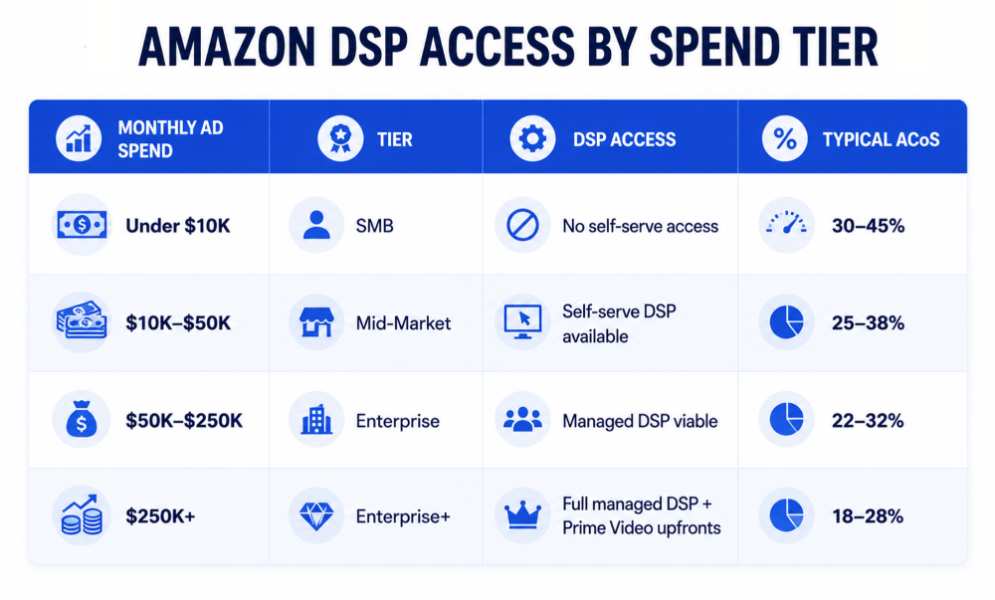
If you have taken a closer look at the table above, you must have noticed where the line actually falls. Brands spending under $10K a month typically don’t have self-serve DSP access at all, which backs up something we’ve told clients for a while now to treat $7,000–$10,000 a month, or roughly $100K a year, as your starting point. That number isn’t about being able to “afford” DSP. It’s about whether your spend generates enough data, fast enough, for Amazon’s a9 algorithm to learn anything useful. A campaign running on $2,000 a month won’t clear its own learning phase before you lose patience with it.
Your revenue leakage from Sponsored Ads needs more attention than you would have assumed because if you’re spending more every month for the same, or worse, return, and optimization has stopped moving the needle, that’s usually the moment to shift the budget toward DSP, not before. Context helps here too. Platform-wide CPM jumped 47.46% in 2025 to $7.82, the sharpest cost increase of any metric tracked across any major digital channel.
DSP’s share of total Amazon ad spend grew from 17.7% to 23.4% over the same period, and by Q1 2026, DSP became cheaper per click than Sponsored Products for the first time in five years of tracked data.
Brands sitting this out aren’t playing it safe. They’re paying more for less, on a channel that keeps getting pricier.
The Biggest Misunderstanding About DSP
People often ask us, “What’s the minimum budget for Amazon DSP?” It’s not a bad question. It’s just not the most useful one. There are really three different conversations hiding under that one question, and each comes with its own costs, timelines, and level of control.
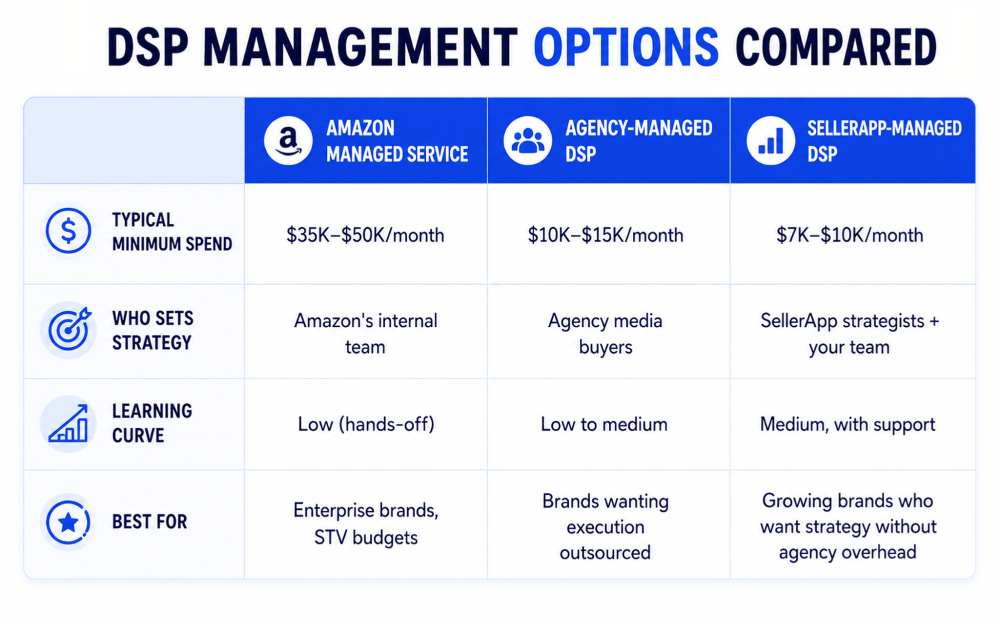
The real question was never whether you can technically launch DSP. It’s whether your budget is large enough to generate the data you need to make good decisions with it and whether you have the expertise on hand to read that data once it shows up.
If You Have $20K, Here’s How We’d Allocate It
This is where a lot of smaller brands trip up. They finally get DSP access and immediately want to run streaming TV, display, video, competitor targeting, lifestyle audiences, remarketing, and Amazon audiences all at once, all in month one. It feels exciting. It rarely works. If we had $20,000 to work with, we’d protect the channels already driving revenue first. The bulk of that budget would still sit with Sponsored Products. DSP has to earn its place by proving it brings in incremental shoppers, not by replacing what’s already working. Think of it as adding a new player to the roster, not benching your best performer to make room.
Your First DSP Campaign Will Probably Be Boring
This might surprise you, but the smartest first DSP campaign is almost always remarketing. People who viewed your product. People who added it to the cart and vanished. People who bought before. People who bought something that pairs naturally with what you sell. These audiences already know who you are. They’re cheaper to reach, they convert better, and running them first teaches you how DSP behaves before you spend real money on colder audiences. Across brand objectives, DSP video campaigns average around 2.4x ROAS, and that number leans heavily on exactly this kind of warm-audience remarketing. Cold prospecting has its place too, but it’s not where you cut your teeth. Sometimes the most profitable campaign is also the least exciting one to talk about at a team meeting.
The Mistakes That Usually Cost Brands Money
This is the pattern that surfaces whenever agencies compare notes, operators talk shop on LinkedIn, or sellers vent on Reddit after an expensive quarter.
Brands lose money when they:
- Launch five audience types before understanding one.
- Pause campaigns after a week because ROAS looks low.
- Ignore view-through conversions entirely.
- Split a small budget across too many line items.
- Change bids every few days before the algorithm has enough data to learn from.
Every single one of these traces back to the same root cause: impatience dressed up as optimization.
The First Three Months Matter More Than the First Three Weeks
Brands often expect DSP to prove itself almost immediately. That’s rarely how it plays out.
Month one is mostly about learning. Month two is about refining audiences. Month three is when real patterns start to emerge. Rewrite your strategy every week, and you’re interrupting the learning process before it’s had a chance to teach you anything. Timing plays its own role here. Amazon’s ad economy swings seasonally, October has historically been the cheapest month to advertise and January the most expensive, a swing of about 4.5 points in ACoS. Launch a flat-budget test in January expecting October’s numbers, and you’ll walk away thinking DSP failed you when, really, you just picked an expensive month to run the experiment.
So… Should You Try DSP Under $20K?
Don’t look at your monthly spend in isolation. Look at your business and where that spend actually lands across the tiers above. If your listings convert, your inventory is healthy, your Sponsored Ads are stable, and your spend already clears roughly $7K–$10K a month, DSP is worth testing. If you’re watching ad spend climb with nothing to show for it, that revenue leakage is usually the clearest sign it’s time to move some of that budget toward DSP rather than keep feeding a channel that’s already plateaued. If you’re still trying to make your core retail business work on under $10K a month, DSP probably isn’t the thing that fixes it. Advertising rarely solves operational problems, it just exposes them faster and at a higher CPM than it did last year.
Final Thoughts
DSP under $20K a month was never about having a bigger budget than everyone else. It’s about spending what you have with more intention than everyone else. Get the fundamentals right, start with remarketing, give it three months before you judge it, and treat $7K–$10K a month as the floor, not a suggestion.If you want a clearer read on where your account actually sits against these benchmarks, by spend tier, category, or otherwise, that’s exactly the kind of gap SellerApp’s advertising intelligence platform is built to close.
FAQs
There’s no Amazon-enforced minimum for self-serve DSP, but in practice, brands need roughly $7,000–$10,000 a month (about $100K a year) to generate enough data for the algorithm to optimize meaningfully. Below that, campaigns often stall in the learning phase before showing real results.
Yes, through self-service DSP, though it comes with a steep learning curve and no Amazon-set spend minimum. Agency-managed DSP typically starts around $10K–$15K a month, while Amazon’s own managed service usually requires $35K–$50K a month or more.
Neither replaces the other. Sponsored Products captures demand from shoppers already searching; DSP builds new demand and remarkets to shoppers Search never reaches. In Q1 2026, DSP became cheaper per click than Sponsored Products for the first time, but the two still work best together.
Budget at least three months before judging performance. The first month is largely a learning phase, the second refines audience targeting, and patterns typically emerge by month three. Changing strategy weekly interrupts that learning process before it produces anything useful.
It can, provided the fundamentals are already solid, converting listings, healthy inventory, and stable Sponsored Products campaigns. Brands spending under $10K a month typically lack self-serve DSP access altogether, so “small” here is about spend tier, not brand size.
Remarketing to people who viewed, cart-abandoned, purchased before, or bought complementary products. These audiences are cheaper to reach and convert better than cold prospecting, and they teach you how DSP behaves before you commit budget to less familiar audiences.
No. DSP should prove it can bring incremental shoppers alongside Sponsored Products, not replace a channel that’s already converting. Most of a $20K budget should still sit with Sponsored Products, with DSP earning a larger share only after it shows results.