

Ask an Amazon agency how it manages twenty-five brands without letting any of them slip, and the usual answer is “We work harder than the competition,” but in reality, it is their tech stack. The Amazon marketing agency tools an agency runs on decide how many accounts one person can handle, how quickly a problem gets caught, and whether a client hears about profit or only ACoS on the monthly call.
Most lists of tools for Amazon marketing agencies stop at a handful of PPC platforms. That covers one part of the job. Managing clients well also takes profitability reporting, account monitoring, market intelligence, a record of every client conversation, and a workflow that survives an account manager leaving.
This guide breaks down the tool stack well-run agencies use to manage clients, what each category solves, and then ranks the Amazon agencies running on this kind of stack today.
Quick Guide
Why the Tool Stack Decides How Well an Agency Manages Clients
In our conversations with brands that move to SellerApp from another agency, the complaints fall into three patterns.
The first is the handoff. The founder or a senior strategist sells a brand, and ninety days later the account is run by someone the brand has never spoken to. Who staffs an account is a people decision, but tools shape it. When every rule, report, and check has to be rebuilt by hand for each client, senior people get buried in setup work and the day-to-day gets pushed down the org chart.
The second is silent turnover, where account managers rotate without the client being told. People leaving is normal. What turns it into a client problem is that the account knowledge, such as goals, past changes, and unwritten rules, lived in one person’s head. With recorded calls, shared notes, and a change log, a new account manager starts with full context, and the client barely notices the change.
The third is reporting activity instead of outcomes, a list of campaigns adjusted with no answer to whether the account actually made more money. What to report is a judgment call, but a reporting tool that only sees the ad console can only report ad metrics. Without Seller Central data in the same view, “Did we make money?” has no answer.
People make the decisions in all three cases, but tools determine whether good decisions can hold up at scale. These are capacity, continuity, and visibility problems more than bidding problems, and each one traces back to the stack.
That gap matters more every year. With Amazon fees rising and margins tightening, sellers care less about a clean ACoS number and more about what is left after COGS, storage fees, and refunds.
An 18% ACoS campaign can look healthy in the ad console and still lose money once those costs are counted. An agency whose Amazon marketing software cannot show that it is reporting on the wrong thing.
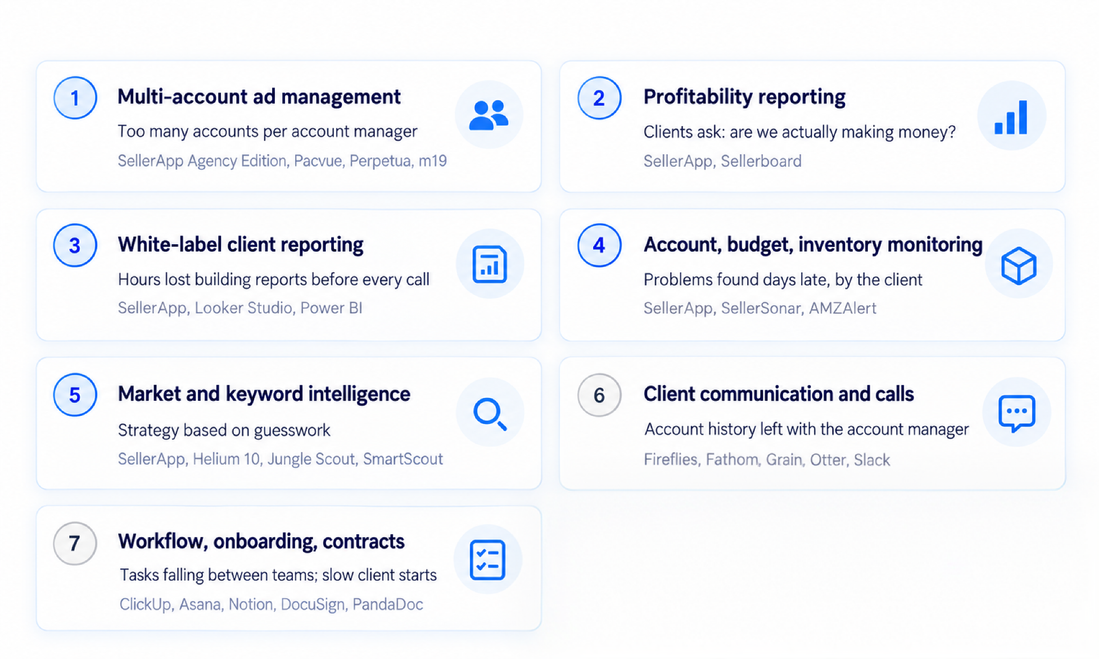
The Amazon Marketing Agency Tools Stack: 7 Categories Agencies Use to Manage Clients
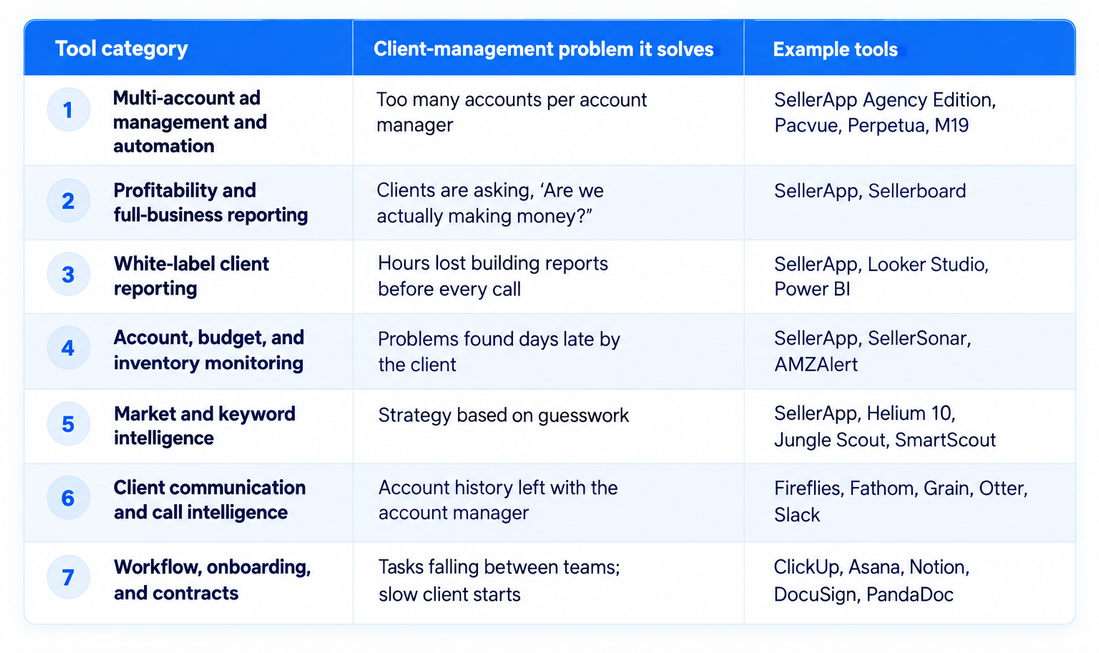
Here is the full stack, organized by the client-management problem each category solves. Well-run agencies do not buy every tool in every category.
They pick a core platform that covers as many categories as possible and fill the gaps with a few point solutions.
1. Multi-account ad management and automation
This is the core of any Amazon agency software stack, because it decides how many brands one account manager can run well.
The difference between tools here is less about bidding and more about scale. Look for automation that runs at the portfolio level, so a rule built once (for example, pausing ads on out-of-stock ASINs) applies to every account that meets the condition instead of being rebuilt twenty-five times.
Other features worth checking are bulk operations across accounts, a mix of transparent rules and AI-driven optimization, and hourly data from Amazon Marketing Stream for dayparting and fast bid changes.
SellerApp combines portfolio-level rules and AI automation on Marketing Stream data, with bulk operations that push one strategy across many accounts at once.
Pacvue is built for enterprise-scale bid management and bulk operations on high ad spend.
Perpetua focuses on goal-based bid and budget automation, which suits accounts in a growth phase.
m19 gives teams granular, rule-by-rule control for agencies that prefer to build logic by hand.
2. Profitability and full-business reporting
This is the category that separates an ad vendor from a growth partner. By connecting Seller Central alongside the Advertising Console, an agency can see revenue, COGS-inclusive profit, fees, refunds, inventory, and TACoS in one view.
That lets an account manager answer profit questions live on a client call and spot margin or stock problems before they become ad problems.
It also opens new revenue. An agency that sees a client running low on inventory or bleeding margin on refunds can offer inventory and profitability support, not just ad management.
SellerApp pulls Seller Central and Ad Console data into one view with true profit calculations that include COGS and fees.
Sellerboard is a standalone profit tracker some agencies add when their ad tool only covers ad metrics.
3. White-label client reporting
Reporting is where agencies quietly lose the most hours. Building branded decks every Monday by copying numbers out of three dashboards does not scale past a handful of clients. The right Amazon marketing tools generate white-labeled reports automatically, keep live dashboards clients can check any time, and include attribution that shows what upper-funnel spend like Sponsored Brands actually contributed.
SellerApp auto-generates white-labeled reports and uses Amazon Marketing Cloud data for attribution beyond the last click.
Looker Studio and Power BI work for agencies that prefer to build custom dashboards on exported data.
4. Account, budget, and inventory monitoring
Nothing damages client trust faster than the client spotting a problem first. Monitoring tools catch budget blowouts, ACoS spikes, and out-of-stock ASINs within hours and push alerts into Slack, so the agency calls the client before the client calls the agency.
SellerApp sends Slack alerts on budget and performance issues and can pause ads automatically when inventory runs low.
SellerSonar and AMZAlert cover listing changes, hijackers, and Buy Box monitoring. Most agencies pick one of the two rather than running both.
5. Market and keyword intelligence
Good strategy starts with knowing what shoppers search for and what competitors are doing. Beyond standard keyword research, the newer signals worth tracking are Search Frequency Rank movement, Rufus query trends, and Share of Shelf shifts inside a category, because they show demand changes before standard reports do.
SellerApp combines Search Frequency Rank, Rufus query data, and Share of Shelf tracking from a 300-million-keyword index.
Helium 10 and Jungle Scout are strong for product and keyword research on individual accounts.
SmartScout is useful for category and competitor audits ahead of a new-business pitch.
6. Client communication and call intelligence
Account history should never live in one person’s head. When an account manager leaves, everything they knew about a client’s goals, preferences, and unwritten rules leaves too, unless it was captured.
Call recorders like Fireflies, Fathom, Grain, or Otter push transcripts and action items into a CRM or a shared Slack channel, so a handoff starts with full context instead of a blank page. Almost no roundup of Amazon marketing tools mentions this category, yet it is often the real reason a handoff goes badly.
7. Workflow, onboarding, and contracts
Project tools like ClickUp, Asana, or Notion let a client lead see PPC, content, and catalog work on one account without three separate status calls. Contract tools like DocuSign or PandaDoc keep onboarding from stalling on paperwork.
Paired with bulk onboarding and campaign templates inside the ad platform, this is what lets an agency get a new client live in days instead of weeks.
5 Ways to Tell Whether an Agency’s Tools Are Working for Its Clients
Whether you are a brand vetting an agency or an agency auditing its own stack, these five questions reveal more than any tool list.
1. Can you see a profitability view, not just an ACoS screenshot?
ACoS is a ratio inside the ad console. It says nothing about whether the account made money after COGS, fees, and refunds. If an agency cannot show true profit in a demo or a sample report, its reporting stops at the ad console.
2. How many accounts does each account manager handle, and how?
A high ratio is only a problem when the tools cannot support it. Ask whether automation runs at the portfolio level or has to be rebuilt account by account.
3. Does the brand keep ownership of its advertising console and data?
Campaign history and search term data belong to the brand. If the relationship ends, that data should not leave with the agency or its software vendor.
4. How quickly would the agency know if something broke?
Hours is the right answer. Days, or “when we review the account on Friday,” means the client will likely find out first.
5. What happens to account history when an account manager leaves?
Look for recorded calls, documented account notes, and a change log that shows every adjustment made and why.
7 Best Amazon Marketing Agencies Using These Tools in 2026
Tools only matter if a team uses them well. The agencies below run on the kind of stack described above, whether they build their technology in-house or combine specialist platforms.
We looked at the depth of technology behind each service and how clearly each reports on profitability, marketplace coverage, and published track record.
1. SellerApp
Best for: Brands that want agency-level management backed by the same technology platform other Amazon agencies use to run their own clients.
Most agencies choose their Amazon marketing tools from the market. SellerApp builds them. Its managed services team handles PPC, Amazon DSP, and listing optimization from inside SellerApp’s own commerce intelligence platform, the same platform its Agency Edition puts in the hands of more than 1,200 other agencies. Every category in the stack above is covered in one place rather than stitched together from five subscriptions.
In practice, that means portfolio-level automation that combines rules and AI on Amazon Marketing Stream data, including dayparting. It means profitability reporting with Seller Central connected, so COGS, fees, refunds, and inventory sit next to ad metrics. Attribution runs through Amazon Marketing Cloud, which shows what Sponsored Brands and other upper-funnel spend contributed instead of crediting only the last click. The team also works with demand signals most agencies cannot access, including Search Frequency Rank movement, Rufus query trends, and Share of Shelf shifts, with Slack alerts and automatic ad pauses when stock runs low. Coverage extends to Walmart as well as Amazon.
SellerApp has managed more than $1.8 billion in ad spend, and over 31,000 sellers use the platform. Agencies running on Agency Edition report roughly 60% less manual optimization work and up to four times as many clients per account manager.
Because the account team and the platform sit under one roof, a new signal in the data reaches the strategist on your account without waiting on a third-party vendor’s roadmap. And because the same platform runs across a wide network of agencies and brands, its automation and benchmarks draw on a far broader base of accounts than tooling built for one team’s internal use.
2. Canopy Management
Best for: Brands that want a full-service account management team with hands-on strategist attention.
Founded in 2018 and based in Austin, Canopy Management is a full-service Amazon agency covering growth planning, PPC and DSP, listing optimization, and creative, with services that have expanded to Walmart and Shopify. Its specialists work with a set of bespoke software tools, some developed to solve specific client needs. The agency publishes strong client retention and profit-growth figures on its site.
The engagement model is built around full-service management, so brands looking for a narrow, ads-only scope should confirm fit early.
3. Incrementum Digital
Best for: Advertising-led growth across Amazon and other retail media networks.
Incrementum Digital was founded in 2019 by Liran Hirschkorn, who began selling on Amazon in 2014 and built consumer brands before launching the agency. The team manages Sponsored Products, Sponsored Brands, Sponsored Display, Amazon DSP, Walmart, and TikTok Shop campaigns. It uses Optari (formerly DataOwl), its own analytics platform, to track blended profitability metrics such as TACoS. Incrementum holds Amazon Ads Advanced Partner and Walmart Connect Partner status.
Advertising is the center of the service, so brands that also need catalog or operations support should confirm scope.
4. Acadia
Best for: Mid-market and enterprise brands running Amazon as part of a broader digital marketing program.
Acadia’s retail media and marketplace practice began as Bobsled Marketing in 2015 and joined Acadia in 2022. In 2025 it added Amazon agency CRUSH through an acquisition. As an Amazon Ads Advanced Partner, the team works across PPC, DSP, and Amazon Marketing Cloud on both Seller Central and Vendor Central and covers Walmart, Instacart, Kroger, and Target alongside Amazon. Clients can also draw on Acadia’s wider analytics, paid media, SEO, and CRO services.
Amazon is one practice inside a larger agency. That is a strength for brands wanting one partner across channels and less relevant for brands that only need Amazon.
5. Channel Key
Best for: Brands on Vendor Central or selling across several marketplaces.
Channel Key is a full-service marketplace agency that manages both Seller Central and Vendor Central accounts, with advertising across Sponsored Products, Sponsored Brands, Sponsored Display, Amazon DSP, and Amazon Attribution. Each brand receives a custom Strategic Business Plan with defined KPIs. The agency is an Amazon Ads Advanced Partner and also supports Walmart and Target.
The plan-first approach means a structured planning phase up front, which suits brands that value a defined roadmap.
6. Nuanced Media
Best for: Seven-figure brands that want a boutique, research-led agency.
Founded in 2010 in Tucson and an Amazon Verified SPN Partner, Nuanced Media starts every engagement with a Market Position Report covering the competitive landscape, customer search behavior, and competitor activity before touching ads or listings. That analysis feeds a strategic roadmap for PPC, DSP, and listing work. The agency has worked with brands including Dollar Shave Club and True Citrus.
It runs a smaller team (under 50 people according to agency directory listings), which suits brands that want close senior attention.
7. Emplicit
Best for: Brands that want marketing and store operations handled together.
Seattle-based Emplicit is led by founder and CEO Adam Weiler, with a team of more than 100 people and a client base of over 400 e-commerce brands. Its services span product strategy, digital marketing and content, and store management, including inventory control and shipping logistics.
The service covers operations as much as advertising, so brands that only need ad management may not use the full scope.
Quick comparison
| Agency | Best for | What powers the service | Marketplaces |
| SellerApp | Agency service on a proprietary platform | Own commerce intelligence platform, also used by 1,200+ agencies: automation, profitability, AMC attribution, SFR and Rufus data | Amazon, Walmart |
| Canopy Management | Full-service account management | Bespoke in-house software tools | Amazon, Walmart, Shopify |
| Incrementum Digital | Advertising-led retail media growth | Optari proprietary analytics | Amazon, Walmart, TikTok Shop |
| Acadia | Amazon within a broader digital program | AMC and multi-retailer analytics | Amazon, Walmart, Instacart, Kroger, Target |
| Channel Key | Vendor Central and multi-marketplace | Strategic Business Plan and KPI framework | Amazon, Walmart, Target |
| Nuanced Media | Boutique, research-led growth | Proprietary Market Position Report | Amazon |
| Emplicit | Marketing plus store operations | 100+ person team across marketing and logistics | Amazon |
Final Thoughts
The best Amazon marketing agency tools are not the longest list of subscriptions. They are a connected stack where ad management, profitability reporting, monitoring, and client records feed each other, so one account manager can run more brands without any of them slipping.
For agencies, that usually means one core Amazon agency software platform covering as many categories as possible, plus a few point tools for communication and workflow.
For brands choosing an agency, it means asking to see the stack before signing, because the tools an agency runs on shape every report and every call you will have with them.
FAQs
Most agencies run seven categories of tools: multi-account ad management and automation, profitability reporting, white-label client reporting, account and inventory monitoring, market and keyword intelligence, call intelligence, and workflow and contract tools. The strongest agencies cover the first five with one core platform and use point solutions for the rest.
Look for software built for portfolio-level management rather than a single-seller tool with extra logins. SellerApp’s Agency Edition covers multi-account automation, profitability reporting, white-label reports, and monitoring in one platform. The right fit still depends on client count, marketplace mix, and how much of the stack an agency wants consolidated.
Seller tools are built around one account and one decision-maker. Agencies need multi-account access, portfolio-level rules, white-labeled reporting, role-based team access, and change logs that show who adjusted what. Many popular Amazon marketing tools were built for sellers first and adapted for agencies later.
Software that connects Seller Central data alongside the Advertising Console, so reports include COGS, fees, refunds, and inventory rather than only ad metrics. Platforms like SellerApp do this natively, while some agencies add a standalone profit tracker to an ads-only tool.
Yes. Ask to see a sample profitability report, how many accounts each account manager handles, how fast the agency is alerted to problems, and whether you keep ownership of your Advertising Console data. The answers show how the agency will actually manage your account.
Run Your Agency on the Stack, or Let Our Team Run It for You
If you run an agency, SellerApp’s Agency Edition gives your team the platform behind this stack, with 30 days of full access to test it on your own client accounts.
If you are a brand looking for an agency, SellerApp’s managed services team can walk you through how this stack would run your account.