

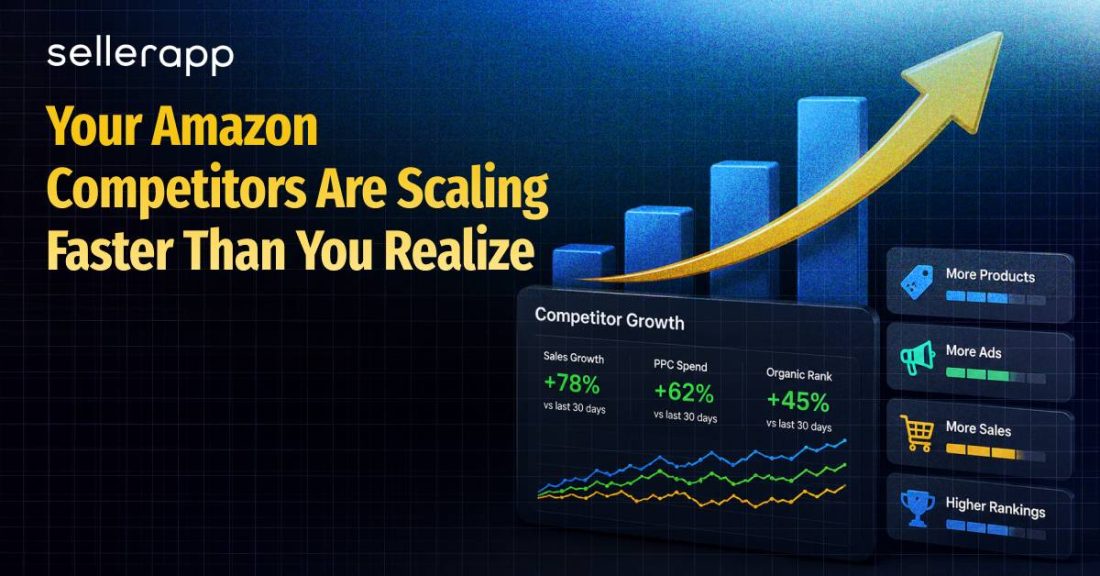
Selling on Amazon in 2026 is no longer just about having a great product, it is about surviving in a marketplace where Amazon competitors are using faster data, smarter ads, and competitive pricing to win customer attention every single day.
At this point, Amazon’s algorithm decides on a slow Thursday that your best-seller no longer deserves page-one placement. You’ve built your business on a platform that controls your traffic, your fees, your customer data, and increasingly, your margins.
Picture this, a home goods seller with a private label brand generating seven figures on Amazon watched their profit per unit shrink from $7.20 to $4.50 over 18 months with the same product, same price, and same sell-through rate. The change here was the ad spend per order that went from $8.20 to $12.54 (industry data from CANOPY Management confirms this trend across the board).
Their ACoS, which sat at a comfortable 22% in 2021, crept to 30% by 2024 as bigger brands and Amazon aggregators flooded into their category with deeper pockets. They were winning the Buy Box and losing the margin war simultaneously. That is the norm in saturated categories in 2026.
And more Amazon sellers than ever are starting to look at Amazon competitors to stop putting all their eggs in one basket.
But here’s the thing, though, Amazon still holds roughly 38% of all US e-commerce sales. Walking away from 310 million active buyers because you’re frustrated makes about as much sense as quitting your job because your boss had a bad week.
The best strategy here is to understand the full competitive landscape and identify where else your business can operate more effectively.
This guide is built for Amazon sellers who want the full picture of who the real Amazon competitors are, how each stacks up on fees, traffic, and seller experience, and, most importantly, which ones are worth adding to your channel strategy in 2026.
Quick Guide
Who Are Amazon’s Top Competitors in 2026?
There isn’t a single company that appears on the Amazon competitors list. What you actually have is a combination of different platforms performing well in the spaces where Amazon is strategically indifferent. To understand who competes with Amazon, you need to segment them correctly.
Here’s how to think about it:
Marketplace rivals (Walmart, eBay): Competing for the same third-party seller inventory and the same buyer pool
DTC infrastructure platforms (Shopify): It is not stealing Amazon’s buyers, but pulling sellers away by offering something Amazon never will: brand ownership
B2B and wholesale platforms (Alibaba, AliExpress): These are operating upstream, supplying the inventory that Amazon’s sellers source
Omnichannel retail competitors (Target, Costco, Best Buy): They are utilizing physical store networks to do things Amazon literally cannot
Niche marketplaces (Etsy, Temu): They are winning in categories where Amazon’s generalist model creates too much noise
Amazon vs Competitors: Full Platform Comparison Table (2026)
Before we get into the platform-by-platform breakdown, here’s the full picture at a glance. You can use this to quickly identify which platforms fit your product category, margin structure, and growth goals.
| Platform | Type | Market Share / Scale | Best For | Key Benefits for Sellers |
| Amazon | Marketplace | ~38% US e-commerce | High-volume sellers | FBA + 310M buyers + ad ecosystem |
| Walmart | Marketplace | ~6–7% US e-commerce | Retail + omnichannel brands | Lower fees, store network, WFS 2-day |
| eBay | Marketplace | ~4–5% US e-commerce | Auctions, used/refurbished | No subscription, 250 free listings/mo |
| Shopify | SaaS / DTC | ~10% US GMV (ecosystem) | DTC brands want control | Full brand ownership + customer data |
| Alibaba | B2B Wholesale | Dominant in global B2B | Bulk sourcing & dropshippers | Trade Assurance + manufacturer access |
| Target Plus | Invite-only market | Top 8 in US retail e-commerce. | Established premium brands | Loyalty programs, curated catalog |
| Etsy | Niche market | Artisan/handmade vertical | Independent creators | $0.20 listing + 3.5% commission |
| Temu | Marketplace | Est. $12B+ GMV (2023) | Price-sensitive buyers | 90-day returns, aggressive promos |
| Best Buy | Retail + online | ~$46B revenue | Electronics sellers | BOPIS, niche buyer trust, less counterfeit |
| Costco | Members-only | $249.6B total sales | Bulk / perishable suppliers | Same-day delivery, minimal markup |
Types of Amazon Competitors (And Why the Segmentation Matters)
Not every Amazon alternative is competing for the same thing. Here’s the breakdown that actually helps sellers make decisions:
1. Direct Marketplace Rivals
Walmart Marketplace and eBay are the closest Amazon competitors in the traditional third-party marketplace sense. The key differences show up in the numbers that actually move your P&L.
Walmart’s ad platform is still maturing, which is where the earned secret lives: Walmart’s search results page only places two paid ads before organic listings take over. On Amazon, ads can occupy the first seven or eight visible results.
That means on Walmart, a well-optimized listing with strong content and WFS fulfillment can rank organically without competing against sellers with $50K/month ad budgets. For established sellers who are tired of pay-to-play, Walmart’s organic visibility is the single most underrated advantage in the e-commerce landscape right now.
2. DTC Platform Alternatives
Shopify, WooCommerce, and BigCommerce pull sellers off Amazon by offering something Amazon won’t: ownership. Not just of the storefront, but of the customer relationship, the email list, the retargeting audiences, and the repeat-purchase data.
The thing sellers on Reddit consistently say about Shopify is that the first year is hard, and then it compounds. The email list you build from your first thousand Shopify customers is worth more in year three than anything you’ve built on Amazon, because Amazon doesn’t give you that list.
Every Amazon customer you serve is Amazon’s customer. Every Shopify customer who buys from you is your customer. That distinction doesn’t show up in month-one revenue. It shows up in CAC and LTV data over three years.
3. B2B and Wholesale Platforms
Alibaba and AliExpress sit upstream of Amazon’s entire seller base. Most US private-label sellers are already sourcing from Alibaba without thinking of it as a competing ecosystem. The sellers who win on Alibaba aren’t just buying at the lowest MOQ.
They’re negotiating exclusivity clauses on specific product configurations, colors, bundle structures, and packaging so that the factory produces a version that no one else on Amazon can replicate cheaply. It’s the sourcing relationship that makes copying it operationally painful.
4. Omnichannel Retail Giants
Target, Costco, and Best Buy use physical store networks in ways Amazon cannot match at scale. But here’s what most sellers are misinformed about: that the buyers who use BOPIS (buy online, pick up in store) are a specific high-intent segment. They’ve already decided to buy.
They’re not browsing for the best deal, as they know what they want, and they want it today. For electronics, home goods, and anything where same-day access matters, that buyer segment converts at a fundamentally different rate than the Amazon window shopper.
5. Niche Marketplaces
Etsy and Best Buy win by going deep instead of wide. The insight that rarely gets said: Amazon’s search relevance algorithm is tuned for transaction speed, not category depth. A buyer searching for a ‘hand-thrown ceramic mug with a blue glaze’ on Amazon will get results ranked by conversion rate and review count, meaning mass-produced items rank above genuinely artisan ones.
Etsy’s search is tuned for exactly the opposite. Category specificity is rewarded. That’s not a bug in Amazon’s model, it’s a deliberate design choice that creates a permanent niche for platforms like Etsy in categories where buyers want craft, not convenience.
Market Share of Amazon vs Its Competitors (2026 Data)
Amazon’s ~38% US e-commerce market share is frequently cited as proof of invincibility. But that number also means that 62% of online purchases are made elsewhere.
That 62% is where Amazon’s e-commerce competitors are building real businesses and where sellers who diversify early are finding less competition, lower ad spend, and healthier margins.
A few data points worth knowing going into 2026:
- Walmart’s e-commerce revenue has grown significantly year over year, now holding approximately 6–7% of US e-commerce share, a number that looked impossible five years ago
- Shopify’s GMV ecosystem accounts for ~10% of US e-commerce, larger than most people realize because it’s distributed across millions of independent storefronts
- eBay holds around 4–5% of US e-commerce, consistent and durable even as the platform doesn’t grow as aggressively as its peers
- Alibaba Group remains the dominant force in global B2B wholesale, operating in 190+ countries and outpacing Amazon’s international marketplace ambitions in Asia
- Temu, barely a blip in 2022, hit an estimated $12+ billion in GMV in 2023 through aggressive pricing, deep discounts, and a 90-day return policy that makes Amazon’s 30-day window look conservative
The data point that should shape your 2026 channel strategy more than any other is that sellers with products in the $50–$200 range on Amazon, with room to build brand equity, is the best-positioned to benefit from multichannel diversification.
Sub-$20 categories are a mosh pit. Above $200, buyer trust requires more brand-building than a marketplace listing alone can deliver. The $50–$200 window is where Walmart, eBay, and Shopify all have a legitimate role to play alongside Amazon.
Top Amazon Competitors: Full Breakdown
Now let’s go deep on each Amazon competitor. For each one, we’ll cover what actually sets them apart, where they fall short, and, most importantly, whether it’s worth your time as a U.S. seller in 2026.
1. Walmart Marketplace
Walmart has always been the heart and soul of American retail. The stat that never gets old is how 75% of Americans live within 10 miles of a Walmart store. That metric alone is an e-commerce asset that Amazon has spent billions trying to replicate with lockers and delivery stations, and it’s still not the same thing.
Walmart’s e-commerce trajectory has been aggressive. Revenue reached nearly $648 billion worldwide by 2024, up 6% year over year. More importantly for sellers, Walmart has been quietly building the infrastructure to support that number.
Walmart’s search page only shows 2 sponsored results before organic listings take over compared to Amazon’s first 7-8 results being ads in competitive categories. Sellers who’ve moved from Amazon to Walmart consistently report that their organic rank moves faster and holds longer because there are 150,000 active sellers competing for it versus Amazon’s 2 million+.
One seller in the Amazon Seller Community reported ranking on page one for a competitive kitchen gadget keyword within 6 weeks of launching on Walmart, a keyword on Amazon that had cost them $14,000/month in ad spend just to stay visible.
What sets Walmart apart from Amazon as a seller channel:
- Walmart has flipped the script by turning stores into fulfillment warehouses, faster last-mile delivery, and lower shipping costs than pure-play e-commerce can achieve
- WFS offers 2-day shipping nationally, directly competitive with Prime
- Referral fees of 6–20% vs. Amazon’s 8–15% plus closing fees, Walmart is often cheaper all-in
- No monthly seller subscription fee (Amazon charges $39.99/month for the Professional plan)
- Quality-controlled catalog limits overcrowding, and sellers who get in get better natural visibility
Who should choose Walmart over Amazon? Established brands that have a proven product and a decent review history and want a less competitive environment with lower advertising spending required. If you’re already profitable on Amazon and you’re looking for your second channel, Walmart is the obvious first call.
2. Costco
Costco operates a completely different model from Amazon, and that’s exactly what makes it a competitor worth understanding. Total sales of $249.6 billion in fiscal 2024 (5% growth year-over-year) on a membership-only model where customers pay $60 or $120 annually just to shop there. Customers who pay to access your products are committed buyers.
Costco’s minimal markup of up to 15% above cost means pricing discipline that creates deep buyer trust. Perishable same-day delivery with a minimum spend of $35 and no extra delivery charges on non-perishables over $75. Their online presence is still growing, but the in-store reputation does enormous heavy lifting.
What sets Costco apart as a seller channel:
- Costco Direct provides additional bulk-pricing discounts, bulk suppliers get a structural advantage that doesn’t exist on Amazon
- Costco handles logistics in-house for accepted sellers, which means less fulfillment complexity for suppliers
- A membership-only model creates a higher-intent, higher-income buyer demographic
If you are a seller with bulk suppliers and manufacturers, especially in perishables, household essentials, and premium goods. If you’re doing B2B volume and your margins require bulk pricing discipline, Costco’s model rewards exactly that.
3. Alibaba
Jack Ma founded Alibaba in 1999 to open China’s wholesale market to the world. What it became is the largest B2B e-commerce platform on the planet, operating in 190+ countries and generating $130.35 billion in revenue in fiscal year 2024. Most U.S. Amazon sellers interact with Alibaba’s ecosystem before they ever launch a product, and it’s usually where the sourcing happens.
Of course, calling Alibaba an Amazon competitor in the traditional sense is a bit of a stretch, since they’re not competing for the same buyers. But they are competing for the same supply chain ecosystem, and Amazon’s AmazonBusiness platform is the closest thing to a direct response to Alibaba’s B2B dominance.
What sets Alibaba apart:
- Primarily B2B , facilitates bulk orders directly between manufacturers and businesses, bypassing the middleman entirely
- Trade Assurance program acts as an escrow-style guarantee, and timely delivery and quality standards are contractually backed
- Product customization options let buyers spec their own packaging, SKUs, and product features, something Amazon’s marketplace model simply doesn’t offer
- Direct manufacturer negotiation on cost, MOQ, and lead times, a lever that Amazon sellers with their own products already use regularly
Who benefits most from Alibaba? Dropshippers, private label sellers, and any business sourcing from Asian manufacturers. If you’re buying from Alibaba and selling on Amazon, you’re already in both ecosystems.
The question is whether you’re fully leveraging what Alibaba’s B2B model makes possible in terms of exclusivity and product differentiation.
4. AliExpress
After dominating B2B, the Alibaba Group launched AliExpress in 2010 as a direct-to-consumer platform, essentially bringing Chinese manufacturing straight to international shoppers. Today, it operates in 200 countries and serves 150+ million active buyers.
The AliExpress value proposition is dead simple: competitive pricing from Chinese manufacturers, direct-to-consumer, with looser documentation requirements than Amazon demands of its sellers. The catch is shipping times. AliExpress uses China’s massive manufacturing and shipping infrastructure, which keeps costs low but isn’t built for Prime-speed expectations.
What sets AliExpress apart:
- Minimal documentation requirements, easier to list than Amazon, which enforces invoice submission and compliance standards
- Ideal dropshipping integration, AliExpress catalogs connect directly with Shopify stores, making it the backbone of the dropshipping ecosystem
- 150M+ active buyers across 200 countries, a genuinely global customer base with price-sensitive behavior that tolerates longer shipping windows
- Pricing that beats Amazon in most categories simply because the supply chain intermediary is cut out
Who should use AliExpress? Dropshippers running Shopify stores, budget-focused sellers testing new product categories without heavy inventory investment, and international sellers targeting markets where Amazon’s reach is thinner. If you’re on the fence about a new product and don’t want to commit to 500 units, AliExpress is where you stress-test the concept.
5. Shopify
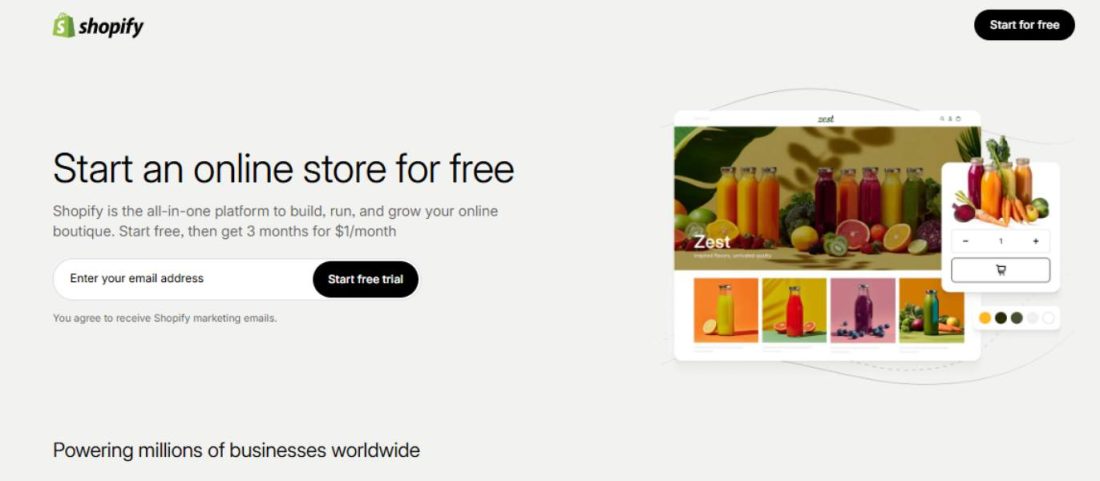
Shopify was founded in 2006 by Tobias Lütke, Daniel Weinand, and Scott Lake, partly out of frustration with the existing e-commerce options at the time. Today, it hosts 5.6 million storefronts across 175 countries, accounts for roughly 10% of US ecommerce transactions, and posted $7.4 billion in revenue in 2024 with 23.2% growth.
Here’s the thing about Shopify that often gets missed in Amazon vs. competitors conversations: Shopify isn’t trying to out-Amazon Amazon. It’s building a completely different value proposition, one where the seller owns everything that Amazon controls.
Brands like Supreme, Skims, Kylie Cosmetics, Gymshark, and Netflix merchandise built their online presence through Shopify, not because it has better traffic than Amazon, but because brand ownership is incompatible with being a commodity on someone else’s marketplace.
What Shopify does that Amazon simply won’t:
- Full access to customer data, email addresses, purchase history, and behavioral data for retargeting. Amazon keeps all of this.
- No direct brand competition, unlike Amazon, which can clone your product and rank its private label next to yours, Shopify has no incentive to compete with its merchants
- Unlimited product listings regardless of plan tier, the Basic plan includes unlimited SKUs
- Comprehensive marketing tools built in: abandoned cart recovery, customizable checkout, blogging, discount codes, and a massive app ecosystem
- Better analytics for traffic sources and attribution, Amazon’s seller dashboard tells you surprisingly little about where your customers come from
Who should prioritize Shopify? Any seller who has built brand recognition, has a repeat purchase product, or is tired of Amazon controlling their customer relationship. Shopify requires you to drive your own traffic, but what you get in return is an asset (your customer list, your brand, your data) that compounds over time. Amazon doesn’t give you that.
6. eBay
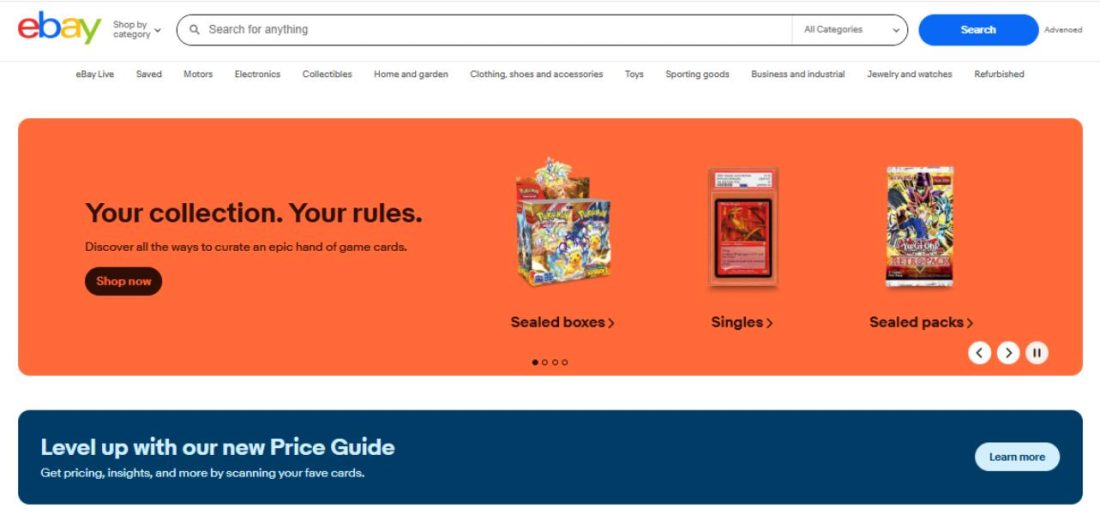
eBay and Amazon grew up together, both launched in the mid-1990s and competed directly for the first decade of e-commerce. While Amazon pulled ahead in new goods and Prime-era convenience, eBay carved out an irreplaceable niche.
The place you go for things you can’t reliably find on Amazon. That positioning has made it one of the most durable e-commerce competitors of Amazon in the used and collectibles space.
A projected $2.576B in 2024 revenue might sound modest compared to Amazon, but eBay’s 1.7 billion+ active listings and presence in 180+ countries tell a story of genuine reach. The 17% growth from 2020 was consistent throughout.
Where eBay genuinely has the edge:
- The auction model is unlike anything on Amazon, buyers compete, prices find their natural market level, and sellers of rare or unique items can capture significant premiums
- 250 free listings per month, no equivalent offer exists on Amazon for third-party sellers
- Final Value Fee of 10% with no closing fees or ambiguous charges, simpler and often cheaper than Amazon’s layered fee structure
- No private label competition, eBay doesn’t launch eBay-brand electronics to undercut your listings
- Best market for used, refurbished, and vintage items, Amazon buyers notoriously expect new-condition products and punish sellers in reviews when something looks pre-owned
- Global Shipping Program handles international logistics automatically for US sellers
Who should choose eBay over Amazon? The electronics resellers, vintage and collectibles sellers, liquidation inventory flippers, and any seller whose margins depend on used-condition goods. If Amazon’s review culture punishes you for the realities of used products, eBay’s buyer expectations are calibrated very differently.
7. Target Plus

Target’s e-commerce vertical has had one of the more impressive growth arcs among omnichannel retailers, rising from $6.6 billion in 2019 to over $22 billion by 2022. Total recorded revenue hit $107.41 billion in 2023, and Target’s loyalty ecosystem (Circle rewards plus the REDcard) creates buyer retention that Amazon Prime simply doesn’t replicate in the same social-proof, habitual way.
Target Plus is invite-only and deliberately so. That selectivity is the product. By controlling what enters its marketplace, Target maintains the curated reputation that makes its catalog trustworthy to shoppers who’ve been burned by Amazon counterfeits and knock-off listings.
What makes Target Plus different:
- An invite-only model means the sellers who get in operate in a lower-competition environment, with fewer sellers fighting for the same shelf space
- No hidden fees or ambiguous charges, Target Plus fee structure is transparent in a way Amazon’s isn’t
- Circle loyalty program and REDcard create a deeply loyal buyer base that returns out of habit, not just because the algorithm served them your product
- True omnichannel capability: buy online, pick up in store, same-day delivery, easy in-store returns. Amazon can’t match this without a physical retail footprint of Target’s scale
In June 2024, Target and Shopify announced a partnership that brings select Shopify merchants into Target Plus’s catalog. If you’re already on Shopify with a quality brand, this opens a legitimate path into Target’s ecosystem without going through the traditional invite process.
You should aim for Target Plus if you are an established brand with a clean track record, quality-first products, and a brand story that fits Target’s positioning. This is for brands that have built something and want premium retail distribution to match.
8. Best Buy
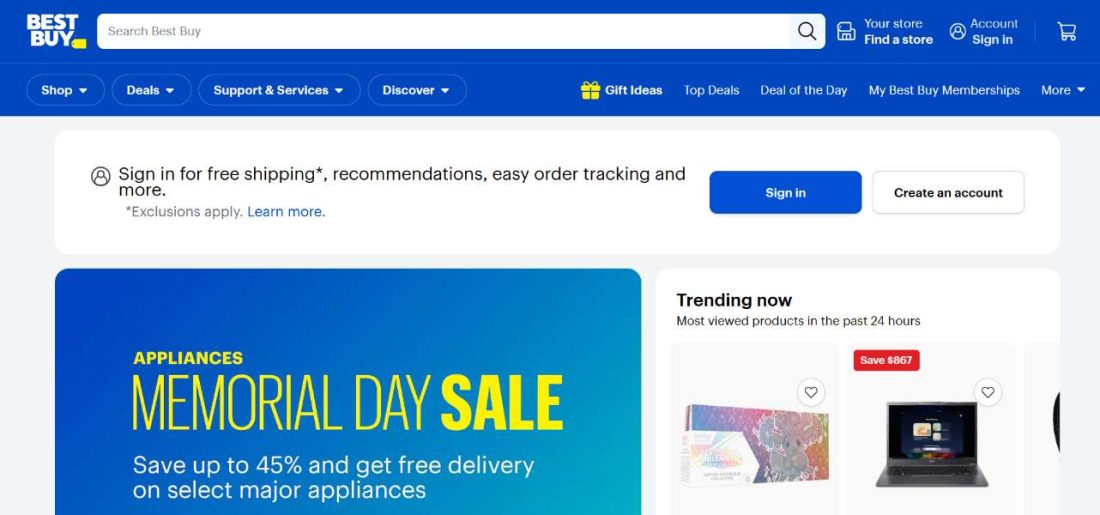
Best Buy has been the go-to name in electronics retail since 1966 and, in 2022, posted roughly $46 billion in revenue. More recently, they’ve rolled out Totaltech, a $199.99/year subscription offering discounted pricing, 24/7 tech support, and up to 2-year warranties. Sound familiar? It’s Best Buy’s answer to Amazon Prime, tailored specifically for the electronics buyer demographic.
For Amazon sellers in the electronics category who have dealt with counterfeit competition, review bombing, and the nightmare of Amazon’s own electronics listings sitting next to theirs, Best Buy offers something genuinely different: a category-specific audience with high purchase intent and lower tolerance for fakes.
What Best Buy offers sellers:
- Niche electronics audience, buyers coming to Best Buy are already in electronics-purchase mode, which improves conversion rates compared to Amazon’s broader browsing traffic
- Brand reputation lift, being on Best Buy’s platform carries implied quality certification that Amazon’s open marketplace can’t offer
- BOPIS (Buy Online, Pick Up In Store) and same-day delivery options , critical for electronics buyers who don’t want to wait 2 days and want to touch the product before they commit
- Lower counterfeit risk, Best Buy’s vetting process reduces the chance of a knock-off sitting next to your listing at a lower price
- Less likely to face private-label competition from the platform itself
Who should consider Best Buy? Established electronics brands and sellers looking for an omnichannel presence with better brand protection than Amazon currently provides. If your category is plagued by counterfeit competition on Amazon, Best Buy’s curated approach is a meaningful differentiator.
9. Etsy
Etsy exists because Amazon is too noisy for buyers who want something made by a human, not a factory. In 2023, Etsy posted approximately $2.6 billion in revenue, a 25% CAGR from 2020 to 2023, driven entirely by growing buyer appetite for handmade, vintage, and custom goods.
For the right seller, Etsy is a better fit. Buyers on Etsy self-select for craftsmanship and uniqueness. They’re not comparing your handmade ceramic mug to 47 factory-produced alternatives at half the price. They came specifically for what you make.
What Etsy offers that Amazon doesn’t:
- Listing fee of $0.20 per item plus 3.5% commission, structurally cheaper than Amazon for small-volume, high-margin artisan goods
- Buyers with entirely different expectations, Etsy shoppers expect handmade, accept small-batch production timelines, and review based on artisan quality rather than Amazon’s ‘received in 2 days, works as described’ standard
- Quick setup with a Facebook login, capitalizing on seasonal trends is faster and cheaper than setting up new Amazon listings
- Discount code tools for repeat purchase, simple marketing infrastructure that doesn’t require Amazon’s ad ecosystem
- Storefront customization options that let you actually build a brand aesthetic, something Amazon’s listing pages never allow
Handmade sellers, independent artists, custom goods creators, and vintage curators should try Etsy. If your product can’t be mass-produced without losing its value proposition, Etsy is where your buyer lives. Trying to sell artisan goods on Amazon is like showing up to a farmer’s market inside a Walmart.
10. Temu
Temu launched in 2022 as a subsidiary of PDD Holdings (parent company of Chinese e-commerce giant Pinduoduo) with one goal as to capture price-sensitive buyers in markets where Amazon’s pricing is vulnerable. It went from $290 million GMV in 2022 to an estimated $12.26 billion in 2023.
The Temu model is simple and aggressive: ultra-low prices on everyday goods, free shipping, an unheard-of 90-day return window, and localized marketing in markets where Amazon’s hold is weaker. For sellers on Amazon who compete in the price-sensitive end of any category, Temu is the competitor that crept up fastest.
What makes Temu different from the other Amazon e-commerce competitors:
- The direct manufacturer-to-consumer model removes the middleman markup, sellers communicate directly with buyers without platform intermediation on price
- 90-day return window vs. Amazon’s 30 days, a significant buyer confidence differentiator that removes purchase hesitancy
- Aggressive promotional campaigns and shopping credits for bulk orders create repeat purchase behavior through incentives rather than habit
- Focuses on trending, high-velocity items, if your product is in a category Temu has identified as hot, you will feel the price pressure
- Targeting emerging markets and geographies where Amazon’s logistics advantage is less pronounced
Any seller in a low-to-mid-price-point category where Amazon buyers are already price-sensitive should consider Temu. Temu isn’t a channel most established US sellers will add to their portfolio, but it is a competitive threat that’s putting downward pressure on pricing across several categories. Know your enemy.
Best Amazon Alternatives for Sellers: How to Actually Choose
Here’s the structure that actually helps sellers stop thinking about which platform is ‘best’ and start thinking about which platform solves your specific problem.
Every seller who’s frustrated with Amazon is frustrated about something specific, like high ad costs, low organic visibility, counterfeit competition, lack of brand control, or fear of account suspension. Different platforms solve different problems.
Channel Diversification Framework
- Volume + Discovery = Amazon stays in your mix.
- Brand ownership + customer data = add Shopify.
- Lower competition + omnichannel = add Walmart Marketplace.
- Used/refurbished/niche inventory = add eBay.
- Premium brand + invite = target, Target Plus.
- Artisan/handmade = go all-in on Etsy.
The sellers who are actually winning in 2026 are using Amazon for what it’s good at (volume, discovery, FBA logistics) and building equity on platforms that give them brand ownership and customer data. That combination is more resilient than any single-platform strategy.
A few practical notes for sellers
- Don’t add platforms all at once. Each new channel requires operational attention, separate inventory, separate customer service, and separate listing optimization. Add one at a time and get it profitable before expanding.
- Walmart first, then eBay or Shopify. For most established Amazon sellers, Walmart is the lowest-friction second channel. The catalog overlap is high, WFS is familiar if you use FBA, and the fee structure is comparable.
- Shopify is a long game. The brand-building payoff is real, but dn’t expect Amazon-level traffic in month one. Build your email list from day one, that’s the asset that makes Shopify compound over time.
- eBay is underrated for liquidation. If you have overstock, returns, or B-grade inventory, eBay moves it faster and with less price pressure than selling it on Amazon at a discount.
Final Thoughts
Amazon isn’t going anywhere, and neither are its competitors. What’s changing is the risk analysis of single-platform dependency.
Every seller who’s had their account suspended, their bestseller hijacked, or their ad spend doubled while returns halve knows exactly what that risk feels like. The platforms covered here, Walmart, eBay, Shopify, Alibaba, Target, Etsy, Temu, Best Buy, and Costco, aren’t consolation prizes. They’re real channels with real buyers and, in several cases, better ROI than Amazon for specific product types and business models.
The question isn’t whether Amazon is still worth selling on because it is. The question is what you’re building on top of it. A seller with Amazon for volume, Shopify for brand equity, Walmart for a second marketplace channel, and eBay or Etsy for a niche segment is running a resilient business. A seller whose entire revenue runs through one Amazon account is running a risk.
Of course, knowing the competitive landscape is step one. Executing across it is where most sellers get stuck in different platforms, different ad systems, different fulfillment logic, and different listing requirements.
And for such situations, SellerApp’s Full Account Management service handles the complexity for you. Whether you’re running a seven-figure Amazon business and ready to expand to Walmart or you’re looking to bring your Amazon PPC efficiency up before you diversify, our team of e-commerce specialists works directly in your account, not alongside it.
Here’s what we handle:
- Amazon PPC and Sponsored Products optimization, cutting wasted ad spend, improving TACoS, and building keyword strategies that hold organic rank
- Amazon DSP (Demand-Side Platform): DSP is where sellers who’ve maxed out their sponsored products’ efficiency go next.
- Listing optimization
Book a free strategy call with the SellerApp team and find out what your account’s real growth ceiling looks like and what’s holding it down.
FAQs: Amazon Competitors
Walmart, eBay, and Shopify are Amazon’s closest US competitors. Walmart competes in marketplace share, eBay dominates the used-goods niche, and Shopify pulls sellers away from Amazon by offering brand ownership. Globally, Alibaba remains the dominant force in B2B wholesale.
In marketplace saturation terms, yes. Walmart has around 150,000 sellers compared to Amazon’s 2 million+, which means less competition for approved sellers. Walmart’s e-commerce revenue grew 27% YoY in Q3 2024, and its “75% of Americans within 10 miles” store footprint gives it a last-mile advantage Amazon is still trying to match.
Not in the traditional buyer-traffic sense since Shopify doesn’t provide a built-in audience. But it competes directly for sellers. More than 5.6 million merchants have chosen Shopify because owning customer data, controlling branding, and avoiding Amazon private-label competition matters more than borrowed traffic.
It depends on the product category. Walmart Marketplace works well for general goods, eBay for used or refurbished products, Shopify for brand-building, Etsy for handmade products, and Best Buy for electronics where counterfeit concerns matter. The right platform depends on margins, audience, and fulfillment strategy.
More relevant than many people think. eBay’s auction model, 1.7 billion+ listings, presence in 180+ countries, and 250 free listings per month still make it a strong platform for used goods, collectibles, and liquidation inventory. Amazon buyers prioritize speed and convenience, while eBay buyers are more comfortable with condition-based purchasing.
Amazon controls roughly 38% of US e-commerce. Shopify’s ecosystem accounts for about 10% of GMV, Walmart holds 6–7%, and eBay around 4–5%. Together, competitors make up the remaining 62% of the market, which is where many multichannel sellers are finding lower competition and stronger margins.