

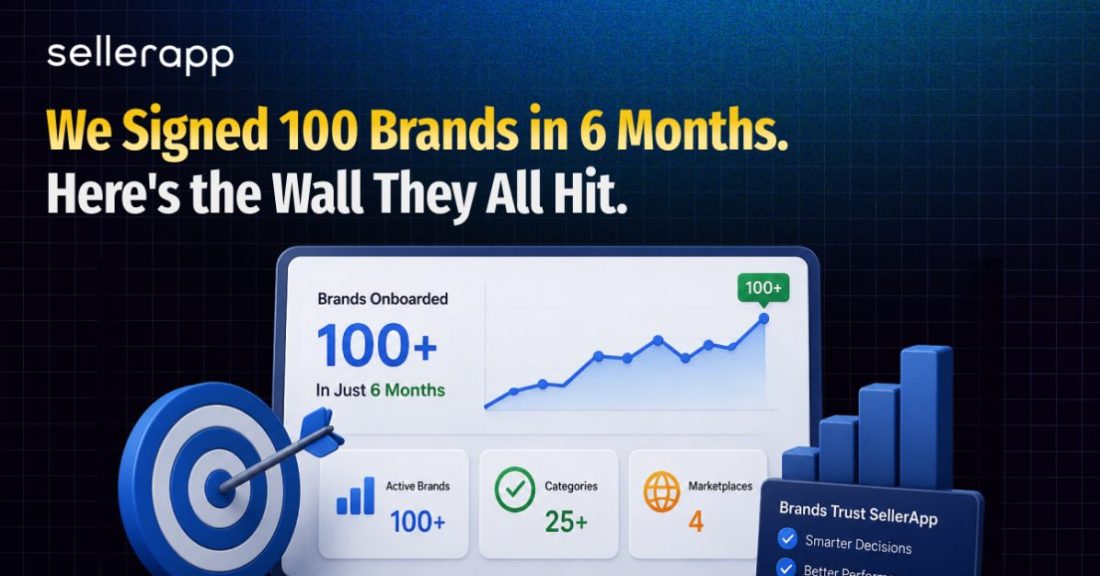
We closed 100 enterprise clients in the first six months of 2026. A hundred, in two quarters, all for Amazon DSP.
We’re giving ourselves one sentence to enjoy that, so this is it.
Now the number that actually runs this article. Across all hundred accounts, more than 60% of the revenue we drove came from people who had never bought the brand before.
Not repeat buyers we chased with retargeting. Not shoppers already reaching for their wallet. First-time customers, at a volume these brands had spent years being told was out of reach.
That one number told us something almost every one of them had missed. Their Sponsored Products campaigns had stopped growing, and they were still shoveling money in. We call the thing they hit the search ceiling. This is what it is and what to do about it.
If you’ve been weighing Amazon DSP against Sponsored Products, or asking whether DSP is worth it at your spend, this is the same answer we give our own clients.
Here’s our 100-client scoreboard
| What we did | The numbers that matter |
| Enterprise DSP clients closed in H1 2026 | 100 |
| Average new-to-brand rate across those accounts | Above 60% |
| Platform-average new-to-brand rate, for comparison | 36.5% |
| Share of conversions that were DSP-assisted | 42% |
| Share of voice growth within six months | Tripled |
We didn’t get there with a trick. We got there by putting the next dollar where it still compounds, at the exact moment the economics flipped. Here’s the walk-through.
More spend stops buying more growth the day you max out search
Almost every Amazon brand runs on one belief. Spend more, grow more. It isn’t a dumb belief. It’s precisely how the platform pays you back, right up until it doesn’t.
Sponsored Products does one job, and it does it well. It puts you in front of people already searching for your Amazon product category. But there are only so many of those people. Once your campaigns have caught them, you’ve reached the edge of what search will ever give you.
Push past that edge and the math flips on you. You start paying more for clicks you were already winning. Our own State of Amazon Advertising 2026 benchmark report, which we built from $3 billion in managed ad spend and then held against 28 independent sources to keep ourselves honest, found Sponsored Products CPC climbed 15.5% year over year to $1.12 while conversion sat flat.
(Source: SellerApp State of Amazon Advertising 2026, published June 2026. Built on $3B in managed spend across 33,000+ brands, cross-referenced against 28 independent sources including Amazon Ads, Statista, and 26 other independent sources including our competitors like Skai, Pattern.)
That’s the ceiling. It doesn’t mean you failed at search. It means you won at search and used it up.
Your next search dollar returns less than your next DSP dollar
This is where the money leaks, and it’s a logic point, so stay with me.
These brands didn’t overspend. We want them spending more, not less. The trouble is where the next dollar goes. On a maxed-out search campaign, your hundred-thousandth dollar buys a fraction of what your ten-thousandth bought, because you already won the easy conversions and now you’re paying top bids to chase the stragglers. That’s diminishing returns, and it’s not an opinion, it’s arithmetic.
So the question was never “should we spend less.” It was “does the next dollar do more in search, or somewhere we haven’t drained yet.” For a brand at six figures a month, that somewhere is almost always DSP.
Most brands read this exactly backwards. They hit the ceiling, mistake flat growth for under-spending, and pour more into the one channel with the least left to give. It feels like the responsible call. It’s the most expensive one on the table.
In Q1 2026, DSP became cheaper per click than Sponsored Products
For years, there was a fair reason to keep money out of DSP. It cost more, and it was a nightmare to justify to finance. That reason is dead, and most of the market hasn’t noticed the funeral.
Our research caught something that hadn’t happened in the five years we’ve tracked this. In Q1 2026, DSP became cheaper per click than Sponsored Products. DSP clicks grew 156% year over year, and its share of total Amazon ad spend rose from 17.7% to 23.4% across 2025.
Now put that next to the ceiling.
The channel that reaches 95% of shoppers who aren’t searching for you is now cheaper per click than the channel where you’ve run out of people to reach. The marginal-dollar math isn’t close anymore. It’s lopsided. That’s why a hundred brands moved, and most of them moved before their competitors ran the numbers.
DSP rewards scale, so here’s the spend line where it starts working
We’d rather tell you the truth than sell the whole room. DSP pays off at scale, and under a certain spend it’s the wrong tool.
| Monthly Amazon ad spend | What we’d tell you |
| Under $10k | Not yet. Tighten search, grow the catalog first |
| $10k to $50k | DSP starts to make sense, mostly self-serve |
| $50k to $250k | Full-funnel DSP viable, best efficiency zone opens |
| $250k and up | DSP is essential, ACoS tightens to 18 to 28% |
Under that line, wait. There’s no shame in it. But if you’re already spending six figures on Amazon, you’re past it, which is exactly where all hundred of these brands were standing when they called us.
Six in ten new customers is what that next dollar actually bought
Cheaper clicks are worth nothing if they don’t hand you customers you didn’t already have. Which is the entire point of that opening number. New-to-brand rate above 60% across the hundred, against the 36.5% platform average our research documents.
That’s the new-customer growth search physically cannot produce once you’ve captured the searchers. Our data doesn’t hedge on this. New-to-brand acquisition is DSP’s structural advantage, and no other Amazon format brings in first-time buyers at that scale.
One thing separates the brands who scale from the brands who only spend. Our research shows how hard the math swings by category.
| Category | Converts at | On a click of | What it means |
| Grocery | 15.57% | $0.58 | Cheap reach, fast flywheel |
| Electronics | 4.60% | Higher | Only works on a ~$104 basket |
Run one identical playbook across both and you’ll overfeed one and starve the other. That’s the generalist’s mistake, and at six figures a month it gets expensive fast.
Reaching new buyers is the easy half. Proving it is what unlocks a bigger budget.
Reaching new people is the visible half of the job. The half that gets your budget increased is proving the spend was incremental, that DSP added sales instead of taking credit for ones search would have closed anyway.
Our research shows why the scrutiny gets sharp here. Full managed DSP becomes viable around $250,000 a month, which is also where incrementality testing through Amazon Marketing Cloud stops being optional and becomes something the board expects. At that spend, a blended monthly report isn’t a reporting style. It’s a number nobody wants to stand up and defend.
The fix is structural, not clever. Attribution has to separate DSP-assisted, DSP-only, and DSP-to-search purchases, so you can point at exactly what the channel added. Across these hundred accounts, that split showed 42% of conversions as DSP-assisted, the figure that gets a budget increase signed.
As Nithin Mentreddy, who runs our customer success, puts it, a number you can’t take apart is a number you can’t defend.
Every lesson from the 100, in one table
Six months, a hundred accounts, the same lessons on repeat. Here they are, each mapped to the fix.
| The mistake we kept seeing | What actually works |
| Reading flat growth as under-spending | Treat it as diminishing returns, move the next dollar |
| Pouring more into maxed-out search | Shift budget to DSP while it’s cheaper per click |
| One DSP playbook across every category | Match the playbook to category economics |
| Reporting blended numbers to the board | Prove incrementality with AMC-split attribution |
| Chasing revenue at any cost | Grow only where cost of sales holds flat |
That last row is the rule under all the others. Growth only counts if your margins live through it. TubShroom took DSP from zero to 35% of total revenue in six months while advertising cost of sales stayed flat, which is proof the revenue was new, not lifted out of Sponsored Ads.
A gaming-chair brand that had run search dry grew revenue six times in five months by reaching people mid-stream on Twitch, buyers who were weeks from ever searching the category.
Most agencies can’t run DSP this way, and won’t
We’ll be straight about the model, because it explains both the results and our limits.
Most agencies run DSP as a set-and-forget line item, and we get why.
Done right, it needs a senior strategist in the account every day, not a junior stretched across forty logins. It needs someone who reads the category math, watches the pacing, and rebuilds the attribution when the board asks a harder question. That’s expensive to staff and it doesn’t scale to hundreds of accounts per head, so most shops just don’t.
We built the opposite way on purpose, and it caps how many brands we can take. A worse business in a spreadsheet. A better campaign in the account.
What to do next, whether you call us or not
Stop reading a growth stall as an under-spending problem. It’s diminishing returns, and the fix isn’t less budget, it’s the next dollar aimed where you haven’t drained the well.
Be honest about whether you’ve actually maxed search. If you have, treat it as a graduation, not a failure. Move budget into DSP while it’s still cheaper than search, build attribution that proves what it added, and respect the category math instead of running one playbook everywhere.
That’s the whole lesson from our first hundred, handed over in full.
None of it needs us.
Where we come in is the part teams find hardest, running it well when the standard agency won’t. Tell us where you are and we’ll pull your campaign data and show you where the next dollar belongs, before you spend it.
Frequently Asked Questions
As of Q1 2026, yes, on a cost-per-click basis. In our State of Amazon Advertising 2026 research, DSP became cheaper per click than Sponsored Products for the first time in the five years we’ve tracked it, while DSP clicks grew 156% year over year.
When search stops growing no matter how much budget you add. Once you’ve captured the shoppers already searching your category, every extra search dollar returns less. Our data shows DSP becomes genuinely viable in the $10k to $50k monthly range and hits peak efficiency above $250k a month.
The platform average is 36.5% by our research. Well-run, full-funnel DSP campaigns can push above 60%, meaning six in ten purchases come from customers who have never bought the brand before.
Amazon’s own managed service generally requires a $35,000 monthly commitment. Specialist agencies can bring the same depth to brands spending less.