


Amazon DSP campaign performance is harder to evaluate than native reports make it seem. Campaign-level metrics can show spend, conversions, and attributed revenue, but they rarely reveal whether DSP is acquiring new customers, influencing Sponsored Ads conversions, or simply reaching the same shoppers repeatedly.
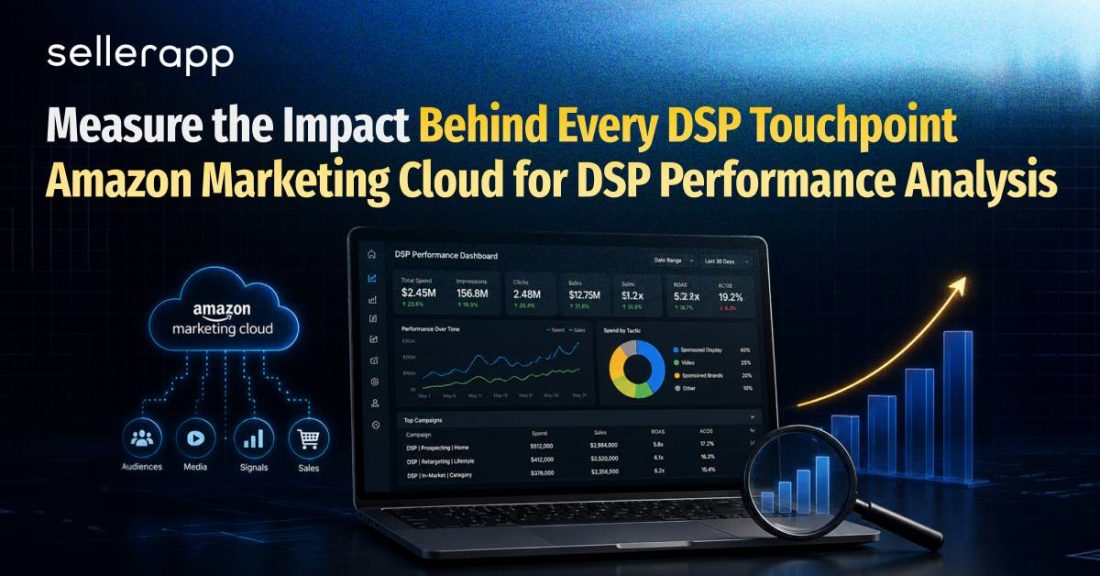
SellerApp’s 2026 Amazon Advertising Benchmark Report, based on $3B+ in managed ad spend across 33,000+ brands, shows why deeper analysis matters as DSP takes a larger role in Amazon advertising. Amazon Marketing Cloud (AMC) helps connect the missing pieces, allowing advertisers to analyze customer journeys, cross-channel interactions, audience overlap, and new-to-brand acquisition instead of optimizing campaigns on attributed metrics alone.
In this guide, you’ll learn how Amazon Marketing Cloud helps evaluate Amazon DSP performance beyond standard attribution metrics, which AMC analyses matter most, and how SellerApp combines DSP reporting with AMC insights to turn complex campaign data into faster, more informed optimization decisions.
Quick Guide:
What Is Amazon Marketing Cloud? (A Brief Overview)
Amazon Marketing Cloud (AMC) helps advertisers see how their Amazon Ads work together, connecting customer interactions across campaigns to reveal what drives conversions and growth. The difference is important because native DSP reporting measures campaign performance, while AMC explains customer behavior across campaigns.
Native Amazon DSP reporting focuses primarily on campaign-level performance, measuring metrics such as impressions, clicks, conversions, and attributed revenue.
While these metrics indicate how individual campaigns performed, they rarely explain how customers moved between advertising channels before converting or whether a campaign generated incremental business outcomes.
The Limitations of Native DSP Reporting
Amazon DSP reporting provides valuable operational metrics, but campaign optimization becomes increasingly difficult as advertising strategies expand across multiple channels.
What Native DSP Reports Show
Native DSP reports provide campaign-level metrics such as impressions, clicks, spend, and attributed conversions. For advertisers running multiple campaigns, these metrics make it possible to monitor individual campaign performance and manage day-to-day delivery.
The problem is that each campaign is largely evaluated on its own.
Where Campaign-Level Reporting Falls Short
Consider a brand running prospecting campaigns through Amazon DSP while simultaneously investing in Sponsored Products and Sponsored Brands. Native reports can show how each campaign performed independently, but they cannot explain how those campaigns influenced one another.
For example:
Did a DSP campaign introduce customers who later converted through Sponsored Products?
Are multiple campaigns competing for the same audience?
Is increasing frequency improving conversions, or simply inflating media costs?
These are customer-journey and cross-channel questions that campaign-level reporting alone cannot answer.
The Cost of Optimizing in Silos
This limitation becomes more important as advertising costs rise. SellerApp’s benchmark report found that platform-wide CPM increased by 47.46% year over year to $7.82, while CPA declined by 5.65%, conversion rates improved to 11.02%, and ROAS increased to 3.14x.
The data shows that higher media costs do not necessarily mean lower advertising efficiency. Instead, performance increasingly depends on how effectively advertisers allocate budgets, coordinate channels, and interpret customer behavior.
Why Customer-Journey Context Matters
Optimizing individual campaigns without understanding their contribution to the broader customer journey can lead to misleading conclusions.
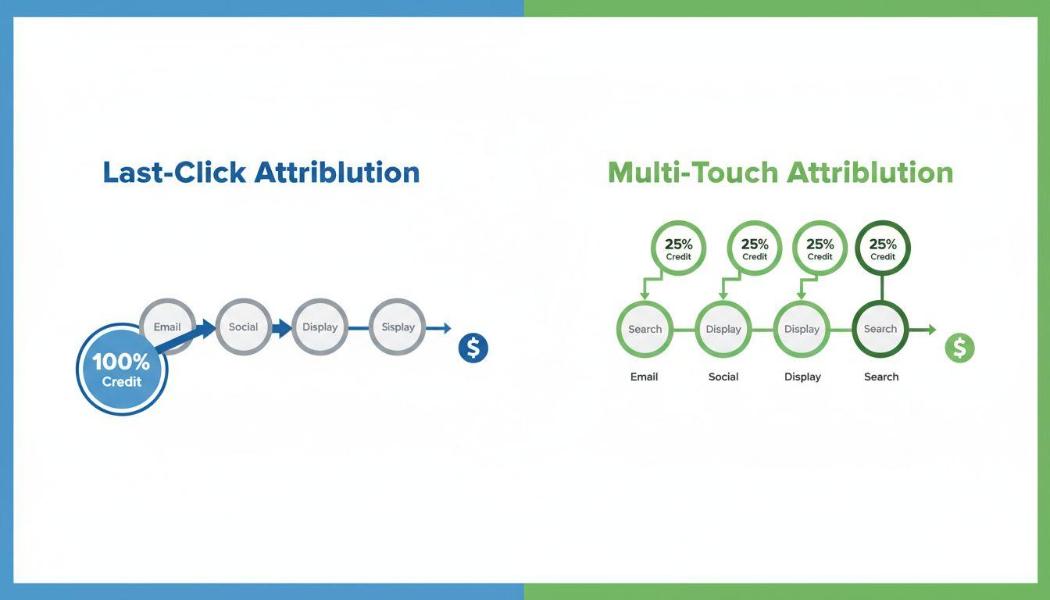
A campaign that appears inefficient under last-touch attribution may, in reality, play a critical role in introducing new customers or influencing future conversions. Without that context, advertisers risk cutting campaigns that contribute to growth simply because another channel received the final conversion credit.
Integrating DSP Data With Amazon Marketing Cloud
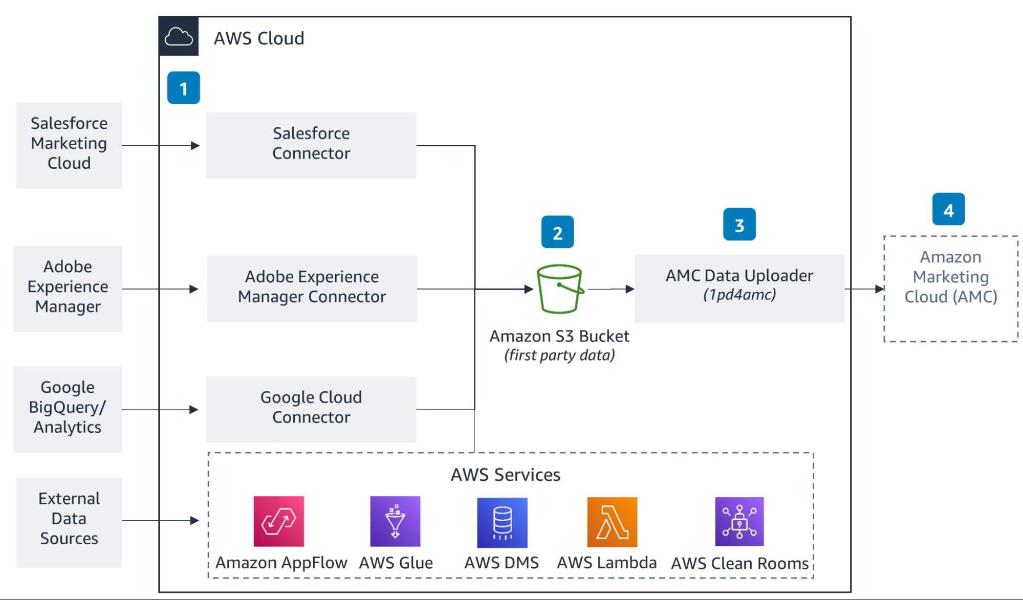
AMC connects advertising exposure, engagement, and conversion data across Amazon Ads, allowing advertisers to evaluate how channels work together instead of independently. Rather than asking which campaign generated the last click, advertisers can evaluate which combination of touchpoints produced incremental business impact.
Eligibility and Account Setup
Before running customer journey analyses, advertisers should verify that their AMC instance is correctly configured. Without complete campaign and conversion data, analyses such as audience overlap and new-to-brand attribution may produce incomplete insights.
Data Sources Ingested Automatically
AMC automatically combines advertising signals generated across supported Amazon advertising products, including Amazon DSP and Sponsored Ads.
For example, DSP impression data can be connected with Sponsored Products clicks and conversion events to reconstruct complete customer journeys. Instead of evaluating attribution at a single touchpoint, advertisers gain visibility into how multiple campaigns collectively influence purchasing decisions.
Instance Configuration Checklist
Before relying on AMC insights, advertisers should verify that their instance is configured correctly.
AMC Instance Configuration Checklist
Before running customer journey or attribution analyses, verify that your AMC instance has the data required for the questions you want to answer.
- Connect all relevant advertising accounts so the required Amazon Ads data is available for analysis.
- Confirm campaigns are actively contributing data to the AMC instance.
- Verify conversion events are available for the campaigns and analyses you plan to evaluate.
- Check data completeness before relying on audience overlap, new-to-brand, customer journey, or cross-channel analyses.
A complete configuration helps ensure that AMC analyses reflect customer behavior accurately rather than producing conclusions from incomplete datasets.
The AMC Analyses That Actually Improve DSP Performance
Amazon Marketing Cloud becomes valuable when it helps answer specific campaign questions that native DSP reporting cannot resolve. For DSP advertisers, the most actionable analyses help determine whether campaigns are reaching new audiences, how DSP contributes to conversions across Sponsored Ads, whether multiple campaigns are competing for the same shoppers, and when additional frequency stops adding value.
Use these analyses to answer four practical questions:
- Are my DSP campaigns expanding reach or repeatedly reaching the same audiences? Media Overlap Analysis identifies audience duplication across campaigns.
- Is DSP contributing to conversions that happen through Sponsored Ads? Path-to-Purchase analysis shows how customers move across advertising touchpoints before converting.
- Is DSP actually acquiring new customers? New-to-Brand analysis separates first-time buyers from returning customers.
- Am I reaching audiences too frequently? Reach & Timing analysis helps identify optimal frequency and audience saturation.
These analyses turn AMC from a reporting tool into a decision-making layer for audience allocation, campaign sequencing, customer acquisition, and frequency optimization.
Understand Whether Your Campaigns Are Expanding Reach or Repeating It
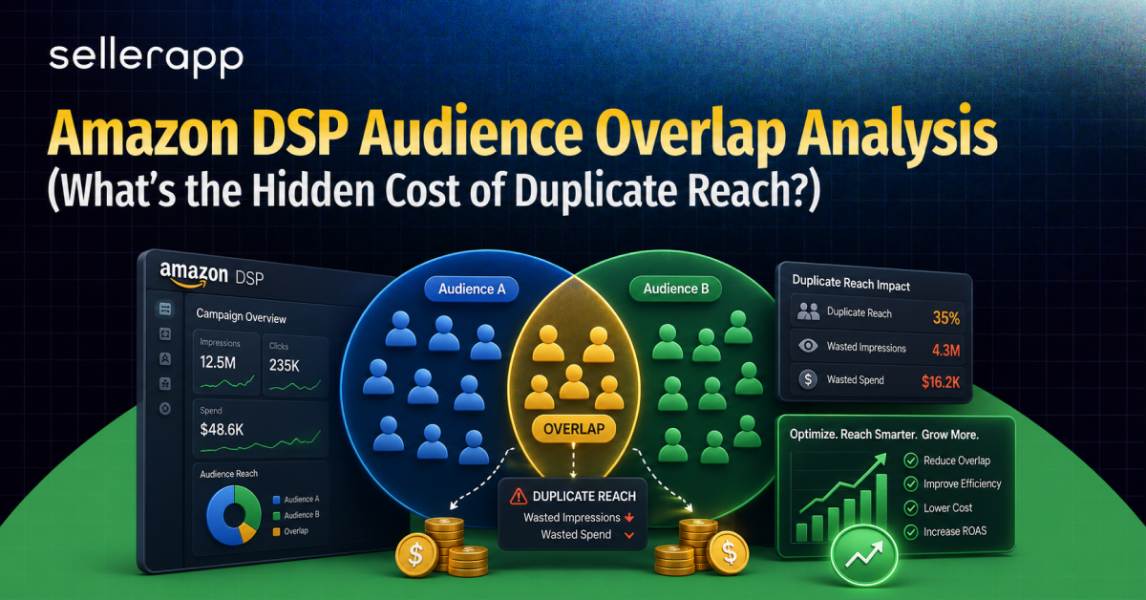
Campaign-level metrics often hide audience duplication. This often results in budget inefficiencies that remain invisible in campaign-level reports. Two DSP campaigns may both report healthy performance while serving impressions to the same group of shoppers. Increasing spend under these conditions raises frequency without necessarily increasing incremental reach. AMC’s Media Overlap Analysis reveals how audiences intersect across campaigns, helping advertisers distinguish between genuine audience expansion and repeated exposure.
SellerApp brings these AMC insights into dedicated modules, including Media Overlap, Path-to-Purchase, New-to-Brand, Reach & Timing, Channel Synergy, and Query Studio. These modules help advertisers identify overlapping audiences, understand customer journeys, measure new-customer acquisition, optimize frequency, evaluate cross-channel performance, and explore custom analyses without relying solely on native DSP reporting.
Reconstruct the Customer Journey Instead of Measuring the Final Click
Last-touch attribution rewards the final interaction before purchase, but customers rarely convert after a single advertising touchpoint.
For example, a shopper might first see a DSP prospecting ad for a product, return a few days later after seeing a Sponsored Brands ad, and eventually click a Sponsored Products ad before purchasing. If you only look at the final conversion, Sponsored Products gets the credit while the earlier DSP and Sponsored Brands interactions disappear from the picture.
Reconstructing these journeys manually can be difficult. Advertisers would need to connect interactions across campaigns, identify recurring conversion paths, compare time-to-purchase, and determine which sequences are associated with stronger outcomes. As campaign and channel volume grows, doing this through separate reports and raw datasets becomes increasingly time-consuming.
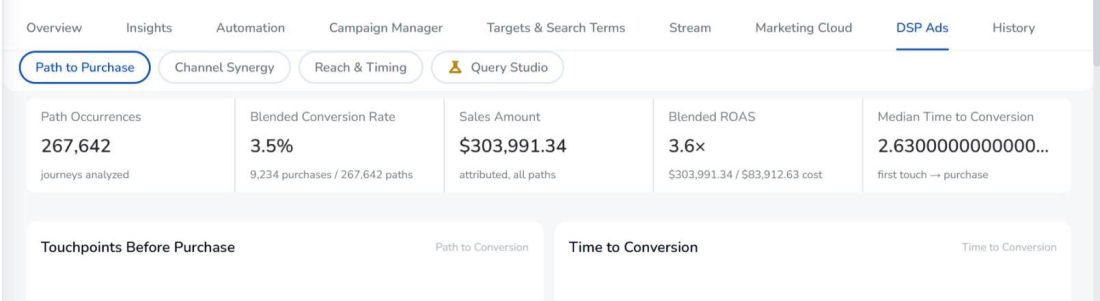
AMC’s Path-to-Purchase analysis reconstructs these customer journeys, showing which combinations of touchpoints consistently occur before conversion and how long customers take to purchase.
SellerApp makes these insights easier to act on through its Path-to-Purchase module, which turns the analysis into an interactive customer journey view with conversion paths, blended ROAS, and time-to-purchase metrics. Instead of manually stitching together AMC data, advertisers can identify high-performing customer journeys and use those insights to refine campaign sequencing and investment decisions.

Separate Customer Acquisition From Customer Retention
Revenue alone doesn’t indicate business growth. An account can report strong ROAS while relying heavily on repeat purchasers. AMC’s New-to-Brand analysis distinguishes first-time buyers from returning customers, allowing advertisers to evaluate whether prospecting campaigns are actually expanding the customer base.
This distinction has become increasingly important. SellerApp’s benchmark report found that 36.5% of Amazon DSP-attributed purchases came from new-to-brand customers, demonstrating DSP’s growing role as a customer acquisition channel.
Within SellerApp, these insights are connected directly to campaign performance, helping advertisers identify the audiences, creatives, and campaigns responsible for acquiring new customers instead of optimizing solely around attributed revenue.
Optimize Frequency Before It Becomes Waste
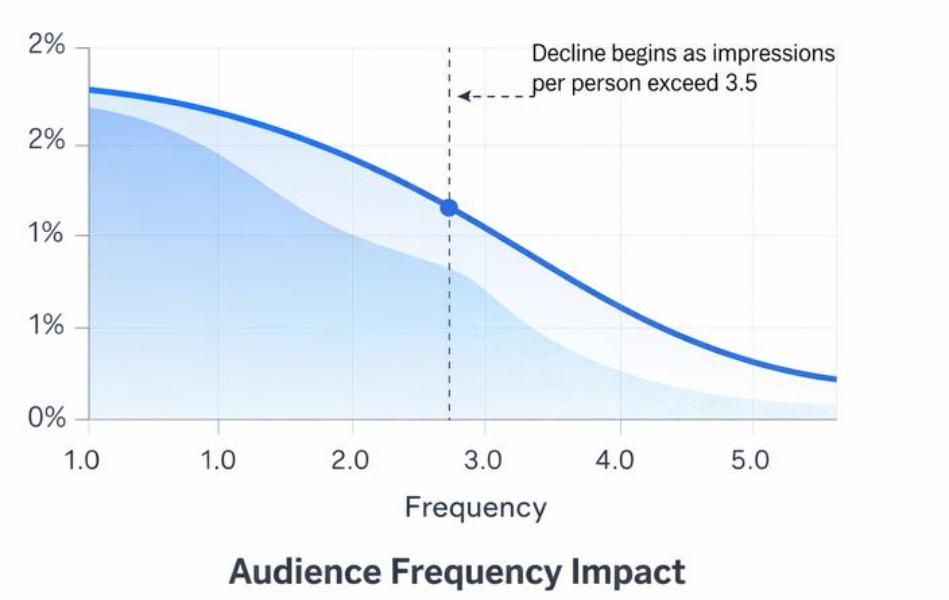
More impressions do not automatically improve performance. Beyond a certain threshold, additional exposure often increases costs without generating proportional gains in conversions.
AMC’s Reach & Timing analysis helps advertisers determine how frequently different audiences should be reached, when engagement is highest, and where impression saturation begins.
SellerApp visualizes these insights through unique reach, optimal frequency, hourly engagement trends, and audience saturation metrics, enabling advertisers to balance visibility with efficiency rather than relying on fixed frequency caps.
Measure How DSP and Sponsored Ads Work Together
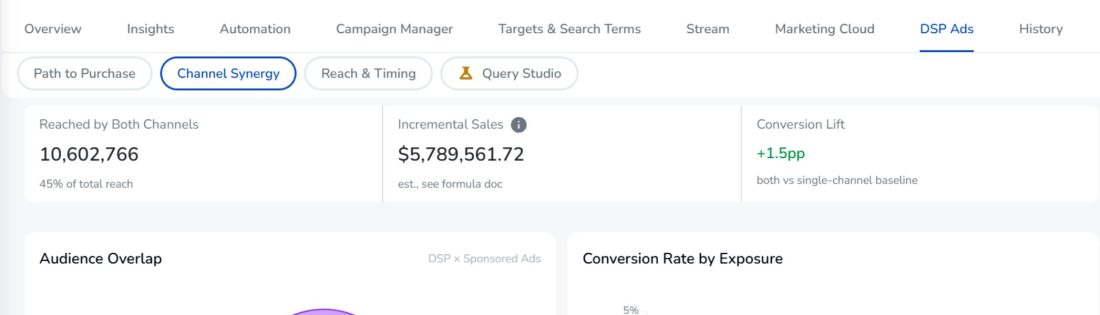
Many advertisers evaluate DSP and Sponsored Ads independently, even though customers interact with both throughout the buying journey. AMC’s Channel Synergy analysis measures audience overlap, conversion lift, and the combined contribution of multiple advertising products. Instead of asking which campaign received credit for the sale, advertisers can understand how channels support one another.SellerApp surfaces these relationships in a dedicated Channel Synergy dashboard, allowing teams to evaluate incremental sales, audience overlap, and cross-channel performance without manually building AMC queries. This shifts budget allocation from channel-level optimization to full-funnel optimization.
Applying AMC Insights to Optimize DSP Campaigns
AMC insights are most useful when they lead to a specific campaign decision. Instead of reviewing each analysis as another report, use the findings to identify what is limiting performance, determine what needs to change, and then measure the outcome.
Step 1: Identify Audience Overlap Before Increasing Spend
Start with Media Overlap Analysis to determine whether multiple DSP campaigns are reaching the same shoppers.
For example, if two prospecting campaigns show similar conversion performance but have substantial audience overlap, increasing spend across both may increase frequency without meaningfully expanding reach.
What to do: Refine audience segmentation, exclude overlapping audiences where appropriate, or redistribute budget toward campaigns that provide incremental reach.
Step 2: Map the Customer Journey Before Cutting Upper-Funnel Campaigns
Use Path-to-Purchase to understand how customers interact with DSP and Sponsored Ads before converting.
For example, if customers frequently see a DSP ad, later engage with Sponsored Brands, and finally convert through Sponsored Products, evaluating DSP only on last-touch ROAS can make the campaign appear less valuable than its role in the overall journey suggests.
What to do: Evaluate the full conversion path before reducing DSP investment, and adjust campaign sequencing based on the journeys that consistently lead to conversions.
Step 3: Separate Customer Acquisition From Retention
Use New-to-Brand analysis to determine whether DSP campaigns are bringing in first-time customers or primarily converting existing buyers.
A campaign can deliver strong ROAS while contributing relatively little to customer acquisition if most of its purchases come from returning customers.
What to do: Identify campaigns and audiences that contribute to new-to-brand purchases and balance acquisition-focused investment against retention activity.
Step 4: Adjust Frequency Based on Audience Response
Use Reach & Timing to identify how frequency affects audience engagement and where additional impressions begin to produce diminishing value.
Instead of applying the same frequency cap across every audience, use the analysis to understand where audiences are becoming saturated.
What to do: Adjust exposure levels by audience and reduce unnecessary impressions where additional frequency is not contributing meaningful value.
Step 5: Evaluate DSP and Sponsored Ads Together
Use Channel Synergy to understand how DSP and Sponsored Ads contribute to the same customer journey.
The analysis can reveal audience overlap, conversion lift, and the combined contribution of multiple advertising products.
What to do: Shift budget decisions from isolated channel ROAS toward the combined contribution of DSP and Sponsored Ads.
Step 6: Investigate Custom Questions With Query Studio
When the standard analyses do not answer a specific business question, use Query Studio to explore the underlying data through custom analysis.
This is particularly useful when you need to investigate a campaign, audience, or customer journey beyond the questions covered by the standard AMC analyses. The article positions Query Studio alongside the other AMC capabilities as part of the optimization workflow.
What to do: Use custom queries to investigate specific performance questions, then bring the findings back into campaign optimization.
Turn AMC Findings Into Campaign Decisions
The goal is not to generate more AMC reports. It is to turn each finding into an action: reduce overlap, change campaign sequencing, prioritize customer acquisition, adjust frequency, or reallocate budget.
SellerApp brings these analyses together with campaign performance reporting, making it easier to move from customer-level insights to campaign-level decisions without manually reconciling multiple datasets.
Common Pitfalls and Constraints to Consider
Amazon Marketing Cloud can provide deeper analysis than native reporting, but its findings still need to be interpreted within the limits of attribution, data availability, and analysis methodology.
Don’t Treat Attribution as Proof of Incrementality AMC can show how advertising touchpoints appear across a customer’s journey, but that does not prove that every touchpoint caused the purchase.
For example, a customer appearing in a multi-touch conversion path does not mean each campaign contributed equally to the outcome. Use AMC findings alongside campaign objectives and broader business outcomes rather than treating attributed interactions as evidence of incremental sales.
Account for Privacy Thresholds
AMC applies privacy thresholds that can suppress reporting for small audience groups. This means highly segmented analyses may return incomplete results, particularly when the audience being analyzed is small.
Before acting on an analysis, check whether the available dataset is sufficiently complete to support the conclusion. Avoid making optimization decisions based on limited results that may not represent the broader audience.
Keep Query Logic Consistent
Custom AMC queries can produce different results when you change attribution windows, audience definitions, or filtering logic. Even small differences in query construction can make performance comparisons difficult to interpret.
Use standardized query templates and consistent reporting definitions when comparing campaigns or tracking performance over time. This makes changes in the results easier to attribute to actual campaign performance rather than changes in methodology.
Use AMC Alongside DSP Reporting
AMC is not a replacement for native Amazon DSP reporting. The two serve different purposes.
Use DSP reporting to monitor operational performance such as delivery, pacing, spend, and campaign health. Use AMC when you need deeper analysis of customer journeys, cross-channel interactions, audience behavior, or other questions that campaign-level reporting cannot answer.
The strongest workflow combines both: DSP reporting tells you what is happening operationally; AMC helps explain the broader customer and advertising context behind it.
Final Takeaway: From Attributed Metrics to Proven Impact
As brands invest across DSP and Sponsored Ads, understanding how customers move between touchpoints has become essential for making informed advertising decisions.
Amazon Marketing Cloud provides that visibility by connecting campaign interactions, audience behaviour, and conversion paths into a unified analytical framework.
Rather than relying solely on last-touch attribution, advertisers can evaluate incremental customer acquisition, measure cross-channel influence, and identify the campaigns that genuinely contribute to business growth.
SellerApp extends these capabilities by combining Amazon DSP reporting with AMC analyses such as Path-to-Purchase, Channel Synergy, Reach & Timing, and Query Studio in a single workspace. Instead of spending valuable time exporting reports, writing repetitive SQL queries, and manually reconciling datasets, advertisers can focus on interpreting insights and acting on them.
As SellerApp’s 2026 benchmark report demonstrates, advertisers continued improving efficiency despite rising advertising costs because better measurement led to better decisions. Competitive advantage comes from understanding which insights matter and acting on them faster than everyone else.
Frequently Asked Questions
It depends on the questions you’re trying to answer. Native Amazon DSP reports are useful for monitoring campaign delivery, spend, and attributed conversions. However, if you want to understand how customers move across DSP and Sponsored Ads, measure new-to-brand acquisition, or evaluate incremental impact, Amazon Marketing Cloud provides insights that standard DSP reporting cannot.
Amazon DSP is where you build, launch, and optimize advertising campaigns. Amazon Marketing Cloud is where you analyze how those campaigns influenced customer behavior. In simple terms, DSP helps you run campaigns, while AMC helps you understand whether those campaigns are actually driving business growth.
This is one of the biggest challenges with upper-funnel advertising. DSP often introduces customers who later convert through Sponsored Products or Sponsored Brands. Because native reporting typically attributes credit to the last interaction, DSP can appear less effective than it actually is. Amazon Marketing Cloud helps advertisers evaluate the complete customer journey instead of relying solely on last-touch attribution.
Not always. Amazon Marketing Cloud offers pre-built analyses that allow advertisers to answer common questions about customer journeys, audience overlap, new-to-brand acquisition, and cross-channel performance without writing custom queries. Advanced or highly specific analyses may require SQL, depending on the question and level of customization needed.
Attributed sales alone don’t answer that question. Amazon Marketing Cloud’s New-to-Brand analysis separates first-time purchasers from existing customers, helping advertisers evaluate whether DSP campaigns are expanding their customer base or primarily driving repeat purchases. This is especially important for brands focused on long-term growth rather than short-term conversion metrics.