


Target return pallets are one of the quieter money-makers in the liquidation-reselling world. Now, Amazon return pallets may get all the YouTube thumbnails and TikTok hype, but people who actually do this will tell you Target merchandise flips just as well if not better.
Mostly because the product mix skews toward home goods and apparel that hold resale value instead of electronics that depreciate the second someone cracks the seal.
Interestingly, products found in Target return pallets also tend to be in good condition. Way more in comparison to Amazon’s pallets.
And of course, when it comes to the opportunity itself, there’s strong potential to establish proper flipping or reselling business using these return pallets as a source.
For example, Target is a $106 billion company with over 2,000 stores. Nearly eight out of ten American shoppers are Target customers. And with retail return rates around 16.6 percent, billions of dollars worth of good products cycle back through reverse logistics every year.
Target can’t restock all of it, so they liquidate through authorized partners, and resellers who buy Target returns pick it up for 20 to 30 cents on the dollar. Now, that’s the basic pitch and an overall glimpse into this domain. However, the reality is always going to be bit more nuanced and challenging which is why this guide may come in handy.
TL;DR
- Target return pallets are bulk lots of customer-returned and overstock merchandise sold through liquidation platforms at steep discounts.
- You can buy Target returns through B-Stock, Direct Liquidation, Select Liquidation, BULQ, and several others covered below.
- Prices range from $100 at auction to $600 or more. Realistic ROI is 30 to 60 percent if you buy manifested and verify resale value.
- Start local, start small, don’t buy unmanifested until you know what you’re doing.
Quick Guide:
What Are Target Return Pallets and Why Are They Worth Your Attention
Before you dive in and start Googling how to buy Target pallets, it helps to understand what you’re actually looking at here.
The concept behind these Target Return Pallets is fairly simple. When a customer returns an item to Target, whether in-store or through Target.com, that product enters a reverse logistics pipeline.
Meaning, Target’s team inspects the item, tags it with a condition grade, and decides whether relisting makes sense. More often than not, it doesn’t. Maybe the margin is too thin, or the season passed, or the item’s been opened.
If you’ve ever wondered how to buy pallets from Target, understanding this journey matters.
Once the inspection is done. Those products get bundled into bulk lots, loaded onto standard 48 by 40-inch pallets, and routed to authorized liquidation partners such as B-Stock.
What makes Target pallets more appealing compared to Amazon’s is the quality and the overall product mix. Home decor, apparel, beauty, toys, and seasonal merchandise. These are items people actively search for on Facebook Marketplace, Poshmark, and eBay.
A Threshold bookshelf or a set of Hearth and Hand kitchen items carries brand recognition that translates to buyer trust. That’s not something you consistently get with random Amazon products.
Target also uses Gaylord packaging for most pallets, essentially one giant box fitting the pallet dimensions. You can actually filter it by this on liquidation platforms. It’s important to note that this type of packaging protects contents way better than stacked and wrapped. Fewer damaged items mean more sellable inventory for you.
Where to Buy Target Return Pallets for Sale
This is the part that matters most. Especially, as sourcing these pallets from the wrong sources can have terrible consequences.
There are legitimate platforms where you can buy Target returns, and they each operate differently. Additionally, there’s no such thing as the “perfect one”. The right one for you solely depends on your budget, your experience, and how much uncertainty you can stomach.
B-Stock (Target Auction Liquidations)
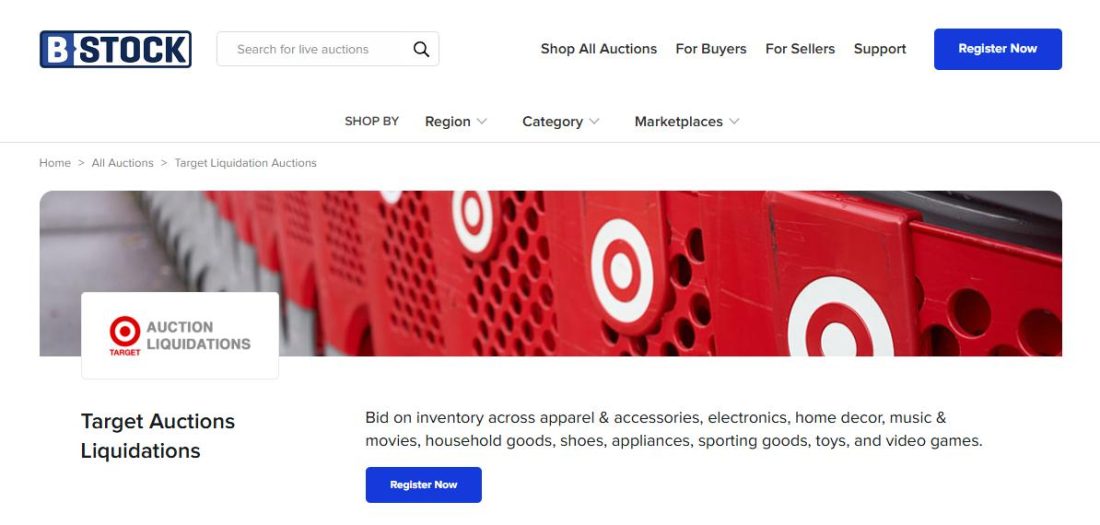
B-Stock is Target’s official liquidation channel, where returned and overstock inventory is sold in bulk through a managed auction marketplace. If you want to get as close to buying directly from Target as possible, this is it.
How does B-Stock work?
The process is pretty straightforward. You register with a resale certificate, browse auctions listing category, condition, estimated retail, and shipping origin, and bid against other buyers.
You also gain access to manifests that are detailed enough to download into a spreadsheet and run your own numbers before committing. Typically, Target pallets come in truckload (24 pallets) and LTL (one to twelve pallets) options..
Oh, and one thing that doesn’t get enough attention is that B-Stock also offers Target electronics in boxed quantities at fixed prices, shipped via UPS instead of freight.
Genuinely big deal for smaller resellers who don’t want to deal with liftgates. But this is as uber competitive segment. So, you need to be on your toes when it comes to placing your bids.
What’s the catch?
Target requires delabeling on some liquidated merchandise, meaning you will have to remove Target branding and price stickers before reselling.
This isn’t complicated, but it can be a bit tedious, and most people don’t find out until the pallet is already in their garage.
With respect to the platform, competition has also gotten noticeably stiffer. Prices aren’t what they used to be on B-Stock. You can that TikTok for that.
Pros:
- Official Target liquidation partner with best manifest transparency
- Fixed-price electronics option shipped UPS
Cons:
- Resale certificate required
- Delabeling adds labor
- Competitive auctions drive prices up
Who’s this platform best for?
Serious resellers who want full visibility into Target return pallets for sale and can compete on price.
Direct Liquidation
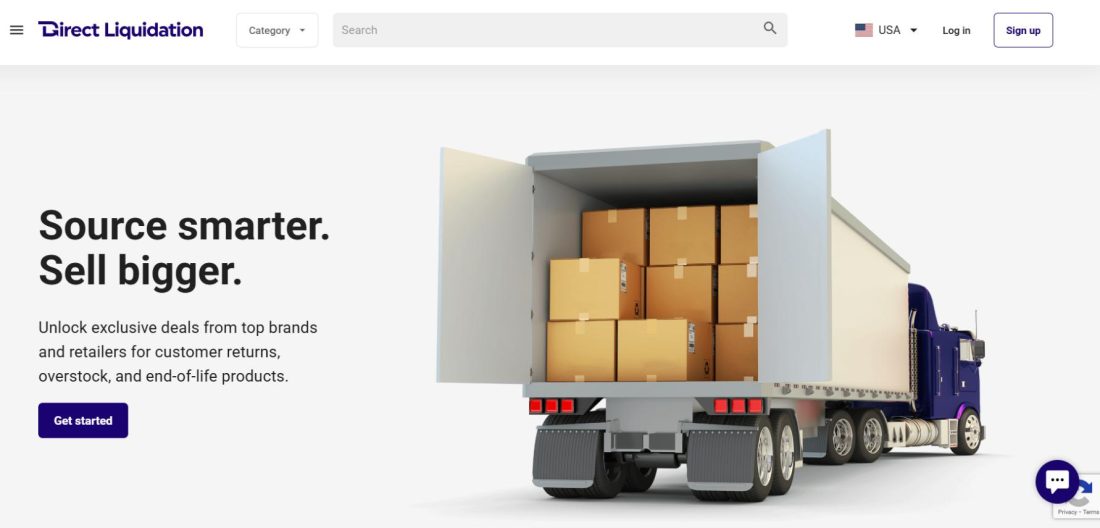
Direct Liquidation is a a multi-retailer liquidation marketplace that sources customer returns and overstock from Target, Amazon, Walmart, and other major retailers all under one roof. It’s one of the more popular platforms and is pretty reliable.
How does Direct Liquidation work?
You browse pallets from multiple retailers through a single interface. Manifests are detailed, lot sizes are more approachable than B-Stock, which essentially means that you can test categories without committing thousands upfront.
If you’ve been looking to buy Target returns online through other channels and want a more structured experience, Direct Liquidation makes that switch painless.
What’s the catch?
Appliance pallets are a recurring headache. Kitchen goods and small appliances consistently arrive missing power cords and accessories.
It’s best you budget an extra $3 to $5 per item for replacements if you’re going heavy on those categories.
Pros:
- Multi-retailer sourcing under one roof
- Smaller lot sizes for testing
Cons:
- Appliance accessories frequently missing
- Slightly higher per-unit cost
Who’s this platform best for?
Resellers who want variety across retailers and prefer smaller commitments.
Select Liquidation
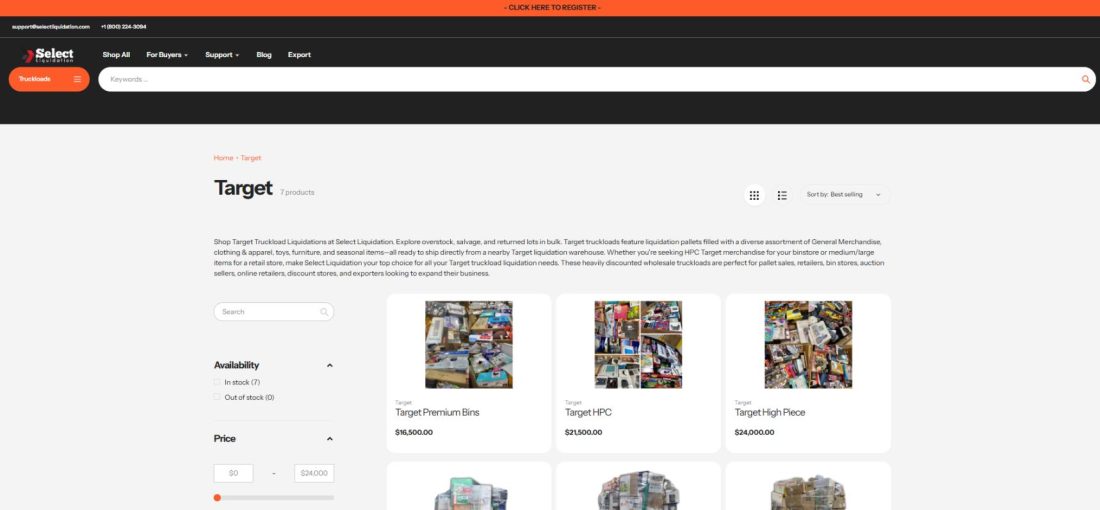
Sellect Liquidation is a liquidation company that specializes in Target truckloads sourced directly from Target distribution centers. This is where the bigger operators shop.
How does Select Liquidation work?
They source straight from Target DCs in North Carolina, Pennsylvania, Indiana, Arizona, and California. Truckloads range from 900 to 15,000 units across 24 pallets, with estimated retail between $160,000 and $200,000 depending on category.
Everything from general merchandise and HPC pallets to premium mixed loads and DC salvage.
If you’re past the testing phase and ready to buy Target returns at serious volume for a bin store or multi-channel operation, Select Liquidation is built for that.
What’s the catch?
No returns or exchanges. At all. Once you buy, it’s yours. You need to know what you’re doing and have enough capital to absorb a bad load. This is not a beginner platform, and that’s fine.
Pros:
- Direct from Target distribution centers
- Massive lot variety
Cons:
- No returns or exchanges
- High minimum investment
Who’s this platform best for?
Bin store owners and high-volume resellers who need consistent Target inventory at scale.
UpLiquidation
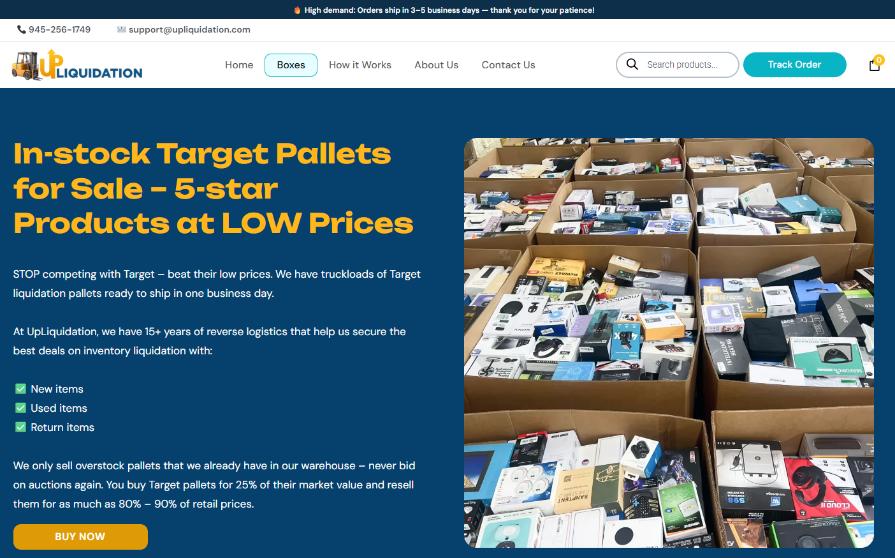
UpLiquidation is a wholesale liquidation company with 15 years in reverse logistics that sources Target pallets for sale directly from Target, Amazon, Walmart, and Home Depot. If you’ve already established a proper reselling business then this is your best supplier.
How does UpLiquidation work?
They only sell inventory they physically have in their warehouse. Meaning, you won’t have to deal with auction waiting games. The process is quick and efficient. You’ll be able see what’s available, buy it, and they ship within a business day.
Refill time is also pretty consistent. For example, with B-Stock you could be staring at the 0 pallets available for weeks on end. With UpLiquidation you can expect new inventory drops every seven days.
This is where those TikTok Live sellers, Whatnot streamers, eBay operators, and bin store owners source from.
What’s the catch?
This one might be a bit irritating, but payments are only wire transfer only. And because they sell warehouse stock rather than running auctions, you don’t get the same opportunity to snag below-market deals. However, although the prices are pretty much fixed, they do tend to be fair.
Pros:
- Ships within one business day
- No auction or bidding process
Cons:
- Wire transfer only
- Fixed pricing, no negotiation
Who’s this platform best for?
Resellers who want speed and certainty over auction dynamics.
888Lots
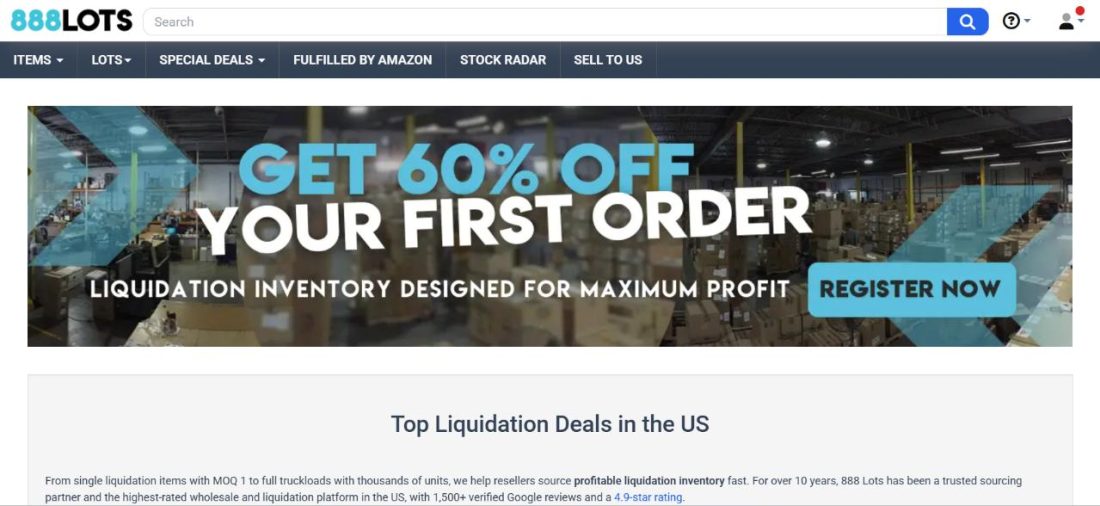
888Lots has been in this game for quite a while. This is a proper liquidation platform built around manifest transparency, designed specifically for resellers who want to see exactly what they’re buying before they spend money.
Works particularly well for people still learning how to evaluate Target return pallets.
How does 888Lots work?
Low minimums, 60 percent off your first order, and manifests with ASINs, UPCs, review scores, and sales rank.
That level of detail before you spend a dollar is genuinely useful if you’re still figuring out which categories deserve your money.
What’s the catch?
Condition isn’t guaranteed. Items marked “used” or “damaged” can mean anything from a scuffed box to something that doesn’t turn on. The manifest transparency compensates at this price point, but you need to be comfortable with variability.
Pros:
- 60 percent off first order
- Extremely detailed manifests with sales rank
Cons:
- Condition quality inconsistent
- Smaller catalog
Who’s this platform best for? Newcomers who want data before committing money.
Quicklotz
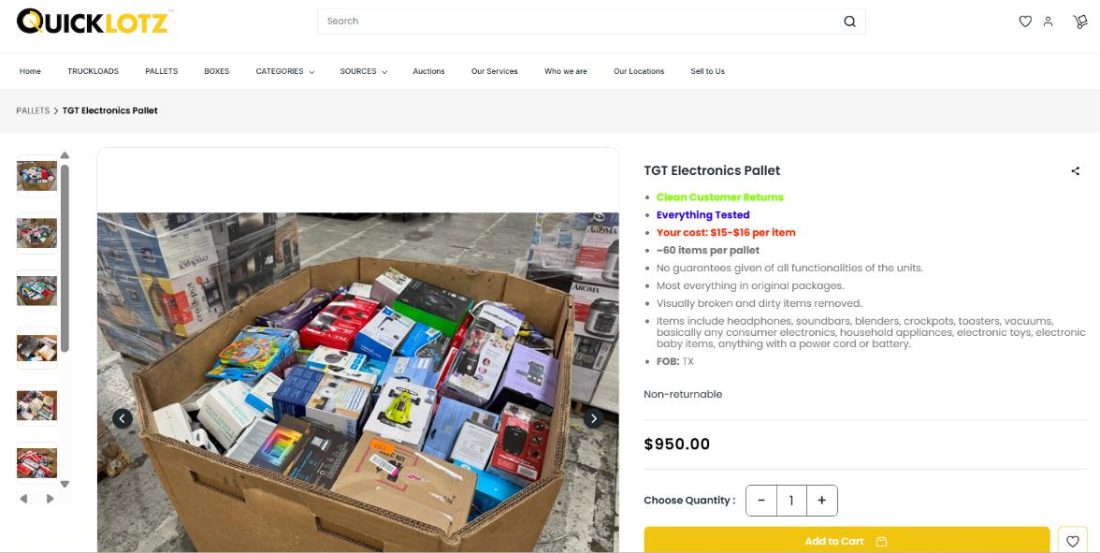
A wholesale liquidation company selling Target return pallets and truckloads with strong customer support for people just getting started.
How does Quicklotz work?
A pallet of returned goods worth $4,000 at market price can be found on their site for as little as $2,000. They walk you through the process, offer support throughout, and claim many items arrive brand-new with original packaging and tags.
If navigating B-Stock’s auction interface makes you break out in hives, Quicklotz is designed to feel more like regular online shopping.
What’s the catch?
The hand-holding comes with higher pricing than auction platforms. You’re paying for convenience. Perfectly reasonable trade-off when learning, but you’ll probably graduate to better per-unit economics as you gain experience.
Pros:
- Beginner-friendly experience
- Customer support throughout
Cons:
- Higher pricing than auction platforms
- Less manifest detail
Who’s this platform best for? First-time resellers looking to buy Target returns who value guidance over raw deal hunting.
Local Warehouses and Bin Stores
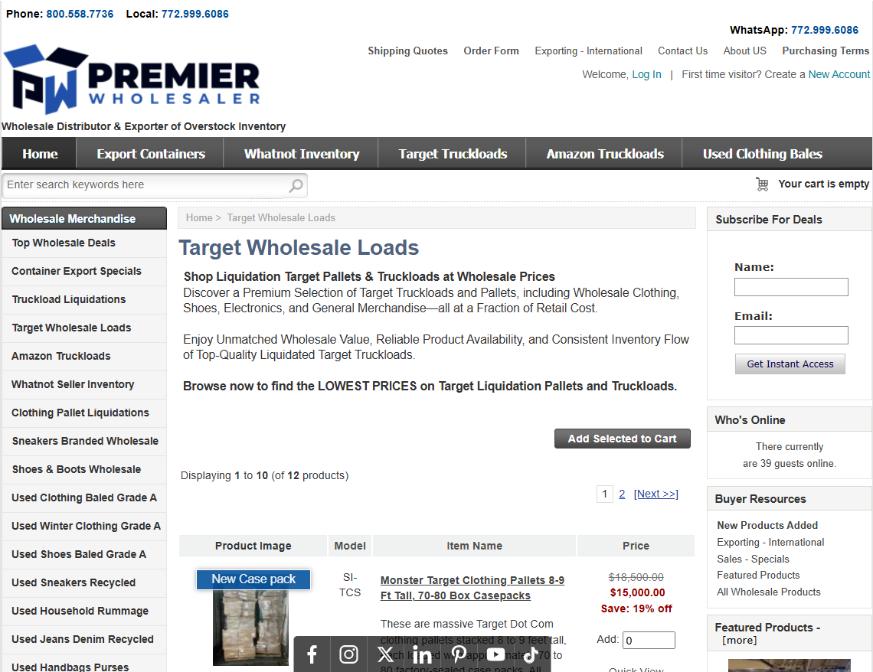
Regional liquidation warehouses and discount bin retailers that buy truckloads of Target returns and either resell them by the pallet or dump them into low-cost dig bins for individual customers.
How do these work?
LiquidationMap.com helps you find vetted liquidators nearby. Show up, inspect Target pallets for sale near me with your own hands, negotiate, and load your truck. No freight. The real edge is relationships. Staff who see you weekly start tipping you off about Target loads before they go public.
Bin stores chop truckloads into $1 to $14 dig bins. It’s chaos, but it’s the batting cage of pallet flipping. Low investment, real practice.
Pros:
- Zero freight costs I
- nspect before you buy
- Relationship-driven early access to inventory
Cons:
- Geographically limited
- Requires truck or cargo van
- Inventory inconsistent week to week
Who’s this platform best for?
Local flippers who want hands-on control and long-term supplier relationships.
Facebook Marketplace and eBay
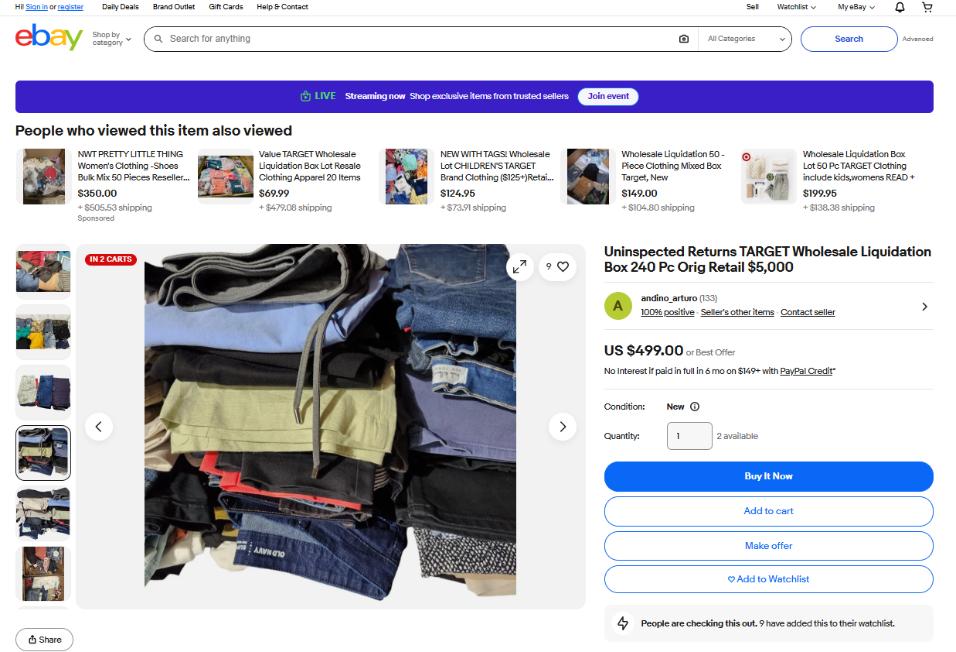
Facebook Marketplace and eBay are more peer-to-peer platforms where individual resellers and small liquidators list Target return pallets for local pickup or regional shipping.
How do these work?
Search for “Target return pallets” in your area, message the seller, and arrange pickup. This doubles as a Target returns buy opportunity since many small liquidators list excess inventory here before larger platforms.
What’s the catch?
If you can’t physically see the pallet before buying, assume the best stuff is already gone. Look for unloading videos and verified buyer feedback.
We’ve seen too many cases of someone buying a “mystery pallet” and ending up with damaged goods that should’ve hit the dumpster months ago.
Those TikTok creators showing off amazing hauls? They don’t necessarily have your best interest at heart. Develop your own instincts.
Pros:
- Same-day local pickup
- No platform fees
Cons:
- High risk of cherry-picked inventory
- No guarantees
Who’s this platform best for?
Experienced buyers who can spot value in person and walk away from bad deals.
How to Buy Target Pallets Step by Step
Knowing the platforms is table stakes. This is what separates people who make money from people who donate half their garage to Goodwill.
Step 1: Start with manifested lots. Always.
If you’re an absolute newbie, it’s always best to start with pallets that have a manifest list. Especially, as these lists show every item with condition, MSRP, and retail category. Pull three to five items and check eBay sold listings. Not “listed at” prices. Actually sold prices and not MSRP. Which is pretty much a fairy tale. At the end of the day, sold data is the absolute truth.
Step 2: Match the platform to your situation.
While B-Stock, Upliquidation, and Select Liquidation are the go-to platforms for veterans, 888Lots and Quicklotz are perfect for beginners.
If you’re at the business validation stage and figuring out if buying Target returns is for you, it’s best to find a local bin store, spend $200 or even $500, and learn the process before scaling.
The “Double or Nothing” rule applies here. Typically, $500 all-in should yield $750- $1,000 in recoverable resale revenue. After fees and your time, that’s about $200 to $300 in actual profit. Please don’t mistake this domain for one of those passive income methods that TikTok gurus yap about. This is ultimately a reselling business that only pays well when you respect the operations and the math.
Step 3: Vet the seller before bidding.
Look for unloading videos, real buyer comments, and pallets that haven’t been cracked open. Cherry-picking is where sellers pull the best items and resell leftovers at full price. One tell is the shrink wrap. If it looks freshly redone with uneven tension, walk away.
If you’re planning on reselling them on Amazon, run the numbers through SellerApp’s FBA Calculator before any bid. Validate selling prices, FBA fees, and storage charges for anything going back on Amazon.
Cross-reference eBay sold comps for everything else. Target return pallets for sale can deliver 40 to 60 percent ROI, but only when the spreadsheet says yes first.
Step 4: Plan for the duds.
Even on good pallets, 15 to 25 percent won’t sell as-is. Harvest parts. Bundle accessories. Donate for write-offs. Resellers who plan for dead stock stay profitable.
Flipping Tips That Make the Difference Between Profit and Storage Fees
Buying Target returns is the procurement side. Everything after that is where people either build something real or quietly stop mentioning their “side hustle.”
Keep An Eye Out On Specific Brands
Target merchandise flips differently than Amazon merchandise, and that difference is actually your advantage if you understand it.
One such advantage is access to Target’s private label brands such as Threshold, Hearth and Hand, Cat and Jack, Good and Gather, Room Essentials, that carry genuine consumer loyalty.
A Cat and Jack kids’ jacket that retailed for $25 will move for $12 to $15 on Poshmark because parents already trust the brand. You don’t get that with random Amazon third-party products.
Start With Forgiving Categories
Home goods and seasonal items are Target’s liquidation bread and butter, and they’re the most forgiving categories for new resellers.
Decorative throw pillows don’t need testing, don’t have batteries, and don’t require tech support. Compare that to electronics where you test every unit, handle returns, and eat hazmat fees on lithium batteries. Night and day.
Match Your Platform to Your Product
Where you sell determines the margin as much as what you bought. eBay for branded items nationally. Facebook Marketplace for bulky home goods with local pickup. Poshmark and Mercari for apparel.
Amazon FBA for items with strong demand and sales rank. Jamie and Sarah McCauley, who’ve cleared over $19,500 in profit from pallets including Target merchandise, recommend pricing at 40 to 50 percent of retail and expanding to eBay once your local market gets crowded.
Buy at the Right Time
Timing matters more than most people realize. The best time to buy Target returns is four to six weeks after major retail events when the return wave floods warehouses. January and February are prime.
Late summer after back-to-school is another window. Worst time to buy Target liquidation pallets is right before Q4 when every reseller is stocking up and prices climb.
Let Data Drive Your Selling
Once you’re selling, data makes the difference. At SellerApp, we work with resellers who use our marketplace intelligence and PPC tools to price competitively and run ads that convert on Amazon. Sourcing cheap Target pallets is half the equation. Selling profitably is the other half.
Scaling Beyond Your Local Target Return Pallet Flipping Business
Most resellers who start with Target pallets stay local for years, and there’s nothing wrong with that if the numbers work. But here’s something worth knowing, and honestly, it takes longer than it should for most people to figure this out.
Certain Target merchandise moves for substantially higher prices internationally, and in 2026, accessing those buyers is easier than it’s ever been. Cat and Jack clothing that sells for $12 locally might pull $18 to $22 from buyers in the UK or Australia, where Target doesn’t operate, and parents are actively searching for American brands they trust. On top of that, home decor follows the same pattern, especially anything with that clean, modern Target aesthetic that translates well across markets.
The thing is, the logistical reality gets messier when resellers actually start selling internationally, and this is where a lot of them hit a wall they didn’t see coming.
They’ve got cash sales happening locally through Facebook Marketplace, eBay transactions settling in British pounds, maybe Amazon payments coming through in Canadian dollars if they’ve expanded to that marketplace, and potentially some wholesale relationships with small retailers across the border.
So suddenly they’re juggling multiple currencies and payment systems, and a surprising amount of their working capital is just sitting there in foreign currency accounts where they can’t immediately access it to buy the next pallet or cover storage fees.
This is genuinely one of those problems that sounds minor until someone’s living it, and then it becomes a constant background frustration that chips away at margins and slows down operations.
Like, a reseller sells $800 worth of merchandise to UK buyers, the money hits their PayPal in pounds, and now they need to convert it and transfer it and wait, all while the next auction they want to bid on is closing in two days. It’s not exactly a crisis, but it’s annoying enough that it starts affecting how they operate.
Think of it like winning money at the casino but finding out they’ll only pay you in chips from a different casino across town. Sure, it’s technically yours, but good luck buying groceries with it.
Making International Payments Actually Work for You

This is where Payoneer comes into the picture, and it solves this in a way that matters for pallet resellers specifically. We’re mentioning them not because they’re the only option but because their setup addresses the exact friction points that come up when operating across borders at any real volume.
When international buyers see a seller has what appears to be a local receiving account in their country, the psychological barrier drops significantly. They’re not thinking about exchange rates or international transaction fees or whether their payment will even go through properly. It just looks like a normal domestic purchase, which means they’re far more likely to complete the transaction instead of abandoning their cart or moving on to another seller.
Most importantly, the other piece that matters more than most resellers realize until they’re deep into international sales is currency timing, and we’ve seen this catch people off guard repeatedly. When operating on the kind of margins pallet flipping provides, being strategic about when to convert currencies can genuinely impact the bottom line.
For instance, if a reseller has €1,200 sitting from European sales and the euro to dollar rate isn’t favorable this week, they can hold it until it improves rather than automatically converting and losing three or four percent to unfavorable timing.
It’s important to note that over the course of a year, across hundreds of transactions, those seemingly small optimization decisions add up to real money that either stays in the business or evaporates into exchange rate losses and unnecessary fees.
And, this becomes especially relevant in 2026 as more resellers figure out that international demand exists and start competing for it.
What’s more, the ones who have their payment infrastructure streamlined and their currency management dialed in are going to keep better margins than the ones still losing chunks of profit to clunky payment processes and poor conversion timing.
It’s one of those advantages that doesn’t sound sexy but absolutely makes a difference when trying to scale past hobby income. Ultimately, smooth payment systems won’t make anyone rich by themselves, but messy ones will definitely keep resellers stuck in the minor leagues while watching others play in the majors with the same inventory they’re sitting on.
The Risks That Don’t Make It Into the Unboxing Videos
Every pallet unboxing video is a highlight reel. Nobody films the part where they’re sitting on the floor at 11pm testing items that all turned out to be broken. This is why it’s important to understand the risks associated with this business before you get your feet wet.
Shipping Costs Will Blindside You
Shipping will blindside you if you don’t plan for it. A $300 pallet becomes $550 once you add freight, liftgate fees, and residential surcharges. Both B-Stock and Select Liquidation list shipping origin in auction details. Filter for lots from nearby states and cut freight in half.
Target’s Delabeling Requirement Is Real Work
Target’s delabeling requirement catches first-timers off guard every single time. But it’s a bridge you’ll absolutely have to cross. Although some won’t have the label, you’ll have to check these pallets require removing all Target branding and price stickers before reselling. Adds an hour or two per pallet and nobody warns you until you’re sitting there with a heat gun wondering what you got into.
Seasonal Buys Lock Up Your Cash
Seasonal merchandise is a double-edged sword. Halloween decor and Christmas stockings for pennies in January sounds amazing until you realize your cash is tied up for eight to ten months. If you buy Target returns in seasonal categories, plan for the long hold.
Velocity Beats ROI
Cash flow beats ROI every single time. A pallet with 30 percent return that moves in two weeks beats one with 50 percent return that takes four months. Every dollar in your garage is a dollar that can’t go into the next deal. Velocity matters.
Avoid the Single-SKU Trap
And the single-SKU trap hits Target pallets just as hard. Three hundred identical throw blankets sounds great on paper. In reality, you’re competing against yourself on every platform. Variety almost always wins.
Final Thoughts
Target return pallets are a legitimate sourcing channel for resellers who bring homework instead of hope.
The product mix gives you real advantages over Amazon liquidation. Items are easier to photograph, simpler to ship, and carry brand recognition that converts on resale platforms. The margins are there and the competition is still thinner than Amazon auctions.
Start with one pallet and process every item. It’s always best to track every dollar and when you’re ready to scale, SellerApp’s dashboard and marketplace intelligence can help you price smarter, advertise better, and move inventory faster.
The people building real income from buying Target returns aren’t waiting for some mythical perfect pallet. They’re learning categories, building systems, and treating each purchase like what it is. A small business decision that gets smarter every time you do it.
Additional read:
Amazon Return Pallets for Sale: Your Guide to Buying Wholesale
Walmart Return Pallets for Sale: Everything You Need to Know
FAQs
arget return pallets are bulk lots of customer returns, overstock inventory, shelf pulls, and open-box products sold through liquidation channels. These pallets can include home goods, apparel, toys, electronics, kitchen products, seasonal items, and other merchandise at significantly discounted prices.
They can be highly profitable when purchased strategically. Many resellers buy Target pallets at a fraction of retail value and resell individual items through Amazon, eBay, Facebook Marketplace, flea markets, or their own ecommerce stores. However, profits depend on product condition, shipping costs, and resale demand.
The safest option is Target’s official liquidation marketplace operated through B-Stock. Other reputable liquidation platforms may also offer Target inventory. Be cautious of social media ads promoting extremely cheap “Target pallets” because many are scams.
Prices vary based on category, condition, manifest quality, and competition. Smaller pallets may sell for a few hundred dollars, while truckloads and premium categories can cost thousands. Shipping costs should always be included when calculating your total investment.
Most Target pallets contain a mix of customer returns, overstock inventory, shelf pulls, and discontinued merchandise. Common categories include home décor, kitchen products, apparel, toys, baby products, electronics, health and beauty items, and seasonal goods.
The main risks include damaged items, missing accessories, inaccurate value estimates, high freight costs, storage expenses, and unsellable inventory. Beginners should start with manifested pallets to better estimate resale value and avoid costly surprises.
Start with smaller, manifested pallets, research resale prices before bidding, calculate shipping costs upfront, inspect inventory carefully, and focus on categories you understand. Successful resellers treat pallet buying as a business decision rather than a treasure hunt and prioritize predictable margins over mystery deals.