

Sponsored TV Amazon ads don’t just solve a visibility problem. Most sellers already have a high number of impressions. What they struggle with is the quality of conversions once traffic arrives.In crowded product categories, Sponsored Products ads campaigns tend to peak in the same way. You add the keywords, bids rise, ACoS stabilizes, and then growth slows without any obvious lever left to pull. At that stage, performance isn’t limited by optimization skill. It’s limited by how many shoppers arrive at the search results already confident in what they want.
It’s situations like this where Sponsored TV Amazon ads step in. They can influence buyers before keywords come into play while still keeping the resulting behavior inside Amazon.
However, it’s important to understand that the value isn’t immediate sales attribution. It’s what happens afterward. Specifically, more branded searches, higher click-through rates on exact match terms, and cleaner conversion patterns across the account.
In this ultimate guide, we’ve tried to go beyond another feature breakdown. We’ve focused more on how Sponsored TV Amazon ads actually behave once they’re live, how signals move, how performance should be judged, and where the format genuinely makes sense to you, or if it could potentially waste your money.
Quick Guide:
What are Amazon Sponsored TV ads?
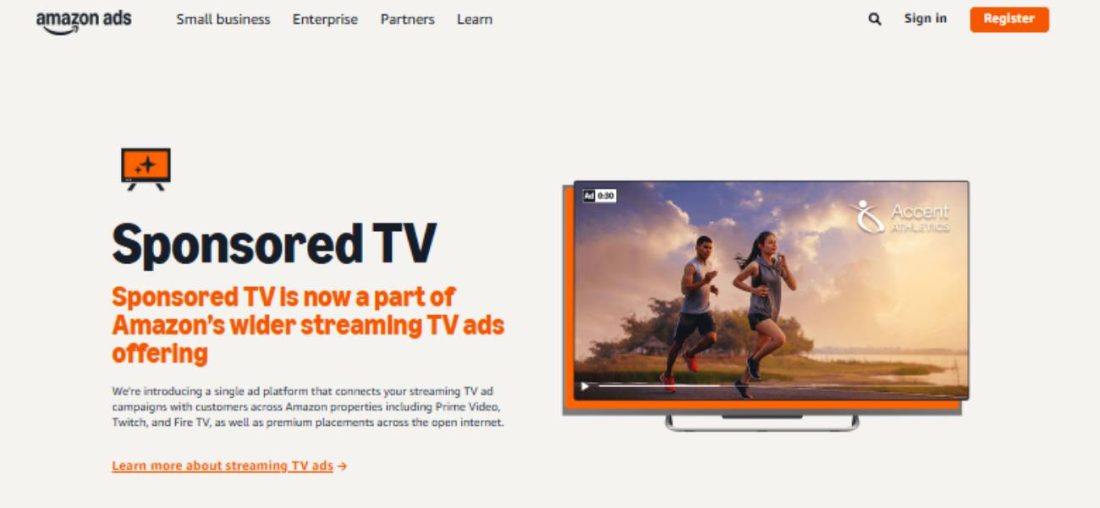
Fundamentally, Amazon Sponsored TV ads are Amazon’s self-serve streaming ads that run on Prime Video, Fire TV, Twitch, and other connected-TV inventory. They’re bought on a CPM basis, launched from the same Ads Console you already use, and they don’t require DSP access or agency involvement.
That’s the part Amazon explains.
What matters more is what they don’t do. Sponsored TV amazon ads don’t behave like Sponsored Products. They don’t generate clean, click-based attribution. And they won’t “turn on sales” for accounts that are already struggling at the bottom of the funnel.
The broader reality of the search journey makes this more complex. Roughly 73 percent of product discovery journeys may begin on Google while only 27 percent start directly on Amazon. That means mid-funnel education often happens outside the marketplace, through blogs, reviews, YouTube videos, and comparison content.
Sponsored TV Amazon ads allow you to reclaim part of that mid-funnel influence without sending traffic away from Amazon.
However, the value of Sponsored TV Amazon ads isn’t immediate attributed sales. It’s what happens afterward. You see an increase in branded searches, higher click-through rates on exact match campaigns, improved conversion rates across high-intent keywords, and cleaner account-wide conversion patterns. When the format works, it strengthens the performance of your existing Sponsored ads rather than replacing them.
Below are advanced strategic considerations most sellers overlook before launching Sponsored TV Amazon ads.
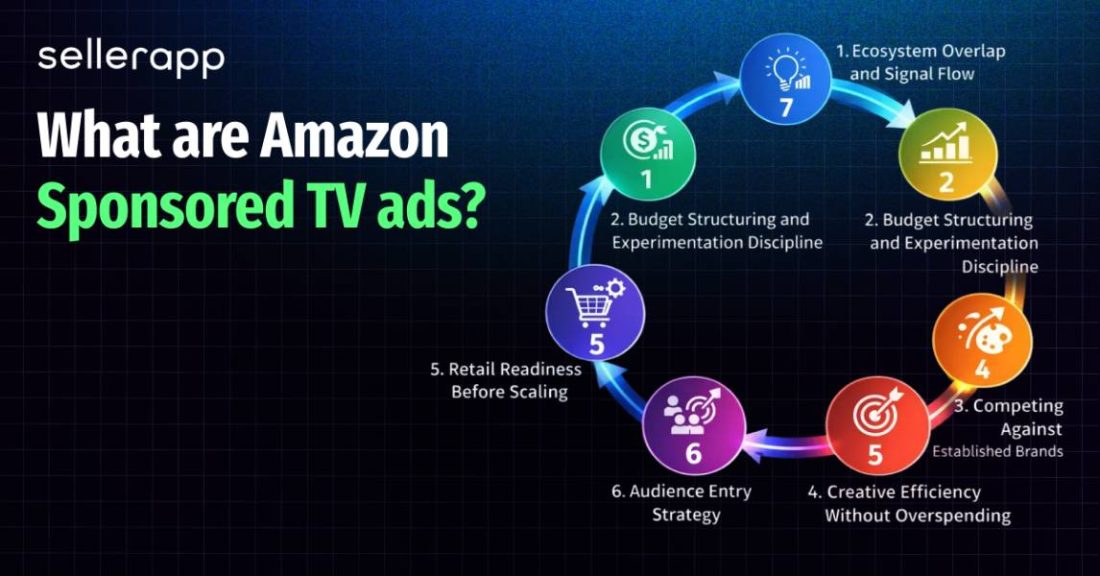
1. How Sponsored TV Influences the Rest of Your Amazon Ads Performance
Sponsored TV impressions feed signals back into the amazons ecosystem. When a shopper later searches your brand or clicks your Sponsored Products listing, the impact of Sponsored TV Amazon ads doesn’t stay limited to that one campaign or placement. Advanced sellers monitor changes in branded search volume and branded CVR after TV bursts rather than judging the format on direct attribution alone.
2. Budget Structuring
Budget matters more here than in search, similar to Amazon PPC optimization. Sponsored TV Amazon ads require sufficient impression volume to detect lift. Running a $500 test rarely produces statistically meaningful results. Conservative experimentation works best when you define a clear learning objective, such as lift in branded search rate or store visits, rather than pure ROAS.
3. Competing Against Established Brands
If you’re competing with affluent, established brands, you are not just competing on keywords. You are competing on perceived credibility. Sponsored TV Amazon ads help smaller or mid-sized brands appear alongside premium advertisers on connected TV inventory. The perception shift alone can improve click behavior later in search results.
4. Creative Efficiency Without Overspending
Production cost is often overestimated. The format may vary from high-production cinematic ads to slideshow-style product storytelling. Sellers can afford to run Sponsored TV Amazon ads with lower production costs if the message is clear. Differentiation matters more than polish. A strong unique proposition, visually demonstrated, outperforms generic brand storytelling.
5. Retail Readiness Before Scaling
Before spending aggressively, evaluate product retail readiness. If your listing quality is weak, reviews are low, pricing is uncompetitive, or the product visuals don’t match expectations, Sponsored TV will amplify problems instead of fixing them. Your video should accurately show what the product is in reality, not exaggerate it. Misalignment increases bounce rates and damages long-term performance.
6. Audience Entry Strategy
Starting conservatively is smart. Instead of broad targeting immediately, begin with similar or relevant audiences tied to your category. Once performance stabilizes, expand outward. Advanced sellers map audience tiers from similar-category viewers to broader reach segments while monitoring post-view search behavior.
7. Brand Awareness With Intent Alignment
Sponsored ads, brand awareness campaigns, and performance campaigns should not operate independently. Sponsored TV Amazon ads sit between brand awareness and measurable performance. If your account strategy treats awareness as separate from conversion, you will struggle to see the real impact. The format works best when awareness and lower-funnel capture are structurally connected.
Create an Amazon Sponsored TV Ads Campaign
1. Open Sponsored TV in the Amazon Ads Console
Log in to your Amazon Ads Console and click Create campaign. Select Sponsored TV from the available campaign types.
Sponsored TV runs inside the same environment as Sponsored Products and Sponsored Brands. There is no DSP contract, no insertion order, and no minimum spend requirement. This allows sellers to test TV-format ads without operational overhead.
2. Set a clear campaign objective
Define the exact outcome you want before launching. Sponsored TV is most effective when tied to a measurable account-level goal such as:
- Increasing branded search volume
- Improving conversion rates on existing Sponsored Products campaigns
- Supporting new product launches
- Strengthening brand recall in competitive categories
Sponsored TV influences buying decisions before shoppers search. Its value shows up in improved performance of lower-funnel campaigns.
3. Set a controlled starting budget
Start with a conservative daily budget. This allows you to observe performance signals without overspending.
Avoid scaling immediately. First, validate that the campaign is improving:
- Branded search volume
- Click-through rate on branded and exact match keywords
- Conversion rate on existing campaigns
4. Select relevant audiences
Begin with audiences that already show buying intent. These typically include:
- Shoppers who viewed similar products
- Competitor product audiences
- In-market category shoppers
5. Upload a video that clearly explains the product
The video should focus on product clarity, not brand storytelling.
It must show:
- What the product is
- How it works
- What makes it different
Simple product demonstration videos consistently outperform abstract brand videos.
Low production videos work if the product and value proposition are clear.
6. Verify product retail readiness before launching
Sponsored TV increases visibility. It does not fix conversion problems.
Before launching, confirm your listing has:
- Clear product images
- Strong review quality and quantity
- Accurate product positioning
- Conversion-focused copy
If the listing does not convert well, Sponsored TV will increase traffic without improving revenue.
7. Measure performance using downstream signals
Do not evaluate Sponsored TV only using attributed sales. Its primary impact appears in downstream campaign performance.
Notice these while running ads:
- Increase in branded searches
- Improvement in Sponsored Products conversion rates
- Higher click-through rates on exact match keywords
- Improved efficiency across existing campaigns
Common Pitfalls to Avoid With Sponsored TV Amazon Ads
Most Sponsored TV Amazon Ads don’t fail because the channel is ineffective; they fail because small structural mistakes quietly erase lift before it ever shows up in reporting.
Knowing where these breakdowns occur allows sellers to address issues early, protect their spending, and avoid writing off a channel that was misconfigured rather than misjudged.
Mistake 1: Getting Impressions but Seeing No Real Impact
One of the most frustrating patterns is seeing a flood of impressions with no measurable increase in store visits, PDP sessions, or add-to-cart activity. This almost always comes down to a creative-to-landing mismatch or misaligned CTA.
For example, a lifestyle-focused creative that teases the brand universe will underperform if it drives straight to a single product page. Conversely, product-specific messaging works poorly if it points to a generic Store without context.
Map each creative to the destination that reinforces the intended behavior. Use Store pages when building brand/category awareness, and reserve PDPs only when the ad explicitly highlights that SKU. Test this alignment with a small segment first to confirm behavioral lift before scaling.
Mistake 2: When Your Campaign Spends Too Fast and Loses Control
Campaigns that pace out early or exhaust the budget in a day are almost always victims of uncontrolled frequency and bid aggressiveness, not “high demand.” Streaming inventory is less elastic than search; overspending early compresses exposure and prevents meaningful lift across your intended audience.
Implement dayparting and frequency caps to control delivery windows and prevent early saturation. Slightly lowering bids can spread impressions more evenly, preserving exposure across prime viewing hours while maintaining ROI efficiency.
Mistake 3: Not Having Clear Visibility Into Performance
Sponsored TV Amazon ads live in a different attribution universe. Ad Console metrics rarely match Store Insights or downstream sales perfectly, which frustrates sellers who expect last-click parity. Many misinterpret small discrepancies as performance failures when in reality, the lift is happening outside the measurement lens.
You should treat AMC as the authoritative source for exposure-based impact, complement it with Store Insights for actual engagement signals, and request raw campaign delivery logs from your agency when reconciliation or internal reporting is required. Focus on relative lift trends rather than absolute numbers, especially for awareness-driven upper-funnel campaigns.
Advanced Strategies for Sponsored TV Amazon Ads
Once Sponsored TV Amazon Ads are stable and delivering consistent reach, the real gains come from how you control frequency, recycle audience intelligence, and decide when self-serve limits are costing you growth.
These tactics are less about visibility and more about extracting incremental lift and compounding it across Amazon’s lower-funnel ad stack.
Tactic 1: Control How Often Shoppers See Your Ads
Frequency management in sponsored TV is more nuanced than in search or display. While capping frequency prevents overexposure and ad fatigue, it comes with a trade-off: stricter caps reduce total reach and may leave prime audience segments underexposed, especially in categories with smaller viewing populations.
Experienced sellers balance this by layering frequency rules per audience tier. Broader awareness segments can tolerate higher caps, while retargeting segments are intentionally limited to maintain credibility and prevent wasted impressions. The key is monitoring completion rate decay alongside downstream metrics to ensure that capping is protecting lift rather than stifling it.
Tactic 2: Turn Sponsored TV Viewers Into High-Converting Retargeting Audiences
Another underleveraged tactic is using AMC audiences generated from Sponsored TV exposures to feed back into lower-funnel channels. By isolating viewers who engaged but did not convert, sellers can create lookalike segments for Sponsored Products or Sponsored Brands campaigns.
This approach amplifies the initial TV investment by converting latent awareness into measurable downstream performance. The advantage is twofold: the TV campaign informs subsequent targeting, and the lower-funnel campaigns are seeded with higher-propensity shoppers, reducing wasted spending.
Tactic 3: Know When It’s Time to Move From Sponsored TV to DSP
Finally, knowing when to graduate from self-serve Sponsored TV to DSP-managed buys is critical for scaling. Sponsored TV is effective for testing, brand awareness bursts, and mid-market coverage, but DSP becomes necessary when targeting granularity, multi-touch measurement, or large national buys are required.
For example, DSP allows advanced dayparting, bid-level adjustments by placement, and access to custom data integration capabilities that self-serve Sponsored TV cannot deliver. Sellers should consider the move when the goal shifts from directional awareness to measurable lift at scale across multiple product lines, or when internal reporting requirements demand multi-touch attribution that AMC alone cannot satisfy.
Final thoughts
Sponsored TV Amazon ads are no longer an experimental upper-funnel channel; they are a measurable lever for shaping shopper behavior across Prime Video, Fire TV, and Twitch. Success comes from approaching the format with rigor: structured testing, intentional alignment of creative to landing, layered audience sequencing, and disciplined measurement through AMC.
Brands that treat Sponsored TV as a strategic demand-building tool, rather than a last-minute “awareness splash,” consistently see downstream lift in store visits, product page sessions, and ultimately sales.
For sellers aiming to maximize ROI, every stage from creative iteration to audience refinement benefits from data-driven insights and automation. Platforms like SellerApp provide advanced analytics, audience tracking, and creative performance monitoring, making it easier to translate upper-funnel exposure into measurable outcomes. By combining Sponsored TV campaigns with SellerApp’s tools, sellers can confidently run experiments, detect incremental lift, and scale campaigns without guessing, ensuring that every dollar spent contributes to long-term brand growth.
Sponsored TV Amazon ads are a high-potential channel, but they reward disciplined execution. Use this framework, monitor results carefully, and leverage SellerApp to turn insights into action, and then you’re not just buying impressions; you’re shaping behavior at scale.