

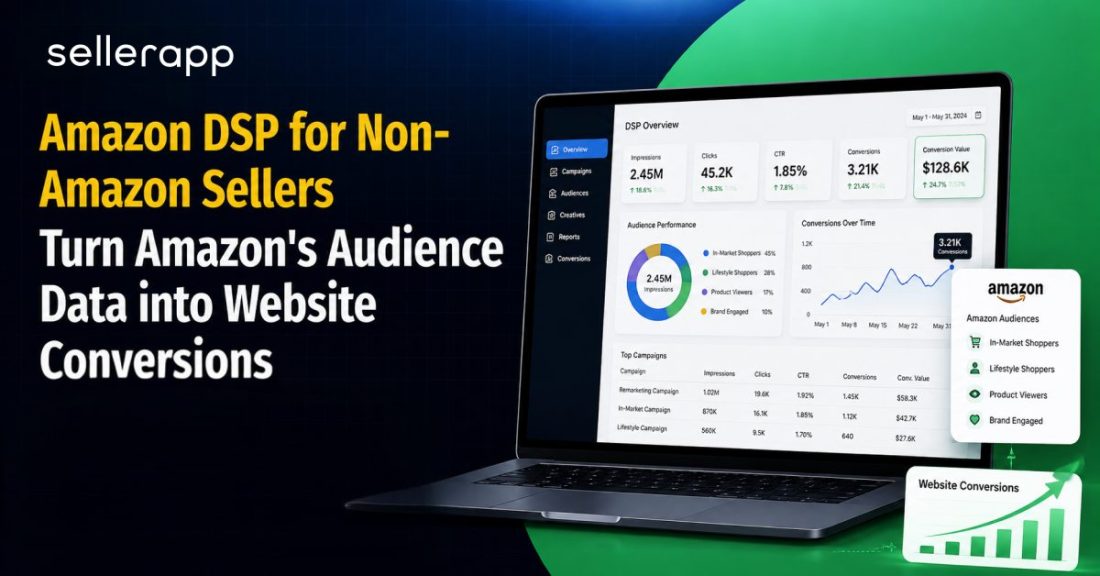
Amazon DSP for non-Amazon sellers helps brands reach high-intent audiences without selling on Amazon. Yet many advertisers still assume Amazon DSP only works for marketplace sellers.
It doesn’t. Whether you run campaigns for a SaaS company, hotel, university, automotive brand, healthcare provider, or DTC business, Amazon DSP for brands not selling on Amazon gives you access to Amazon’s first-party audience data without requiring a single product listing. Instead of driving traffic to Amazon, you can send shoppers directly to your own website, landing page, booking engine, or app. The conversion happens off Amazon. The audience intelligence still comes from Amazon. That’s why Amazon DSP for off-Amazon brands has become a powerful acquisition channel for businesses focused on leads, bookings, subscriptions, and website sales.
This guide explains how Amazon DSP for non-Amazon sellers works, which businesses benefit the most, how to structure campaigns, and how to measure success when every conversion happens outside Amazon.
Quick Guide
Can You Use Amazon DSP Without Selling on Amazon?
Yes. One of the biggest misconceptions about Amazon DSP for non-Amazon sellers is that advertisers need an Amazon storefront or Amazon product listings before they can run campaigns.They don’t. Amazon DSP lets brands advertise across Amazon-owned properties and premium third-party inventory while sending traffic directly to their own websites. Whether your goal is generating leads, booking appointments, selling through Shopify, or driving app installs, the customer never needs to purchase on Amazon.
Imagine a luxury resort promoting holiday packages.Guests don’t book through Amazon. But Amazon knows which shoppers are researching luggage, beachwear, flights, and travel accessories. Using Amazon DSP for brands without Amazon listings, the resort can reach those high-intent audiences and drive them straight to its booking page.For agencies, this means Amazon DSP for non-marketplace sellers is no longer a niche offering. It’s a scalable way to reach qualified audiences before they actively search for a brand.
How Amazon DSP Works for Off-Amazon Brands
The biggest difference between Amazon DSP for non-Amazon sellers and Sponsored Ads is where the customer converts.
Sponsored Ads drive shoppers to Amazon product pages. Amazon DSP for off-Amazon brands uses Amazon’s first-party audience data to reach high-intent shoppers and directs them to an external website, landing page, app, or booking portal.
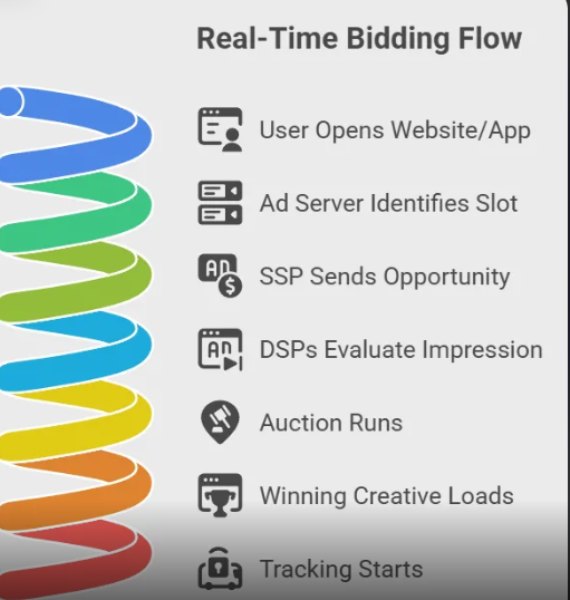
The process is simple:
- Define a business goal such as lead generation, bookings, website sales, or app installs.
- Build audiences using Amazon’s shopping signals, interests, demographics, and in-market behavior.
- Deliver ads across Prime Video, Twitch, Fire TV, IMDb, Amazon-owned properties, and premium third-party websites.
- Drive users to your own website, where the conversion takes place.
For example, a SaaS company can target IT professionals researching enterprise software and direct them to a demo request page. A hotel chain can reach travelers browsing luggage and holiday essentials before sending them to its booking website.
The value of Amazon DSP for brands not selling on Amazon isn’t the marketplace. It’s Amazon’s ability to identify high-intent audiences before they actively search for your business.
Which Off-Amazon Brands Are a Good Fit for Amazon DSP?
Amazon DSP for non-Amazon sellers is ideal for brands with longer buying journeys where customers research before converting. Instead of relying on Amazon product pages, brands can drive bookings, leads, subscriptions, or purchases directly on their own websites. According to SellerApp’s State of Amazon Advertising 2026, Amazon DSP’s share of Amazon ad spend grew from 17.7% to 23.4% in 2025, while 36.5% of DSP-attributed purchases came from new-to-brand customers. That makes Amazon DSP for brands that don’t sell on Amazon a strong acquisition channel, not just a retargeting platform.
| Industry | Primary Campaign Goal | Recommended Conversion Event | Best DSP Format |
| Travel & Hospitality | Bookings | Completed reservation | Streaming TV, Display |
| SaaS & Technology | Lead Generation | Demo request | Display, Online Video |
| Automotive | Test Drives | Booking form | Streaming TV, Video |
| Financial Services | Lead Generation | Quote request | Display |
| Education | Student Enrolment | Application submission | Video, Display |
| DTC Ecommerce | Website Sales | Purchase | Display, Remarketing |
What You Need Before Launching Amazon DSP for a Non-Amazon Seller
Before launching Amazon DSP for non-Amazon sellers, make sure the foundation is in place. Unlike Amazon sellers, off-Amazon brands can’t rely on marketplace sales data, so campaign setup becomes even more important.
At a minimum, you’ll need:
- A conversion-ready website or landing page
- Amazon DSP conversion tracking or a supported measurement partner
- Clearly defined business goals such as purchases, leads, bookings, or app installs
- Audience segments that align with your ideal customer
- Creative assets tailored to different funnel stages
Skipping these steps makes optimization difficult. If conversions aren’t tracked correctly or campaign goals are unclear, even well-targeted DSP campaigns become harder to measure and improve.
How to Set Up Conversion Tracking for Clients Who Don’t Sell on Amazon
Conversion tracking is what turns Amazon DSP for non-Amazon sellers from an awareness channel into a measurable performance channel. Since conversions happen outside Amazon, agencies need to define what success looks like before launching a campaign. Depending on the client’s business, that could be a completed purchase, demo request, booking, lead form submission, or app install.Amazon DSP supports website conversion tracking through Amazon’s measurement solutions and approved third-party integrations. Once tracking is configured, advertisers can optimize campaigns toward the actions that matter most instead of relying on clicks or impressions alone.
Before launching, verify that:
- Conversion events are firing correctly.
- Landing pages match the campaign objective.
- Attribution windows align with the client’s buying cycle.
How to Build the Right Amazon DSP Audience Strategy
Audience targeting is what sets Amazon DSP for non-Amazon sellers apart from traditional display advertising. Instead of relying only on demographics, Amazon DSP uses first-party shopping signals to reach people based on their interests, purchase intent, lifestyle, and browsing behavior. This allows brands to engage potential customers long before they visit a website or submit a lead form.
Step 1: Define Your Ideal Customer
Start by identifying who you want to reach. Use Amazon’s first-party audience data to build segments based on shopping behavior, interests, demographics, and in-market intent.
Step 2: Build Prospecting Audiences
Create prospecting audiences to introduce your brand to new, high-intent customers who are likely to convert but haven’t interacted with your business before.
Step 3: Set Up Remarketing Audiences
Retarget users who have already visited your website or engaged with your brand to encourage them to complete the desired action.
Step 4: Expand with Lookalike Audiences
Use lookalike audiences to reach new prospects who share similar characteristics with your existing customers, helping you scale without sacrificing relevance.
Step 5: Exclude Low-Value Audiences
Apply audience exclusions to prevent ads from reaching existing customers, recent converters, or other users who are unlikely to generate additional value. The goal isn’t to reach everyone. It’s to reach the people most likely to become your next customer.
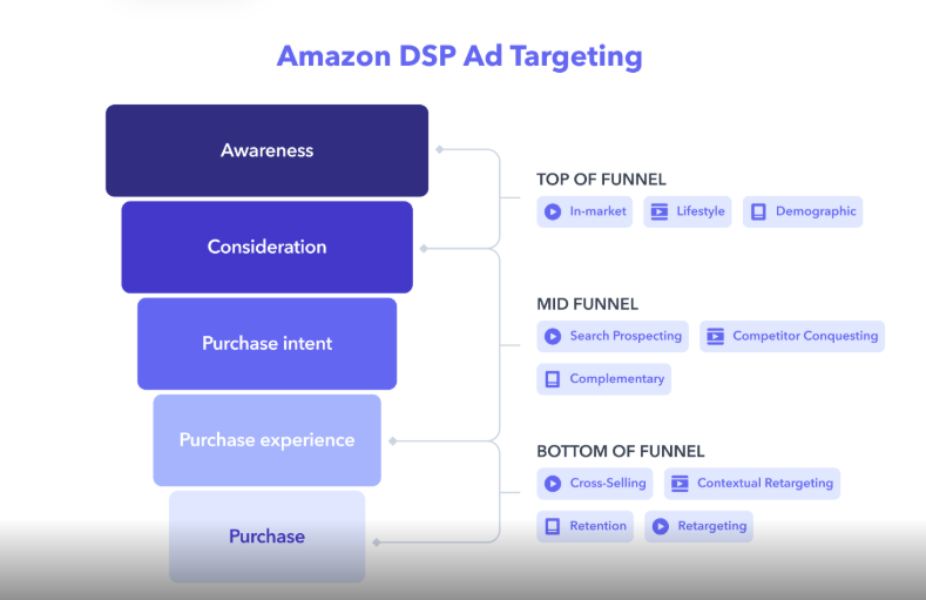
How to Structure Amazon DSP Campaigns for Off-Amazon Brands
Campaign structure plays a big role in how well Amazon DSP for non-Amazon sellers performs. Instead of running one campaign for every audience, separate campaigns by funnel stage. This gives you better control over budgets, messaging, and optimization.
Imagine you’re running Amazon DSP campaigns for a luxury resort. Instead of placing every audience into one campaign, you create separate campaigns for each stage of the customer journey.
Start with an awareness campaign targeting travelers researching flights, luggage, and vacation destinations. Use Streaming TV and online video ads to introduce the resort and build awareness.
Next, launch a consideration campaign targeting users actively researching hotels or holiday packages. Display ads direct them to your booking website, where they can explore rooms, amenities, and pricing.
Then, create a remarketing campaign for visitors who viewed rooms but didn’t complete a reservation. Personalized display ads featuring limited-time offers or exclusive packages encourage them to return and book.
Finally, run a loyalty campaign for previous guests by promoting seasonal offers, member-exclusive discounts, or loyalty rewards to drive repeat bookings.
For example, prospecting campaigns should focus on reaching new audiences, while remarketing campaigns should re-engage users who have already visited your website or interacted with your brand.
| Campaign Layer | Audience | Creative | Conversion Goal | Primary KPI |
| Awareness | New audiences | Video, Streaming TV | Reach | Impressions, VCR |
| Consideration | In-market audiences | Display, Online Video | Website visits | CTR, DPVR |
| Remarketing | Website visitors | Dynamic Display | Purchases, Leads | CPA, Conversion Rate |
| Loyalty | Existing customers | Personalized creatives | Repeat purchases | ROAS, Customer Retention |
Choosing the Right Amazon DSP Inventory and Ad Formats
Choosing the right inventory is just as important as choosing the right audience. Amazon DSP for non-Amazon sellers offers access to Amazon-owned properties, including Prime Video, Twitch, Fire TV, and IMDb, along with premium third-party websites and apps.
The best format depends on your campaign objective.
| Ad Format | Best For | Funnel Stage |
| Display Ads | Website traffic, lead generation | Consideration |
| Online Video | Product education, brand awareness | Awareness |
| Streaming TV | Broad reach and brand storytelling | Awareness |
| Audio Ads | Brand recall | Awareness |
| Dynamic Display | Website remarketing | Conversion |
Rather than relying on a single format, the strongest Amazon DSP for off-Amazon brands campaigns combine video for awareness with display and remarketing campaigns that drive conversions on the brand’s website.
How to Allocate Budget Across the Funnel
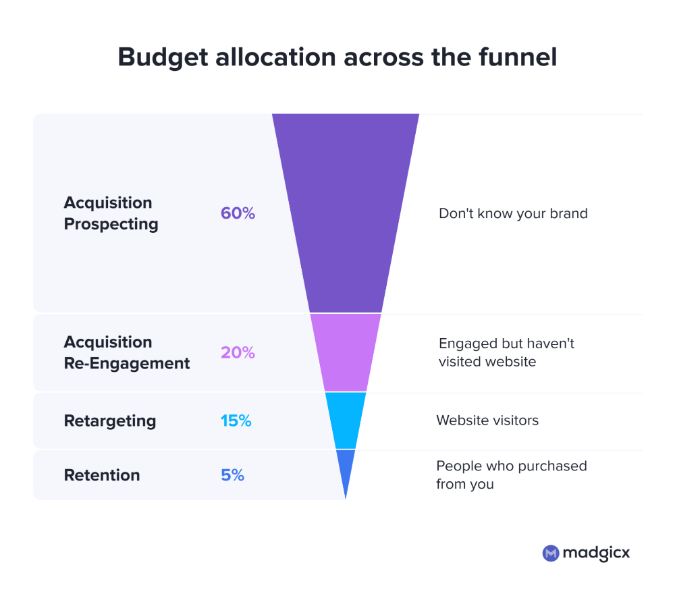
One of the biggest mistakes agencies make with Amazon DSP for non-Amazon sellers is putting most of the budget into remarketing because it delivers faster conversions. While remarketing is important, it can only reach people who have already interacted with your brand. Without consistent prospecting, that audience eventually dries up, limiting future growth. A balanced strategy invests across the funnel. Awareness campaigns introduce your brand to new audiences through Streaming TV, online video, and display. Mid-funnel campaigns nurture interested prospects, while remarketing focuses on users who have already visited your website or engaged with previous ads.
For example, if your monthly Amazon DSP budget is $20,000, you might allocate around 40% ($8,000) to awareness campaigns, 30% ($6,000) to consideration campaigns, 20% ($4,000) to remarketing, and the remaining 10% ($2,000) to loyalty campaigns. While the exact split depends on your business goals and campaign maturity, this approach ensures you’re consistently acquiring new audiences while nurturing and retaining existing customers.
Off-Amazon campaigns also require patience. Unlike Amazon sellers, conversions often happen days or even weeks after the first ad exposure. A customer might watch a video ad today, return through a branded search next week, and complete a purchase later. Optimizing too early can prevent campaigns from gathering enough data to perform effectively. As budgets increase, don’t simply spend more on the same audience. Expand prospecting segments, refresh creatives regularly, and monitor frequency to avoid audience fatigue. Sustainable growth comes from reaching new customers while continuing to nurture existing prospects.
How to Measure Amazon DSP Performance Without Amazon Sales Data
Measuring Amazon DSP for non-Amazon sellers requires a different mindset. Since purchases happen on your website instead of Amazon, success isn’t measured by Amazon sales. It’s measured by the business outcome your campaign was designed to achieve.
For some brands, that’s completed purchases. For others, it could be demo requests, hotel bookings, insurance quotes, application submissions, or app installs. The first step is deciding which conversion matters most before launching the campaign.
Beyond conversions, agencies should also track supporting metrics that explain why campaigns are performing the way they are. Reach and frequency show whether enough people are seeing your ads, while CTR, view-through conversions, and cost per acquisition help evaluate engagement and efficiency.
| Campaign Objective | Primary KPI | Supporting KPIs | Avoid Optimizing Only For |
| Website Sales | Purchases | CPA, ROAS, CTR | Clicks |
| Lead Generation | Qualified Leads | CPL, CTR, CVR | Impressions |
| Hotel Bookings | Completed Bookings | CPA, Booking Value | CTR |
| App Installs | Installs | CPI, Retention Rate | Downloads Alone |
| Brand Awareness | Reach | Frequency, VCR, Viewability | ROAS |
The goal isn’t to report every available metric. It’s to focus on the KPIs that reflect real business outcomes.
How Amazon Marketing Cloud Changes DSP Measurement for Non-Amazon Sellers
For many agencies, one of the biggest challenges with Amazon DSP for non-Amazon sellers is proving what happened before the conversion.A customer might watch a Streaming TV ad, see a display ad a few days later, visit your website through a branded search, and convert a week after that. Looking at the final click alone ignores most of the journey.
That’s where Amazon Marketing Cloud (AMC) adds value.
Instead of evaluating campaigns in isolation, AMC helps agencies understand how different touchpoints work together. It can reveal which audience segments engage the most, how long customers take to convert, and which campaign combinations influence website purchases, bookings, or lead submissions.
For example, a hotel brand might discover through AMC that customers who first watched a Streaming TV ad and later clicked a display ad were twice as likely to complete a booking as those exposed to display ads alone. Similarly, a SaaS company may find that users who watched a product demo video before visiting the pricing page converted at a higher rate than users who only saw remarketing ads. These insights help agencies understand which touchpoints contribute most to conversions instead of relying solely on the last click.
For Amazon DSP for off-Amazon brands, these insights make budget allocation much easier. Rather than scaling campaigns based only on direct conversions, agencies can identify which strategies consistently move customers closer to a purchase and invest with greater confidence.
How SellerApp Helps Agencies Run Amazon DSP for Off-Amazon Brands
Running Amazon DSP for non-Amazon sellers doesn’t stop at launching campaigns. Agencies need to monitor performance, optimize budgets, manage audiences, and demonstrate ROI to clients. Doing all of that across multiple tools quickly becomes time-consuming.
SellerApp brings those workflows together in one platform.
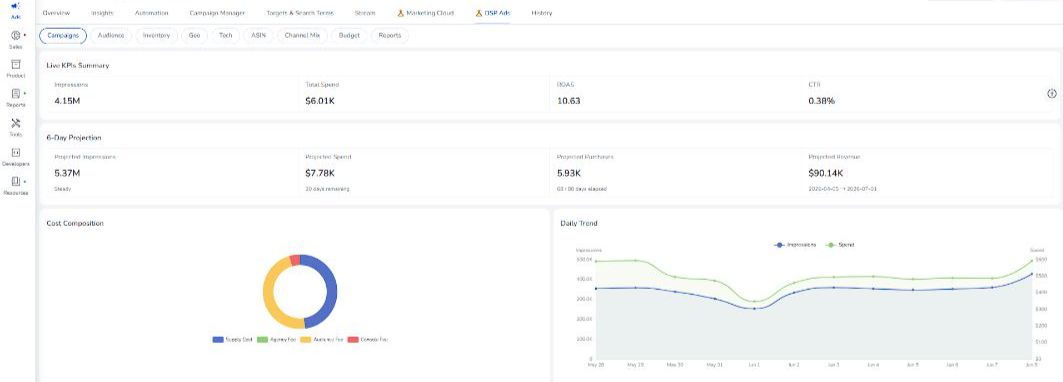
Build Campaigns Around Business Goals
Every client has a different objective. SellerApp helps agencies align DSP campaigns with outcomes that matter, whether that’s website sales, qualified leads, bookings, subscriptions, or app installs.
Manage Performance at Scale
Instead of switching between reports, agencies can monitor campaign pacing, spend, ROAS, CTR, audience performance, inventory, geography, devices, and channel mix from a single DSP dashboard. This makes it easier to identify underperforming campaigns and optimize budgets before performance declines.
Turn AMC Insights Into Action
Amazon Marketing Cloud provides valuable audience and attribution insights, but interpreting that data takes time. SellerApp helps agencies combine DSP performance with AMC insights to make faster optimization decisions without relying on fragmented reporting.
Deliver Reports Clients Understand
Clients don’t just want campaign metrics. They want to know whether advertising is driving business growth. SellerApp simplifies reporting by helping agencies present campaign performance in a way that’s easier to understand and act on.
Final Takeaway: Amazon DSP Is No Longer Just for Amazon Sellers
Amazon DSP was built around audience intelligence, not marketplace listings. The brands that benefit most aren’t necessarily the ones with the most ASINs. They’re the ones that understand how to reach the right people before competitors do.Whether you’re helping a SaaS company generate demo requests, a hotel increase bookings, or a DTC brand grow website sales, the fundamentals stay the same. Build audiences around intent, track the conversions that actually matter to the business, structure campaigns across the full funnel, and optimize against outcomes rather than vanity metrics.
For agencies, this is also a real opportunity to grow. Amazon DSP for brands not selling on Amazon opens the door to clients that previously seemed outside Amazon’s ecosystem entirely, including travel, automotive, education, financial services, and healthcare, while using the same first-party signals that power one of the world’s largest advertising platforms. As Amazon continues investing in Prime Video ads, Streaming TV, and Amazon Marketing Cloud, the gap between brands using DSP well and those ignoring it will only widen. If you’re ready to start running Amazon DSP for your non-Amazon clients, SellerApp can help. From campaign setup and audience strategy to performance tracking and client reporting, SellerApp gives agencies everything they need to manage DSP at scale to see how it works.
FAQ
Amazon DSP for non-Amazon sellers is a programmatic advertising solution that lets brands access Amazon’s first-party audience data without needing a product listing or storefront on Amazon. Instead of driving traffic to an Amazon page, campaigns send users directly to your website, landing page, booking engine, or app where the conversion happens.
Yes. Amazon DSP for independent brands does not require an Amazon storefront, product listings, or even an Amazon seller account. The platform targets audiences based on shopping behavior, interests, and intent signals, then directs them to wherever you want them to convert, whether that is a website, a lead form, or a booking page.
Amazon DSP for non-Amazon sellers works well for any business with a longer buying journey. Travel brands, hotels, SaaS companies, automotive businesses, financial services providers, universities, and healthcare brands all use it to reach high-intent audiences and drive leads, bookings, or website sales without relying on Amazon’s marketplace.
The core difference is the quality of the audience data. Amazon DSP for independent brands uses Amazon’s own first-party shopping signals, which reflect actual purchase intent rather than inferred interest. This makes it particularly effective for reaching people who are actively researching a category, even if they have never interacted with your brand before.
Amazon DSP for brands not selling on Amazon can support a wide range of business objectives including lead generation, demo requests, hotel and travel bookings, app installs, website purchases, student enrollments, and insurance quote submissions. The key is defining the right conversion event before launching and making sure tracking is set up correctly.
Since conversions happen off Amazon, measurement depends on conversion tracking set up on your own website through Amazon’s measurement tools or approved third-party partners. Key metrics vary by objective but typically include cost per acquisition, return on ad spend, conversion rate, and view-through conversions rather than Amazon sales data.
Amazon DSP for independent brands generally requires a higher minimum investment than self-serve ad formats. Managed service campaigns typically start at around $10,000 per month, though this can vary depending on the region, inventory type, and campaign objectives. Programmatic self-serve access through partners like SellerApp can offer more flexibility for agencies managing multiple clients.
SellerApp helps agencies plan, launch, and optimize Amazon DSP for non-Amazon sellers from a single platform. From audience strategy and campaign structure to performance reporting and Amazon Marketing Cloud insights, SellerApp simplifies DSP management so agencies can focus on delivering results for clients across industries, not just Amazon sellers.