


As an Amazon vendor, do you struggle to understand why some of your listings thrive while others quietly disappear? Amazon Net PPM or Amazon Net Pure Profit Margin is the answer that most often choose to ignore, in spite of it being such an impactful metric.
This is the number Amazon uses to judge how profitable your products really are after costs, discounts, and vendor terms. Yes, there’s actually a formula you’d need to keep a track of beyond just the Amazon Net PPM definition. If your Amazon Net PPM is too low, Amazon may even stop replenishing certain SKUs altogether. It’s a dreaded condition that sellers recognize as “CRaP-out” (Can’t Realize a Profit).
Funny as it may sound, but not for the vendors facing it, making the Amazon Net PPM report absolutely essential for performance reviews.
But here’s the good news. You can influence Net PPM, and we’ll discuss this in our article as well as formulae, impact on vendors, and more. By knowing how Amazon calculates it and taking strategic actions, from optimizing your cost of goods sold to renegotiating trade terms and running smarter promotions, you can keep your products in Amazon’s good graces.
Quick Guide:
Net PPM Amazon meaning Net Pure Profit Margin, is the main profitability metric Amazon uses to test a vendor’s performance or the profitability of a specific product. It is also sometimes referred to as the Procurement Margin.
Amazon flags the product as “low profitability” in Vendor Central’s analytics dashboard. So when you find the Net PPM dropping below our category target of 25%, you know it’s time to maintain purchase volume, or to improve cost terms or additional marketing contributions.
Amazon Net PPM also indicates the percentage profit Amazon earns from listing and selling a vendor’s products.
For the vendors, understanding and optimizing this metric is crucial for maintaining a strong relationship with Amazon before getting deeper into Net PPM Amazon meaning.
This helps you secure a favorable position with Amazon that makes negotiation easier for you and improves profitability for both parties. Now that you’ve learnt what Net PPM Amazon is, let’s dive deeper into it.
The calculation of Amazon Net PPM determines the percentage profit Amazon makes after factoring in the cost of goods, vendor contributions, and sales discounts.
The formula for Amazon Net PPM calculation varies slightly depending on whether it is for a single product or the entire vendor account.
But before you start Amazon Net PPM calculation, you need to collect specific data points, such as:
Average Selling Price / Shipped Revenue
It is the total revenue generated from the sale of a product.
Cost Price / Shipped COGS (Cost of Goods Sold)
It is the amount Amazon pays the vendor for the product.
Vendor Terms (Contra-COGS)
These terms are the incentives that a vendor provides to Amazon to reduce the effective cost of the product for Amazon. Think of them as “credits” that lower the price Amazon pays without actually changing the invoice cost.
It may include trade investment, co-op agreements, or accruals provided by the vendor that offset the cost for Amazon.
For example, say you pay Amazon $2 per unit if they feature your product in a marketing campaign, that’s a trade investment. Or, at the end of Q3, Amazon receives $5,000 as a volume rebate based on total units purchased, which is an accrual, reducing the cost of goods for Amazon over time.
Sales Discount
These are discounts such as Promo Code Redemptions, Coupons, Gift Card Promotions, Best Deals, Lightning Deals, Prime Day Spotlight Deals, and Subscribe and Save Discounts, provided to the customer that are later deducted from the margin.
So,
Amazon Net PPM calculation for single ASIN,
Amazon Net PPM = (Average Selling Price – Cost Price + Vendor Terms – Sales Discount) /Corresponding sales price x100
Let’s assume the Average Selling Price (ASP) as $49.99, Cost Price (what Amazon pays you) as $30.00, Vendor Terms (marketing accruals, freight allowance, etc.) as $2.00 (these are deductions that improve Amazon’s profitability) and Sales Discount as $1.50 (which is the promotional discount or coupon Amazon offers to customers)
Now when plugged into the formula,
Amazon Net PPM = (ASP – Cost Price + Vendor Terms – Sales Discount) / ASP × 100
= (49.99 – 30.00 + 2.00 – 1.50) / 49.99 × 100
= (20.49) / 49.99 × 100
= 40.98%
So, the Amazon Net PPM for this ASIN is 40.98%.
Similarly, for vendor account Amazon Net PPM calculation,
Amazon Net PPM = (Shipped Revenue – Shipped COGS + Vendor Terms – Sales Discount.) /Corresponding sales price x100
Note: Investments in Amazon Advertising, chargebacks, and payment terms are not included in the Amazon Net PPM calculation, as Amazon reports these variable investments later in its profit and loss account.
Understanding and optimizing Amazon Net PPM is essential for safeguarding profitability. Now let’s get into the details of why.
1. Amazon Net PPM plays a Central Role in Negotiations and Vendor Terms
Amazon Net PPM is one of the most important metrics Amazon uses during quarterly or annual financial reviews. This means if a vendor’s Amazon Net PPM is healthy which is around 40% in Hardlines (electronic gadgets, tools etc.) or 30% in Consumables, Amazon is more likely to offer favorable business terms for negotiations.
Similarly, a low Amazon Net PPM may convince Amazon Vendor Managers to demand adjustments like price reductions in existing terms, because the goal is to protect Amazon’s margins.
A strong Amazon Net PPM helps vendors beat their category competitors, which gives them an edge in category-level discussions with your stakeholders or category managers. This would include whether Amazon will ask you to reduce costs or adjust trade terms, which SKUs Amazon will prioritize, keep, or cut or deals, advertising eligibility, etc.
2. Avoiding CRaP-Out
Products with little to no profitability may be flagged by Amazon as CRaP, which triggers certain consequences like removal of A+ Premium content from listing, loss of Buy Box privilege (maybe due to offering discontinued pricing), or withdrawal of advertising eligibility completely.
In the final phase of CRaP-out, Amazon stops ordering the product entirely, abruptly cutting the vendor’s revenue.
Note: If you suspect a product is CRaP (you’ll often see reduced ad eligibility or no new POs, which may indicate a CRaP) here are the steps to follow:
3. Guiding Internal Vendor Strategy
Amazon Vendors can use Amazon Net PPM insights to identify low-margin products, optimize pricing, reduce COGS, or refine vendor terms by negotiating with the marketplace.
Tracking Amazon Net PPM over time also helps vendors evaluate the impact of promotions, avoid excessive discounting, and make data-driven portfolio decisions.
For vendors, Amazon’s profitability can’t be chalked down with one metric, it directly determines whether Amazon continues to stock, promote, and support your products.
1. Amazon’s Bottom Line as a B2B Partner
The vendor relationship is fundamentally a B2B concept. So, as a platform, Amazon will only let vendors sell what are profitable for them. Amazon Net PPM reveals the true profit margin Amazon earns per unit sale, which indicates whether the product is worth keeping in Amazon’s catalog.
2. Impact on Vendor Operations
If Amazon sees consistent profitability, purchase orders and product visibility remain stable.
If profit margins dip, vendors may face consequences such as stricter terms, reduced orders, or forced cost optimizations.
While Amazon Net PPM is crucial, it doesn’t account for operational costs (like fulfillment, chargebacks, or advertising).
Vendors must know how to balance Amazon Net PPM insights with supply chain efficiency, packaging improvements, and sustainable pricing strategies to maintain good terms with Amazon.
In short, how much Amazon earns as profit margin from your products shapes the security of your partnership. When Amazon earns consistently from your products, it translates into long-term growth for a vendor.
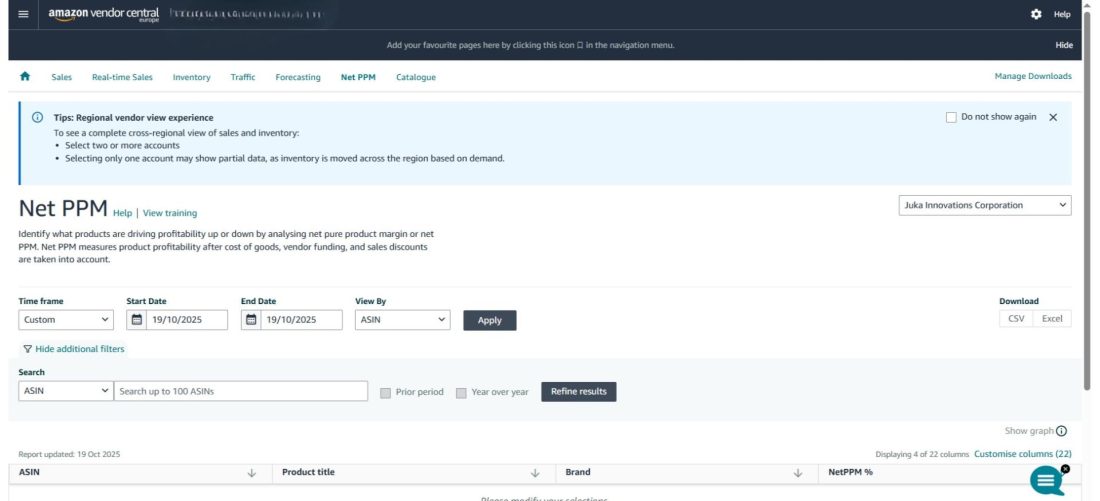
To access the necessary components for calculation, you must specifically customize the columns:
1. Open Vendor Central
2. Go to Menu and click on Reports.
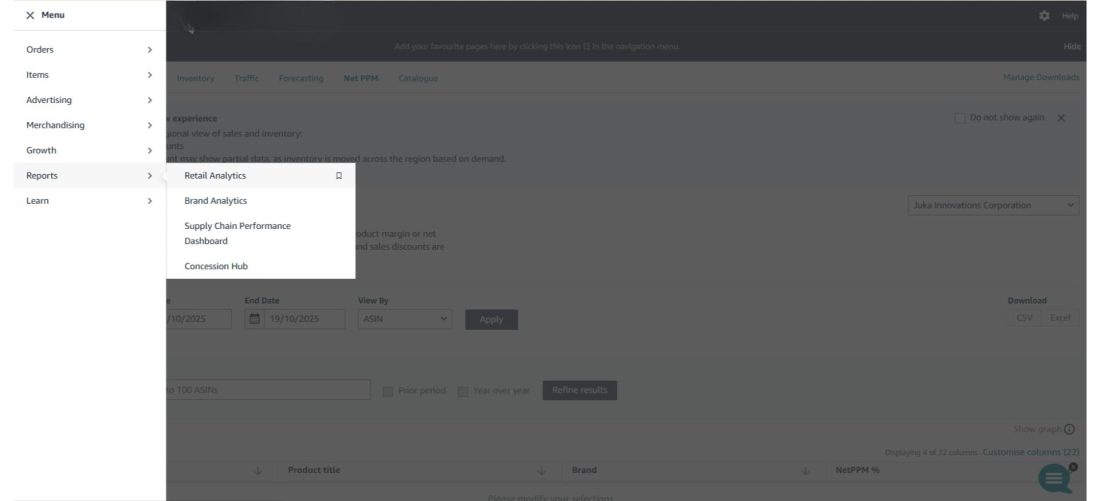
3. Under reports, click on Retail Analytics.
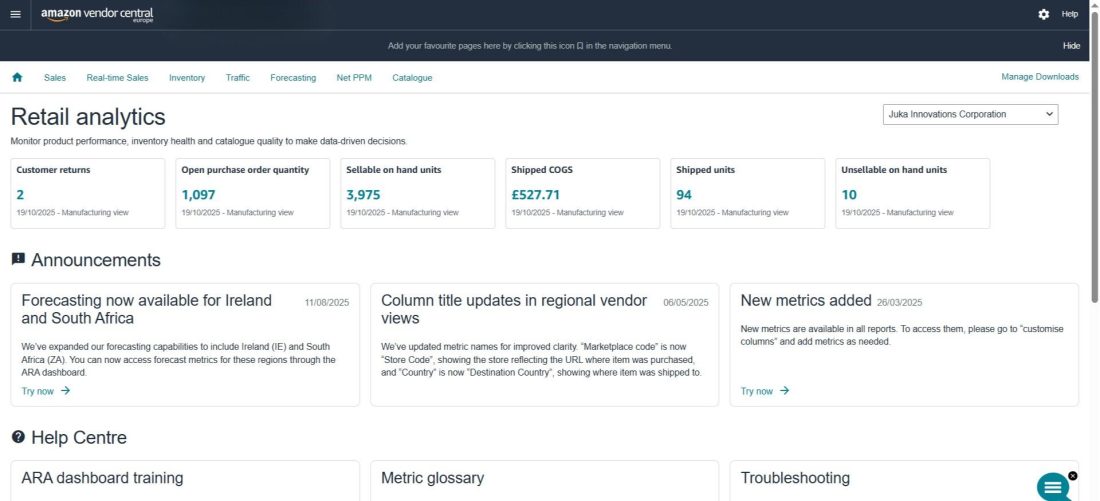
4. Click on Net PPM from the top bar.
5. Choose your time frame, and other options, and click on what format you want the report to be in (CSV or Excel).
6. Finally, hit Download.
Note: Amazon Net PPM tracked in Vendor Central may often differ from the Net PPM communicated by the Vendor Manager.
What’s considered a “good” Net PPM Amazon isn’t a one-size-fits-all indicator. Instead, it depends heavily on the respective category benchmarks that Amazon has set internally.
We’ve mentioned hardlines earlier. These are durables like electronics, appliances, tools, etc. For this category, a healthy Amazon Net PPM is usually around 40% or higher.
For consumables such as FMCG products (grocery, beauty, pet, health & personal care), Amazon’s preferred benchmark is slightly lower, i.e, around 30% or higher.
For books, music, video, gaming, etc., profit margins are expected to be much tighter, so 20–25% Amazon Net PPM is often considered good.
Vendors can employ several strategies to improve Amazon Net PPM
Reducing the cost of your products directly improves Amazon Net PPM. So as a vendor, you can work with suppliers to secure better price points. You can also find cheaper yet efficient shipping and warehousing options to lower overall costs.
Even small reductions in COGS can have a significant impact on profitability. But remember, major reductions can erode your margins, so plan carefully.
Maybe switching to a local fulfillment center can reduce freight costs by $1 per unit, boosting overall profitability.
As vendor terms (Contra-COGS or trade investments) are added to Amazon’s margin calculation, careful management of the terms is essential. Vendors can review co-op, accrual, or promotional agreements to ensure they align with profitability goals.
Revisiting and revising these terms or offering Amazon better purchase conditions can increase a low Amazon Net PPM.
Pricing strategy directly affects Amazon Net PPM since sales discounts reduce margins. Here’s how you can do it:
1. Monitor Market Conditions
The reason why this is important is to ensure pricing is competitive yet profitable in the marketplace. If a portable projector is listed at $45 on Amazon, but competitors have listed similar items at $43–$50.
By regularly tracking competitor prices, the vendor can reduce it to $44. This price is competitive enough to attract buyers, but still profitable and technically a good price, as the difference from the lowest price is nominal. In this case, a repricer can help you achieve the best selling price.
2. Price Adjustments
Price adjustments are made to increase price margins, which can boost Amazon Net PPM. But vendors need to make sure they do not repel buyers with high margins. For instance, a vendor we worked with noticed that a popular crockery set was in high demand because of a viral trend.
By increasing the price from $80 to $85 they keep the price range intact, yet Net PPM Amazon rose steadily because the profit per unit increases in the process.
3. Limit Over-Discounting
Promotions come with a requirement of close vigil to make sure profit margins are not lost. Say a skincare brand is running weekly deals. The ad managers notice that a $10 discount on a $30 serum reduces Amazon Net PPM too much, from 40% to 25%.
Instead, they introduce a $5 coupon, which is lucrative yet keeps the margins healthier while driving sales.
4. Strategic Promotions
A vendor launches a “Buy 2, Get 1 Free” deal on selected high-margin gourmet popcorns. This increases the total sales volume and thus Amazon’s margin as well. While the product remains profitable, it reduces the risk of being flagged as CRaP.
Regularly reviewing your product range ensures high-margin items drive growth while low-margin items don’t drag down overall performance. Small Amazon Net PPM improvements on top sellers have a big impact.
Vendors need to analyze and adjust pricing or reduce costs for the now-margin items. Remove SKUs that consistently underperform or improve their cost structure.
For example, a particular cooking appliance consistently underperformed, with low revenue and its Net PPM Amazon was below 25%. The vendor, to maximize the declining metric, decided to discontinue the SKU and reallocate resources to the high-performing product line, thereby increasing overall profitability.
Operational factors may not be part of the Amazon Net PPM formula, but they affect Amazon’s overall profitability and CRaP-out risk. Take products with high returns and identify and resolve underlying issues. You can also offer bundles or multi-packs to increase Average order value and margins.
Amazon Net PPM can fluctuate due to changes in costs, discounts, or market conditions. By tracking it weekly, monthly, or quarterly, vendors can spot downward trends before they significantly impact profitability.
Ensure new products are priced correctly and vendor terms are optimized from the start. Poor initial pricing or overly generous vendor terms can permanently erode Amazon Net PPM.
When launching a new Bluetooth neckband, a vendor prices it at $99 and offers moderate co-op funds to Amazon. As the product starts with an Amazon Net PPM of 42%, ensuring it is favorable for Amazon, it is less likely to be deprioritized.
Mastering Amazon Net PPM is about protecting the future of your business on the world’s largest online marketplace, so there’s no way you can take it lightly. A healthy Net PPM Amazon keeps your products in demand, ensures repeat purchases, and gives you greater power during vendor negotiations.
When you understand how Amazon measures profitability, you can set the right prices, negotiate smarter vendor terms, optimize your product portfolio, and prevent low-margin items from dragging your account down.
By regularly tracking this metric from Vendor Central and making data-driven adjustments, you can avoid CRaP-out risk and build a long-term, profitable relationship with Amazon. Partnering with SellerApp’s Amazon PPC agency ensures your brand is always ahead of these metrics. We help vendors and sellers analyze profitability patterns, optimize pricing and assortment, and maintain a consistently healthy Net PPM to strengthen overall business performance.






Baxter Hollowell
December 13, 2025Your focus on tracking Net PPM over time helps sellers see trends instead of reacting to short-term fluctuations.
Lina Morecroft
December 14, 2025The inclusion of advertising costs in the formula really highlights how PPC can quietly erode margins if unchecked.
Corbett Winsor
December 14, 2025I love how you show that optimizing for Net PPM can lead to better long-term business decisions, not just short-term wins.
Selene Hawkes
December 14, 2025Great point about factoring in return costs — sellers often forget that refunds and returns materially affect profitability.
Thatcher Ellwood
December 14, 2025The examples showing real numbers make it much easier to understand how fees, returns, and advertising impact profit margins.
Mira Ashcombe
December 14, 2025I appreciate how you explain the difference between Net PPM and other profitability metrics; that distinction is key for smart pricing.
Alden Rockford
December 15, 2025This article really breaks down Net PPM clearly — it’s great to see the full profit picture instead of just focusing on revenue.