

(The Business Model Behind Billion-Dollar Brand Acquisitions)
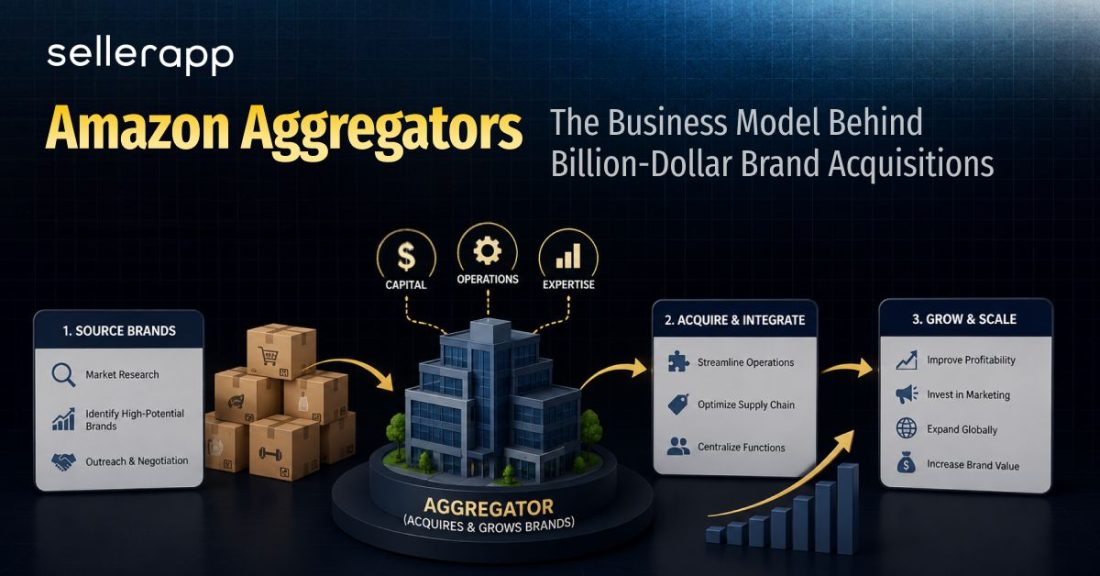
Amazon aggregators have become a notable part of the ecommerce acquisition landscape. These companies specialize in acquiring established Amazon-native brands and scaling them through operational improvements, advertising optimization, supply chain efficiencies, and marketplace expansion. Rather than building products from scratch, aggregators focus on identifying businesses with proven demand and unlocking additional growth after acquisition.
For Amazon sellers, aggregators represent a potential exit opportunity as well as a benchmark for what makes a business attractive to buyers. Understanding how these companies operate can help sellers evaluate their own growth strategies, profitability, and long-term business value.
This guide explains how Amazon aggregators work, the business model behind them, what they look for in acquisition targets, and how they value Amazon brands in 2026.
Quick Guide
What are Amazon aggregators?
After acquiring a business, aggregators typically improve several operational areas:
- Advertising performance
- Listing optimization
- Supply chain efficiency
- Inventory planning
- International expansion
- Product portfolio growth
For many sellers, it created an exit option that simply did not exist before. Acquisition targets are Amazon-native brands that built most of their growth through marketplace sales.
How the Amazon Aggregator’s Business Model Works
The Amazon aggregator’s business model revolves around acquiring brands, improving performance, and increasing overall portfolio value.
Rather than relying on a single business, aggregators build collections of brands operating across different categories. The process generally follows a repeatable structure.
| Step | What Happens | Revenue Driver |
| Identify | Aggregators search for attractive brands | Acquisition opportunities |
| Acquire | Businesses are purchased through negotiated deals | Portfolio growth |
| Optimize | Advertising, listings, and operations improve | Revenue growth |
| Expand | Brands enter new regions and channels | Market expansion |
| Scale | Portfolio value increases over time | Long-term returns |
How Amazon Aggregators Make Money
Aggregators often assume that operational improvements can be replicated across an entire portfolio. In theory, applying proven strategies across dozens of brands should create efficiencies and improve performance at scale. In practice, however, the outcome is rarely that straightforward.
Brands operate in different categories, face different competitive dynamics, and attract different customer segments. Even within the same category, overlapping products can end up competing for the same keywords, audiences, and ad placements, creating the risk of sales cannibalization rather than incremental growth.
Acquisition Multiples and Portfolio Growth
One of the biggest drivers behind the Amazon aggregators business model is acquisition valuation.
Most deals are structured around seller discretionary earnings or EBITDA multiples. Aggregators look for businesses generating healthy profits that can still grow after acquisition.
For example, suppose an Amazon brand generates $500,000 in annual Seller Discretionary Earnings (SDE) and is acquired at a 3x multiple, resulting in a purchase price of $1.5 million.
After the acquisition, the aggregator improves advertising efficiency, reduces supply chain costs, launches two complementary products, and expands the brand into Amazon Europe. Over the next two years, annual SDE grows from $500,000 to $800,000.
If the business is now valued at the same 3x multiple, its valuation increases from $1.5 million to $2.4 million. If the improvements also reduce operational risk and strengthen growth prospects, the brand may even command a higher multiple, increasing its value further.
This is where aggregators create value not simply by acquiring profitable brands, but by increasing both earnings and long-term business valuation after the acquisition.
This creates upside in two ways:
- Higher ongoing cash flow
- Increased long-term portfolio valuation
The strategy is similar to private equity thinking, but adapted specifically for ecommerce brands.
How Amazon Aggregators Improve PPC Performance After an Acquisition
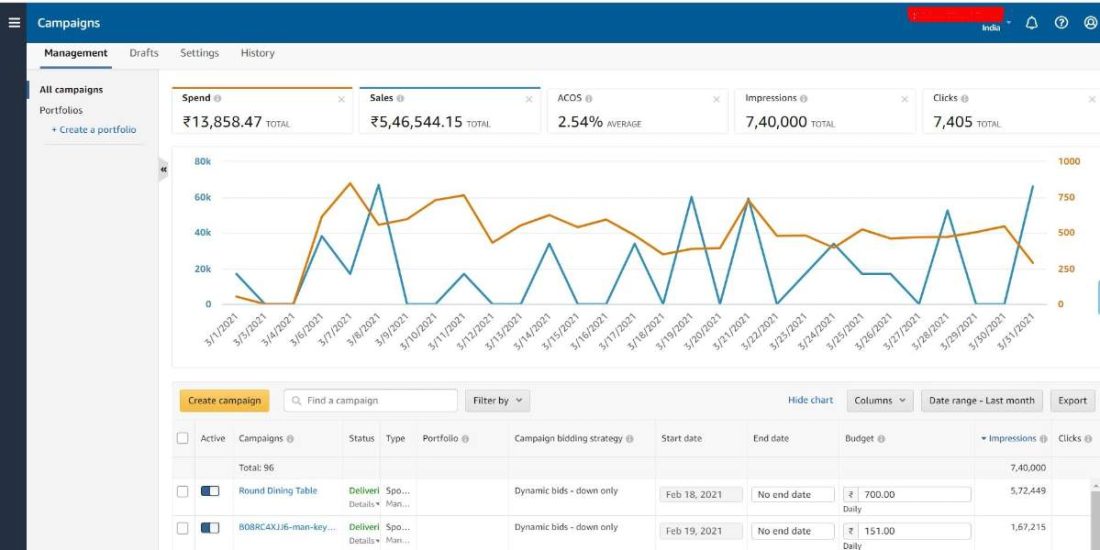
After acquiring a brand, one of the first areas aggregators often evaluate is advertising performance. Many Amazon sellers manage PPC campaigns with small teams, limited automation, or account structures that have evolved over time without a clear optimization strategy.
For example, imagine an aggregator acquires an Amazon kitchenware brand generating $2 million in annual revenue. The business spends $400,000 annually on PPC but operates with broad targeting, overlapping campaigns, and little search term segmentation. As a result, its Advertising Cost of Sales (ACoS) remains high at 35%.
After the acquisition, the aggregator’s PPC team restructures the account by separating branded and non-branded keywords, introducing negative keyword targeting, optimizing bids based on profitability, and reallocating budget toward higher-converting search terms.
Over several months, ACoS drops from 35% to 25%, while sales remain stable or increase. On a $400,000 ad spend, that improvement can translate into tens of thousands of dollars in additional annual profit.
However, scaling PPC across multiple brands is not simply a matter of applying the same playbook everywhere. Brands operate in different categories, compete for different audiences, and often have unique customer journeys. In some cases, brands within the same portfolio may even compete for overlapping keywords, creating the risk of cannibalizing sales.
This is why successful aggregators rely on centralized analytics platforms, portfolio-wide visibility, and specialized Amazon PPC teams. The goal is not just to improve individual campaigns, but to ensure advertising decisions maximize performance across the entire portfolio rather than shifting revenue from one brand to another.
How Aggregators Increase Conversion Rates Through Listing Optimization
Some acquired brands already have strong traffic but fail to convert visitors efficiently. In these cases, listing optimization can create meaningful growth without increasing ad spend.
For example, an aggregator acquires a fitness accessories brand that receives 50,000 monthly product page visits but converts at 8%. After improving product images, rewriting the copy, enhancing A+ Content, and addressing common customer objections, the conversion rate increases to 10%.
That 2% improvement may seem small, but it translates to 1,000 additional orders per month from the same traffic volume.
This is why listing optimization is often a priority after acquisition. Rather than focusing solely on generating more traffic, aggregators look for opportunities to improve how effectively existing traffic converts into revenue.
Supply Chain and Inventory Optimization
Operational efficiency becomes increasingly important as portfolio sizes grow. Inventory forecasting mistakes can quickly affect profitability through stockouts, excess storage fees, and delayed replenishment cycles.
Larger aggregators usually improve:
- Supplier negotiations
- Freight planning
- Forecasting systems
- Inventory allocation
- Warehousing efficiency
Because Amazon aggregators manage multiple brands simultaneously, they often gain purchasing leverage and operational advantages that smaller businesses cannot easily access.
Improved supply chain efficiency directly impacts margins, especially in categories with tighter profitability.
International and Multi-Platform Expansion
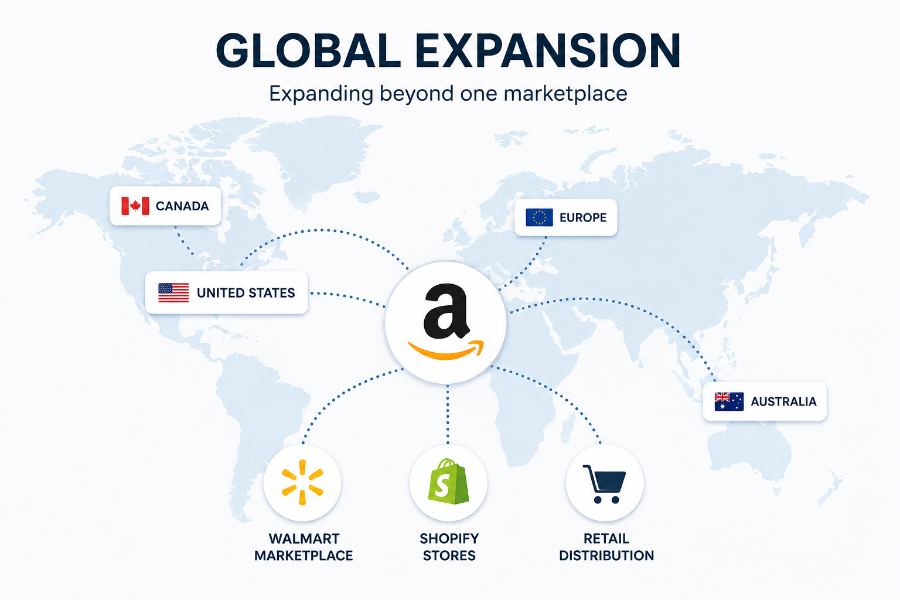
Many Amazon sellers remain concentrated in one marketplace, usually the United States. Aggregators frequently unlock additional growth by expanding acquired brands into:
- Canada
- Europe
- Australia
- Walmart Marketplace
- Shopify stores
- Retail distribution channels
International expansion is often one of the fastest ways aggregators unlock growth after an acquisition.
For example, a brand generating $5 million in annual U.S. sales may add another $1 million to $1.5 million in revenue by expanding into markets like Canada, the UK, and Germany. Beyond increasing sales, a multi-market presence can make the business more attractive to future buyers, potentially increasing its overall valuation.
What Do Amazon Aggregators Look For in a Brand?
Not every Amazon business makes a good acquisition target. Most aggregators look for brands with stable operations, predictable earnings, and clear growth potential. While revenue is important, acquisition decisions are often influenced by factors such as profitability, product diversification, customer sentiment, and operational maturity.
Private Label Businesses Over Wholesale Models
Private label businesses attract stronger interest because they give aggregators greater control over pricing, branding, product development, and expansion strategies. While wholesale businesses can be profitable, supplier dependency often limits long-term growth opportunities after acquisition.
Consistent Revenue and Profitability
Revenue matters, but predictable earnings matter more. Aggregators typically favor brands with stable sales patterns, healthy margins, and a proven track record of profitability.
Product Diversification and SKU Mix
Product concentration is another major factor. A brand generating most of its revenue from a single SKU carries higher risk because ranking fluctuations, policy changes, or competitive pressure can significantly impact performance. Aggregators generally prefer businesses with revenue distributed across multiple products.
Strong Customer Reviews and Brand Reputation
Brands with strong ratings, positive customer sentiment, and established trust tend to attract more acquisition interest because they require less post-acquisition rebuilding.
Operational Stability and Supplier Relationships
Clean operations, reliable suppliers, and organized inventory management systems make integration easier and reduce operational risk after acquisition.
Growth Potential Beyond Current Revenue
Aggregators also evaluate untapped opportunities such as international expansion, new product launches, marketplace diversification, and advertising improvements that could increase future valuation.
| Evaluation Area | What Aggregators Usually Prefer |
| Revenue Pattern | Consistent month-over-month performance |
| Profitability | Healthy and stable margins |
| Business Model | Private label over wholesale dependency |
| Product Portfolio | Diversified SKU structure |
| Customer Reviews | Strong ratings and positive sentiment |
| Operations | Organized systems and supplier stability |
| Marketplace Presence | Established demand within scalable niches |
How Amazon Aggregators Value a Brand
Most Amazon aggregator companies value businesses based on profitability rather than revenue alone. The most common valuation method involves applying a multiple to Seller Discretionary Earnings (SDE) or EBITDA, depending on the size and maturity of the business.
In simple terms, stronger businesses usually receive higher multiples because buyers view them as lower-risk and easier to scale after acquisition.
A business generating stable profits with clean operations will often attract stronger offers than a higher-revenue business struggling with margin instability or operational inefficiencies.
How Much Can Sellers Potentially Make?
Most Amazon businesses sell between 2x and 4x annual SDE. Larger brands with stable operations, diversified SKUs, and strong review profiles can push that range higher.
Smaller businesses or those with inconsistent margins typically land on the lower end.
The multiple matters, but so does the deal structure.
Not every acquisition comes as a full upfront cash payment. Some Amazon aggregators structure deals using earnouts tied to post-acquisition performance, transition consulting arrangements, or a mix of upfront cash and performance-based incentives.
This means the headline number and the actual payout can look very different depending on how the deal is built.
Sellers with cleaner operations and stronger profitability tend to attract more competitive offers and better deal terms. Businesses that require heavy post-acquisition fixing usually see that reflected in the multiple.
Why Amazon FBA Aggregators Focus on FBA Brands
Most Amazon aggregators prioritize FBA-native businesses because they are easier to integrate, scale, and manage after acquisition. Since Amazon already handles key operational functions such as warehousing, fulfillment, and returns, aggregators can focus more on growth initiatives rather than rebuilding backend logistics.
This operational consistency is one of the primary reasons FBA brands attract stronger acquisition interest than many merchant-fulfilled businesses.
Easier Operational Integration
FBA brands already use Amazon’s fulfillment infrastructure, making post-acquisition onboarding faster and more predictable.
Standardized Fulfillment Processes
Since Amazon handles warehousing, shipping, returns, and much of the customer service, aggregators can avoid rebuilding logistics systems after an acquisition.
Greater Focus on Growth Activities
With fulfillment already managed, aggregators can focus on higher-impact initiatives such as PPC optimization, listing improvements, international expansion, and product launches.
Simplified Portfolio Management
Managing dozens of brands becomes easier when businesses follow a similar fulfillment model and operational framework.
Lower Operational Complexity Than FBM Brands
Merchant-fulfilled businesses often rely on different shipping providers, warehouse setups, and customer support processes, creating additional complexity during integration.
FBA Doesn’t Guarantee Acquisition
While FBA is attractive, aggregators still evaluate profitability, margins, inventory management, supplier stability, and growth potential before making an offer.
Top Amazon Aggregator Companies in 2026
Not all Amazon aggregators follow the same acquisition strategy. While the core business model remains the same, acquiring and scaling ecommerce brands, different companies prioritize different types of businesses, growth opportunities, and operational approaches.
Understanding these differences can help sellers identify which type of aggregator may be the best fit for their business.
High-Volume Acquisition Aggregators
Some aggregators focus on acquiring a large number of brands across multiple categories. Their goal is to create operational efficiencies by applying centralized systems for advertising, supply chain management, inventory planning, and marketplace expansion across a broad portfolio.
These companies typically prioritize scale and diversification.
Category-Focused Aggregators
Other aggregators specialize in specific niches such as beauty, home goods, pet supplies, fitness, or consumer electronics.
This specialization allows them to leverage category expertise, supplier relationships, and customer insights to grow acquired brands more effectively.
Profitability-Focused Aggregators
Following the acquisition boom of the early 2020s, many aggregators shifted their attention toward profitability and operational efficiency.
These companies tend to be more selective, prioritizing businesses with healthy margins, stable earnings, and sustainable growth potential rather than focusing solely on revenue.
Multi-Channel Expansion Aggregators
Some aggregators focus on expanding brands beyond Amazon.
After the acquisition, they may grow the business through Walmart Marketplace, Shopify stores, retail partnerships, and international marketplaces. This helps diversify revenue streams and reduce dependence on a single sales channel.
What This Means for Sellers
The best acquisition partner is not always the company offering the highest valuation.
Different aggregators bring different strengths, whether that is operational expertise, international expansion capabilities, advertising optimization, or category knowledge. Understanding an aggregator’s strategy can help sellers evaluate both the offer and the long-term future of their brand after acquisition.
Examples of Amazon Aggregator Companies
| Company | Focus Area | Notable Approach |
| Thrasio | Large-scale acquisitions | Pioneer of the modern aggregator model |
| Perch | Operational optimization | Focus on sustainable portfolio growth |
| Razor Group | International expansion | Strong global marketplace presence |
| Berlin Brands Group | Multi-channel commerce | Expands brands beyond Amazon |
| Heyday | Brand scaling | Emphasis on marketing and operational improvements |
Should You Sell Your Amazon Business to an Aggregator?
Selling to an aggregator can provide liquidity, reduce operational responsibilities, and give founders an opportunity to realize the value they have built over years of growth. However, deciding whether to sell depends largely on the maturity of the business and the founder’s long-term goals.
Several well-known Amazon brands have followed this path. For example, kitchenware brand Angry Orange was acquired by Thrasio after establishing strong traction on Amazon. Similarly, pet-focused brand Denali Pure became part of an aggregator portfolio as companies raced to acquire category-leading FBA businesses during the acquisition boom.
These acquisitions highlight a common pattern. Aggregators are rarely looking for businesses that need to be rebuilt from scratch. Instead, they target brands with proven demand, healthy margins, strong reviews, and clear opportunities for further expansion.
For sellers, the key question is whether more value can be created before an exit.
For example, a brand generating $500,000 in annual SDE at a 3x multiple may receive a valuation of $1.5 million today. However, if the owner expands internationally, launches complementary products, and improves profitability over the next 12 to 18 months, both earnings and valuation could increase significantly.
That is why many founders evaluate acquisition offers against the future growth potential of the business. If major growth opportunities remain untapped, continuing to scale may create more value than selling immediately. If operational complexity, inventory management, and advertising demands are limiting growth, an aggregator may be better positioned to unlock the next stage of expansion.
Ultimately, the best time to sell is when the acquisition offer aligns with both the financial value of the business and the founder’s personal goals.
Pros and Cons of Amazon aggregators
The rise of Amazon aggregators created new opportunities across the ecommerce ecosystem, but it also introduced operational and financial challenges as the industry scaled rapidly.
Pros of Amazon aggregators
1. Creates More Exit Opportunities for Sellers
One of the biggest advantages of aggregation is that it creates clearer exit opportunities for ecommerce founders. Before the rise of aggregators, Amazon sellers had fewer acquisition pathways and often relied primarily on long-term independent growth. Today, specialized buyers actively acquire Amazon-native brands, giving founders additional options when planning their next move.
2. Provides Access to Specialized Growth Resources
Aggregators bring dedicated expertise across advertising, supply chain management, inventory planning, and marketplace expansion. These specialized teams can often identify growth opportunities and operational efficiencies that smaller businesses may not have the resources to pursue independently.
3. Reduces Operational Burden for Founders
Running a successful Amazon business becomes increasingly complex as revenue grows. Inventory forecasting, supplier management, PPC optimization, and day-to-day operations require significant time and attention. Selling to an aggregator can allow founders to step away from these responsibilities while still realizing the value they have built in the business.
Cons of Amazon aggregators
1. Operational Complexity Increased Rapidly
During the early funding boom, several aggregators prioritized acquisition speed over operational sustainability. As portfolios expanded, managing dozens of brands simultaneously created new challenges around inventory forecasting, supplier coordination, and day-to-day operations.
2. Integration Became More Difficult at Scale
Acquiring a brand is one thing. Successfully integrating it is another. Many aggregators discovered that scaling multiple businesses at once requires strong operational systems, standardized processes, and disciplined execution. Without them, post-acquisition performance can suffer.
3. Profitability Came Under Pressure
As competition intensified across Amazon marketplaces, rising advertising costs and margin pressures made profitability harder to maintain. Growth alone was no longer enough to justify acquisitions if businesses could not generate sustainable returns.
4. The Industry Shifted Toward Sustainable Growth
As a result, the aggregator market evolved beyond its rapid acquisition phase. Today, many companies place greater emphasis on profitability, operational efficiency, and long-term portfolio management rather than simply acquiring as many brands as possible.
Final Takeaway: Where Are Amazon Aggregators Headed in 2026?
The aggregator market has matured. The companies still active in 2026 are not the ones that acquired the fastest. They are the ones who built the operational discipline to actually grow what they bought.
For sellers, that shift matters because it changes what gets acquired and at what price. Aggregators are no longer writing checks based on revenue trajectory alone. They are looking for businesses where the fundamentals are already in place: healthy margins, diversified SKUs, strong reviews, efficient advertising, and systems that do not collapse when the founder steps away.
The brands attracting the strongest offers today are also the ones expanding beyond a single marketplace. Multi-channel presence across Walmart, Shopify, and international markets signals to aggregators that growth is not dependent on one algorithm or one platform.
Whether you are building toward an exit or scaling independently, that distinction does not change much. The qualities that make a business attractive to an acquirer are the same qualities that make it resilient on its own.
SellerApp helps brands improve profitability and operational efficiency through its AI-powered software suite, which includes product intelligence, PPC automation, analytics, inventory management, and Amazon Seller APIs for advanced data access. For brands seeking hands-on support, SellerApp’s Amazon PPC Agency provides expert campaign management, listing optimization, and growth strategy services.
FAQs
The Amazon aggregators meaning refers to companies that acquire and scale Amazon-native brands using centralized operational systems. Instead of building products from scratch, these businesses purchase existing ecommerce brands and improve areas such as advertising, supply chain operations, listing optimization, and marketplace expansion. The Amazon aggregators’ meaning has become increasingly important as more founders build businesses with acquisition potential in mind rather than relying entirely on long-term independent growth.
The Amazon aggregators business model focuses on acquiring profitable ecommerce brands and scaling them through operational improvements. Aggregators usually optimize advertising, improve inventory management, strengthen supplier relationships, and expand brands internationally after acquisition. Many companies following the Amazon aggregators business model build portfolios across multiple product categories to create operational efficiencies and reduce dependence on a single brand or marketplace.
Most Amazon brand aggregators prioritize businesses with stable profitability, strong customer reviews, healthy margins, and scalable operational systems. Amazon brand aggregators generally prefer private label businesses over wholesale-heavy models because private label brands offer greater control over pricing and long-term expansion. An experienced Amazon brand aggregator will also evaluate inventory management, supplier consistency, and SKU diversification before making acquisition decisions.
Most Amazon FBA aggregators focus heavily on FBA-native brands because the fulfillment structure simplifies operational scaling after acquisition. Fulfillment by Amazon already handles warehousing, shipping, returns, and customer support infrastructure, allowing aggregators to focus more on growth initiatives such as advertising optimization and international expansion. This is one reason Amazon FBA aggregators usually prioritize businesses with organized operational systems and predictable fulfillment processes.
The Amazon aggregators’ meaning has become more significant because ecommerce founders now have clearer acquisition pathways than before. Instead of building brands only for long-term ownership, many sellers now consider acquisition potential during the growth process itself. The growing presence of aggregators has changed how businesses approach profitability, operational systems, and brand scalability. As the industry matures, the Amazon aggregators meaning continues evolving beyond simple acquisitions into broader multi-channel ecommerce expansion strategies.