


Every week, someone opens an Etsy shop full of optimism and closes it six months later without analyzing the pros and cons of selling on Etsy.
And every week, someone else quietly crosses $10,000 in monthly revenue by selling in the same profitable Etsy categories because they know the Etsy pros and cons list.
Contrary to popular belief, the difference is not negligible and almost never comes down to luck or product quality. It comes down to whether the seller understood the game they were playing before they started.
This guide is for sellers who want to know what selling on Etsy pros and cons include. Not the version that hypes Etsy up, not the one that tears it apart, but the unfiltered version based on our clients’ experience that tells you what’s actually true, what the real trade-offs are, and what experienced sellers know that first-timers usually find out the hard way.
Quick Guide
The Pros of Selling on Etsy
Let us begin with the pros and cons of selling on Etsy. Here are the six pros that you need to know before you start selling:
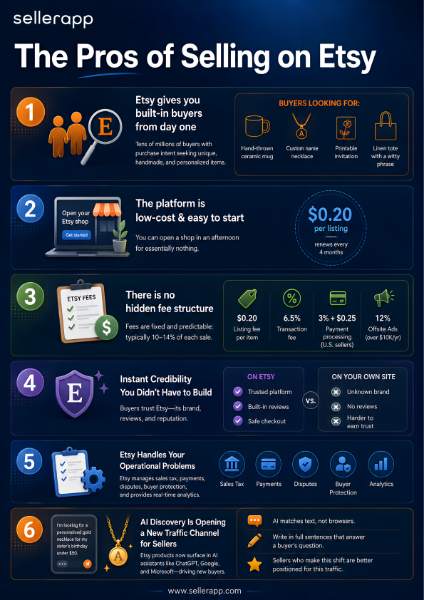
1. Etsy gives you built-in buyers from day one
This is the biggest reason sellers choose Etsy, and it holds up. Building your own Shopify store, running Google Ads from scratch, and growing Instagram from zero, those paths work, but they take months before you see consistent sales. Etsy puts you in front of tens of millions of buyers immediately.
But here’s what makes Etsy different from Amazon, eBay, or any other marketplace with a built-in audience: the type of buyer.
Etsy buyers aren’t price-comparison shopping. They’re looking for a hand-thrown ceramic mug that doesn’t look factory-made. A custom name necklace in 14k gold-fill. A printable birthday invitation with a specific aesthetic they’ve been searching for. A linen tote with a witty phrase that actually makes them laugh.
These are buyers with purchase intent that’s hard to manufacture elsewhere. They leave detailed reviews, they come back, and they tell their friends. Amazon gives you volume. Etsy gives you the right kind of customer to build a brand around, and that’s a meaningful difference.
2. The platform is low-cost & easy to start
You can open an Etsy shop in an afternoon for essentially nothing. The listing fee is $0.20 per item with no monthly subscription required.
Compared to building a website from scratch, including domain, hosting, design, and payment setup, Etsy is the clear winner for anyone starting on a tight budget or someone with commitment issues.
The setup is guided from start to finish. You don’t need much technical knowledge. For makers who’d rather spend their time in the studio than in a website backend, that simple entry matters.
3. There is no hidden fee structure
Here’s the thing about Etsy’s fees: they’re not hidden, but they’re not front-and-center either. Many sellers open a shop without realizing the 6.5% transaction fee. Here’s the full picture:
- Listing fee: $0.20 per item; renews every 4 months
- Transaction fee: 6.5% of the total sale price, including shipping
- Payment processing: 3% + $0.25 per transaction (U.S. sellers)
- Etsy Plus (optional): $10/month
- Offsite Ads: 12% on resulting sales, mandatory once you earn over $10,000/year
Add it all up, and you’re typically handing over 10–14% per sale to Etsy. That’s higher than it used to be; the transaction fee jumped from 5% to 6.5% in 2022. But it’s still under Amazon Handmade’s 15% referral fee.
The real advantage here is predictability. Unlike running paid ads with variable ROI or building a site with unpredictable hosting costs, Etsy’s fee structure is fixed. You can build it into your pricing from day one and know exactly what you’re working with.
One thing to watch is that the $0.20 listing fee looks trivial on a small catalog. On a catalog of 500+ SKUs, it stacks up fast: $100 every four months just to keep listings live, before a single sale. If you’re planning to scale your catalog significantly, factor this in early.
4. Instant Credibility You Didn’t Have to Build
When a buyer lands on your Etsy shop, they’re already on a platform they trust. Etsy has spent years on brand recognition, national ad campaigns, a clear identity, and a reputation for real makers selling real things.
New sellers inherit all of that trust on day one. You don’t have to convince a stranger that your checkout is safe or that you’ll actually ship the order.
Compare that to a brand-new standalone website with zero reviews. Getting someone to hand over their card information to a site they’ve never heard of is genuinely hard. On Etsy, that barrier is already gone.
5. Etsy Handles Your Operational Problems
By operational problems, we mean sales tax calculation, payment processing, dispute resolution, and buyer protection. Etsy manages all of it.
For a solo seller who wants to focus on making and selling rather than accounting and tech support, this is worth more than most people realize until they try running their own site.
The Seller Dashboard provides real-time data on views, visits, conversion rates, and revenue per listing. You get functional analytics without paying for a third-party tool. Not fancy, but it works.
6. AI Discovery Is Opening a New Traffic Channel for Sellers
In late 2025, Etsy integrated ChatGPT-powered checkout and, in early 2026, expanded through Google and Microsoft, meaning Etsy products now surface inside Google’s AI Search Mode, the Gemini app, and Microsoft’s Copilot Checkout.
Buyers who never visit Etsy.com can discover and purchase your products directly through AI shopping assistants.
The catch: AI assistants don’t browse listings the way a human does. They match product information from your listing’s text against what the buyer described in conversational language.
A title stuffed with comma-separated keywords reads poorly when an AI is matching it against “I’m looking for a personalized gold necklace for my sister’s birthday under $50.”
What actually helps: write your listing descriptions in full sentences that answer the question a buyer would ask an AI assistant. Include occasion, material, size, and use case in plain language, woven into the description itself, not just buried in tags.
Sellers who make that shift are better positioned for the traffic already flowing through these channels.
The Cons of Selling on Etsy
None of the marketplaces will get you smooth selling. And when you read about the pros and cons of selling on Etsy, the cons, risks, and challenges are mostly separated into different sections.
But here you will find a realistic view of the challenges Etsy sellers face, along with the risks and downsides of using Etsy.
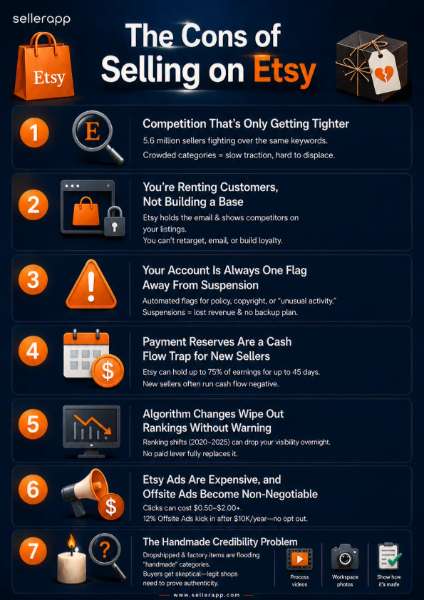
1. Competition That’s Only Getting Tighter
When Etsy launched, it felt like a craft fair. Today, it’s a search engine with 5.6 million sellers fighting over the same keywords.
Categories like personalized jewelry, printable wall art, candles, and digital planners are so saturated that new sellers often spend months getting zero traction despite doing everything right. The sellers who dominated these categories in 2019 built positions that are genuinely hard to displace now.
If you’re entering a crowded category without a real point of difference, not just a slightly different design, but a different customer, a different use case, or a genuinely better product, the competition alone will grind you down.
2. You’re Renting Customers, Not Building a Base
Every buyer who purchases through Etsy is Etsy’s customer, not yours. Etsy holds its email. Etsy shows competing products on your own listing page. You can’t retarget them, email them, or build loyalty in any direct way.
This is a limitation shared by all marketplaces; Amazon, eBay, and Walmart Marketplace have the same fundamental constraint. What’s specific to Etsy is that its buyers are especially brand-affinity driven. They’re the type of customer who would follow you off-platform if given the chance. That makes the inability to build a direct relationship even more costly than it would be elsewhere.
Platforms like Shopify give you full ownership of the customer relationship. On Etsy, you’re leasing shelf space in someone else’s store. Fine at the start. Costly if it’s still your only channel five years in.
3. Your Account Is Always One Flag Away From Suspension
Sellers across Reddit’s r/Etsy and r/EtsySellers, including Star Sellers with years of history, have had their shops suspended overnight with no warning and no clear explanation. Etsy’s automated systems flag accounts for copyright issues, policy violations, unusual activity spikes, or sometimes for reasons that remain opaque even after the appeal is resolved.
The financial impact is real. A two-week suspension during Q4 can cost an established shop $3,000–$5,000 in lost revenue.
The appeal process exists, and most legitimate sellers do get reinstated, but the waiting period is entirely outside your control. If Etsy is your only income source and your account goes dark, there’s no backup plan.
4. Payment Reserves Are a Cash Flow Trap for New Sellers
When you’re new, Etsy can hold up to 75% of your earnings for up to 45 days under its payment reserve policy. The logic is buyer protection because Etsy wants to confirm the seller delivers before releasing funds. That’s fair in principle.
In practice, it’s one of the most common shocks new sellers hit. You can have 10 orders sitting in your queue, with no access to the revenue to buy materials to fill them. We’ve seen this exact situation with clients who launched without a cash buffer and found themselves cash flow negative in their first month, despite real sales. Go in with at least one to two months of material costs set aside before you open.
5. Algorithm Changes Wipe Out Rankings Without Warning
Etsy’s algorithm has shifted repeatedly: personalized search in 2020, free shipping as a ranking factor in 2021, description keyword scanning in 2022, and increasing weight on geo-targeted keywords, conversion rate history, and listing recency in 2025.
This matters more on Etsy than on most platforms because organic search is the primary discovery mechanism. Unlike Amazon, where paid placement can compensate for organic ranking drops, Etsy sellers are heavily dependent on the algorithm showing their listings to the right buyer at the right moment. When the algorithm shifts, there’s no paid lever to pull that fully replaces it.
The pattern we see with clients: rankings drop not because they changed anything but because the algorithm re-evaluated their listings’ relevance based on conversion rate history. Listings pulling clicks from broad keywords but not converting get quietly deprioritized.
The fix is to tighten titles to attract fewer but more qualified clicks, prioritizing quality of traffic over volume.
6. Etsy Ads Are Expensive, and Offsite Ads Become Non-Negotiable
Etsy Ads (on-platform) work on a cost-per-click model. In competitive categories, clicks can run $0.50–$2.00+ with no guaranteed conversion. New sellers often burn through their first ad budget quickly before understanding what’s worth promoting.
Offsite Ads are a separate issue: once your shop earns over $10,000 in a year, Etsy automatically enrolls you and takes 12% of any sale driven through those ads. You cannot opt out above the threshold.
For some sellers, this delivers genuinely incremental revenue. For others, it’s a mandatory 12% fee on sales that would have happened anyway through organic search. Either way, you don’t get a vote.
7. The Handmade Credibility Problem Is Hurting Legitimate Sellers
Etsy is increasingly flooded with dropshipped goods, overseas factory products, and print-on-demand items listed under the “handmade” banner. Buyers are noticing. Some are getting burned, paying handmade prices for something that arrived in a plain poly mailer with no personal touch.
The impact doesn’t stay with the fraudulent sellers. It bleeds into every shop in the category. When a buyer has a bad experience with a “handmade” candle that’s clearly a factory pour, they approach the next legitimate candle shop with more skepticism, including yours. The problem isn’t just competition from resellers. It’s the erosion of the category trust that made Etsy buyers willing to pay more in the first place.
Sellers who navigate this well are leaning into authenticity signals: process videos on their About page, workspace photos in the listing gallery, and specific language about how and where the item is made. This isn’t just marketing. It’s active differentiation from the resellers hiding in your category.
What Our Clients Wish They’d Known Before They Began Selling on Etsy
These are some consistent patterns that come up over and over from real sellers, the kind of things that only click after you’ve been through the experience yourself.
Here are three patterns from our own clients, the situations that shaped how they sell today.
The Client Who Had Everything on Etsy , and Still Got Suspended
Ceramic seller, 4 years on Etsy, now multichannel with Amazon
One of our clients came to us after an experience that changed how she thought about Etsy entirely. She had 300+ sales, a five-star rating, Star Seller status, and 4 years of consistent selling. Then one morning, Etsy flagged a listing for allegedly resembling a copyrighted design. One she had created from scratch.
Her shop went dark for 19 days during the peak holiday season. She was reinstated, but she lost close to $4,000 in revenue during that window with zero recourse.
When she came to us, she wanted to expand to Amazon, not because she was done with Etsy, but because she’d learned that building on a single platform is building on borrowed ground. We helped her set up her Amazon Handmade presence alongside her Etsy shop. Today, her Etsy revenue is still strong, but a suspension doesn’t put her under.
Platform status is not platform security. Star Seller doesn’t protect you from automated flagging systems. Build your off-platform presence before you need it, not after.
The Client Who Blamed the Product When the Real Problem Was One Listing
Digital planner designer, 2 years on Etsy, scaled to 18 listings after working with us
A client came to us convinced his product wasn’t good enough. He’d launched with one digital planner listing, got some traffic, almost no sales, and spent six months tweaking the design and adjusting the price. Nothing moved.
After an audit, the problem was obvious: one listing. One keyword, one buyer intent, one shot at showing up in search. Etsy doesn’t rank shops; it ranks individual listings. Each listing is a separate search entry point targeting different keyword combinations and buyer moments.
We helped him build out 18 listings in a week, including variations, bundles, seasonal versions, and niche-specific editions. His revenue tripled within two months.
Before you change the product, widen your listing count. More listings mean more search entry points. One well-optimized listing is a single bet. Eighteen is eighteen bets running at the same time.
The Client Whose Traffic Kept Dropping Without Her Changing a Thing
A printable wedding stationery designer, now runs Etsy alongside her own site
This client spent two years watching her Etsy traffic drop, recover, then drop again, without changing anything about her shop. New photos, adjusted prices, rewritten descriptions. Nothing held on.
When we dug into her data, the issue was the conversion rate history. Her older listings had been pulling clicks from broad keywords like “wedding invitation” and “printable invite,” but those visitors weren’t buying. To the algorithm, that read as irrelevance. The listings weren’t what those searchers actually wanted. So Etsy quietly stopped showing them.
We tightened every title to long-tail, buyer-specific phrases: “minimalist garden wedding invitation template editable in Canva.” Rankings recovered within weeks. She now runs her own site alongside Etsy, capturing customers the platform would otherwise keep.
The algorithm isn’t random; it’s tracking things you can’t see on your end. High view volume with low conversion rates actively drags your rankings down. The fix isn’t more keywords. It’s more specific keywords that attract the right buyer, not just more traffic.
Best Tips Before You Open Your Etsy Shop
These are the things that actually move the needle. You can find the best tips before selling on Etsy marketplace in the section below:
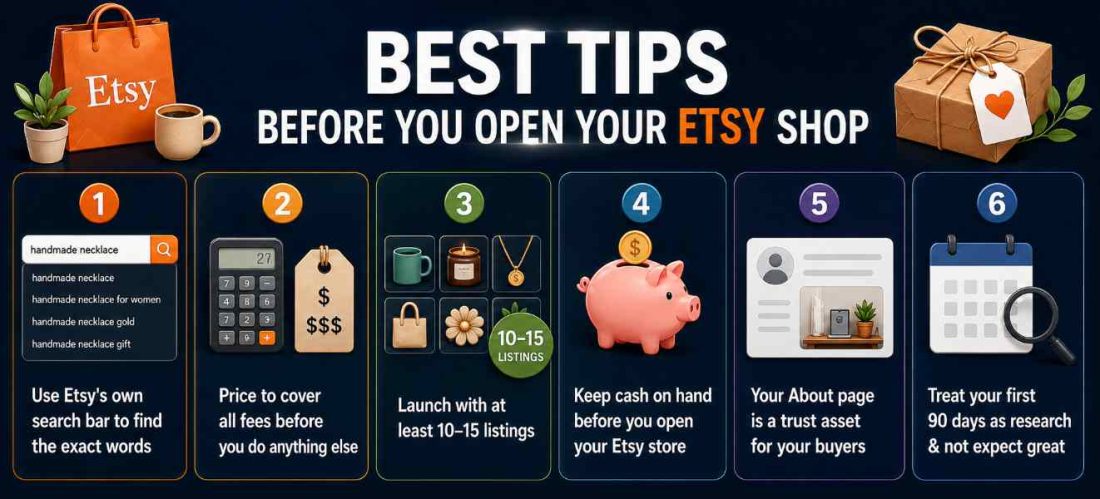
1. Use Etsy’s own search bar to find the exact words before you write your first listing
Type your product’s first few words into the Etsy search and look at the autocomplete. Those suggestions are real buyer searches.
The gap between how you’d describe your product to a friend and how buyers actually search for it is where most new sellers lose visibility. Use buyer language in your titles and tags, not your own vocabulary.
2. Price to cover all fees before you do anything else
Material cost times three is a rough starting floor. Add your hourly rate on top. Most new sellers price based on material cost alone and then feel resentful six months in when they realize they’ve been working below minimum wage. High prices don’t kill Etsy sales; low-quality photos and vague listings do.
3. Launch with at least 10–15 listings
Etsy’s algorithm treats a two-listing shop like a hobby project. Fifteen listings mean fifteen individual search entry points and a shop that signals an active, serious seller. If you don’t have fifteen products yet, create variations, sizes, colorways, or bundles until you do.
4. Keep cash on hand before you open your Etsy store
Payment reserves can hold 75% of your earnings for up to 45 days when you’re new. Don’t assume your first week’s sales are accessible. Go in with a buffer that covers two months of material costs.
5. Your About page is a trust asset for your buyers
Buyers on Etsy are making a deliberate choice to buy handmade over mass-produced. Your About page is the place they find out if you’re the real deal. Show your workspace. Show your process. Put a face to the shop. The sellers who convert well treat it like the most important page on their site, because on Etsy, it often is.
6. Treat your first 90 days as research & not expect great revenue
You’re learning what gets clicks, what converts, what buyers say in reviews, and what questions they ask before buying. That information is more valuable than early sales. Change one thing at a time so you can actually trace cause and effect.
Final thoughts: So, is selling on Etsy worth it?
If you have so far, it might have clicked with you. Is Etsy good for selling products? The answer is yes, but it’s not a passive income, and it’s not a forever platform for everyone.
It’s the right move if you’re testing market demand, need traffic without a marketing budget, or sell something with genuine craft or uniqueness. The built-in audience, low startup cost, and operational support make it one of the most accessible entry points in e-commerce for creative sellers.
It also depends entirely on what you sell. Handmade goods, personalized items, vintage finds, and digital downloads. Etsy is one of the best traffic sources you can tap without a marketing budget. For mass-produced products, price-sensitive categories, and anything that competes on volume, Etsy might not be the right place. The platform’s whole value proposition breaks down when your product is something a buyer could find on Amazon for $8 with free shipping.
It becomes a liability when it’s your only channel. The fees, the algorithm dependency, the lack of customer ownership, and the suspension risk. None of those are dealbreakers on their own, but together they form a pretty strong argument against building your entire business inside someone else’s platform.
The sellers who get the most out of Etsy use it as a launchpad, validate the product, understand the customer, generate early revenue, and then start building something they own alongside it.