

When it comes to Amazon PPC, clarity always outperforms chaos. A Single Keyword Campaign Amazon flips the usual familiar script by dedicating one campaign, one budget, and one set of bids to a single keyword.
Instead of letting your best-performing keywords drown in the noise of multi-keyword campaigns, single keyword campaigns put a spotlight on them. Thus, you get complete transparency on performance, sharper control over spend, and the ability to scale like a portfolio manager doubling down on winning investments.
But single keyword campaigns Amazon are often misunderstood.
Quick Guide:
They’re not a tool for keyword discovery or mass experimentation; they’re a precision instrument for optimization. Here in this article, we’ll discover how to use it for the best results.
A Single Keyword Campaign (SKC) is one campaign dedicated to a single keyword. In most cases, that keyword is an exact match keyword, so the campaign can operate with absolute precision.
Unlike regular multi-keyword campaigns, where the budget and bids are distributed across a list of search terms. Spending on SKCs is like isolating ad spend, dedicating its performance to a single keyword, which evidently makes every data point clear.
This is where many sellers go wrong. SKCs are not designed for keyword discovery in your ppc strategy. You deploy SKCs once you’ve already identified keywords that give the best conversions and if you want to increase their efficacy.
The best way to view Single Keyword Campaigns (SKCs) is as a portfolio management system for your keywords. Wondering how?
Take each campaign as an investment fund, where each has its own dedicated budget, risk profile, and performance metrics.
Just as a financial portfolio manager decides where to allocate more capital, you while running this type of campaign will decide which SKCs deserve more budget based on conversion efficiency, margin contribution, and ranking objectives.
Since we’ve compared Single Keyword Campaigns with investment funds in our previous section, some investments are high-risk experiments, others are steady performers, and only a few are comparable to blue-chip assets.
Those are your SKC-worthy keywords.
The role of a Single Keyword Campaign (SKC) is to double down on conviction and channel resources where performance is proven.
Here’s how to know which keywords deserve a separate Single Keyword Campaign (Amazon).
1. Conversion Efficiency is the First Filter
Your SQP data tells the story of what converts best and what does not. If you find a keyword that delivers conversions at a sustainable ACoS over time, it signals stability. If it is recognized as stable over a long phase, by isolating these keywords into SKCs, you will make the best use of it. On one hand, you prevent them from being overshadowed or budget-starved by less efficient terms, on the other, you make it work its 2x by recognizing its potential.
2. Margin-Driven Decision Making
High volume traffic for a keyword doesn’t always translate to profit-yielding. Also, a keyword that drives conversions but eats into thin margins can quietly erode profit, and such keywords are not suited for Single Keyword Campaigns (SKCs). SKCs should be reserved for keywords tied to high-margin SKUs only, where every click would fuel profitability instead of cannibalizing it.
3. Keywords Maintaining Stability for a Particular Placement
Keywords don’t perform equally across all placements. Some thrive at Top of Search, others dominate on Amazon Product Pages. If you see a single keyword consistently outperforming in a particular placement, that’s a cue to isolate it in an Single Keyword Campaigns Amazon and use placement multipliers to double down on the budget allocation.
4. The Winner’s Circle Mindset
Your SKC portfolio should represent your top 5–15 high-conviction keywords. By keeping this circle exclusive, you avoid campaign sprawl and focus your management time where it brings results.
The workflow is simple but strategic. You can discover these keywords in auto campaigns, then validate their potential in manual campaigns, and then turn the top converting keywords into SKCs.
Let’s break down the benefits and drawbacks of SKC with absolute clarity.
In multi-keyword campaigns, performance reporting blurs together the difference between impressions, clicks, and conversions shared across a cluster of terms. With SKCs, you isolate one keyword per campaign, making attribution razor-sharp.
So, you know exactly how much it costs to rank for “wireless earbuds” vs. “Bluetooth earphones.”
By assigning a campaign its own budget, you’re signaling to Amazon that this keyword deserves attention. Higher budgets on high-ROI keywords improve ad delivery consistency and protect you from loss of ad spends due to spending on non essential keywords..
Instead of running a single campaign where “yoga mat” eats up 80% of spend, you can reserve a $50 daily budget just for “eco-friendly yoga mat,” so that it doesn’t stop running the ads midway through the day.
Amazon’s placement multipliers (Top of Search, Product Pages, Rest of Search) can dramatically change your performance. Single Keyword Campaigns allow you to fine-tune multipliers at the keyword level. If “ergonomic office chair” performs best at Top of Search, you can boost only that placement aggressively without inflating bids for other terms. This control is impossible in multi-keyword setups, where placement bidding applies to the entire group and not concentrated to one.
Single Keyword Campaigns let you scale proven best performing keywords with precision. You can choose to increase budgets only for SKCs with stable ACoS and strong conversion rates. Sellers need to keep it experimental or underperforming SKCs at minimal spend until they prove worthy. This precision scaling minimizes wasted ad spend while compounding growth on profitable terms..
Single Keyword Campaigns Amazon also work beautifully in tandem with other campaign types. You can run SKCs for your top performers to maintain control. Use broader auto or research campaigns to discover new opportunities.
Once a keyword proves its value, migrate it into its own SKCs for scaling.This creates a campaign ecosystem keeping auto campaigns as feeders, Single Keyword Campaigns Amazon as performance engines.
If you have 300 products, each with 20 high-value keywords, you’re suddenly staring at 6,000+ Single Keyword Campaigns Amazon. That’s operational overload. The problem isn’t just the campaign count. It’s the ripple effect of complexity.
Reporting dashboards become cluttered with thousands of rows. Budgets get fragmented across too many campaigns, making spend allocation less predictable. Bid adjustments become hard for manual tweaks.
Without strong automation and thoughtful segmentation, Single Keyword Campaigns (Amazon) risk losing the very clarity they’re supposed to create.
The fix layering systems on top of SKCs. Use rules-based automation (or AI tools) to adjust bids, pause underperformers, and reallocate budgets in real-time. Group campaigns by category, product line, or seasonality so you’re not drowning in endless campaign lists. Keep Single Keyword Campaigns reserved for the top 10–20% of keywords driving the majority of sales, while letting broader campaigns handle the long tail.
Single Keyword Campaigns Amazon require manual oversight budget adjustments, placement testing, bid tuning so without rules-based automation or Amazon PPC tools, you’ll spend disproportionate time tweaking campaigns instead of focusing on strategy.
SKCs don’t help you find new keywords, but they refine performance of already-proven ones. If you rely only on SKCs, you’ll miss opportunities to capture emerging search trends.
Single Keyword Campaigns (SKCs) aren’t a blanket strategy. Knowing when to deploy them is just as important as knowing how to run them.
When seasonality spikes or competition heats up, precision becomes critical for desired results. Running Single Keyword Campaigns (Amazon) for keywords like “Christmas gift set” or “back-to-school supplies” ensures you can dominate placements and maximize short-term momentum while building long-term ranking strength.
After extensive testing, these are SellerApp’s step-by-step playbook to run Amazon Ads Single Keyword Campaigns.
Don’t pick a single keyword target for a Single Keyword Campaigns (Amazon) because it sounds good, do it because the data proves it. Check these requirements to proceed:
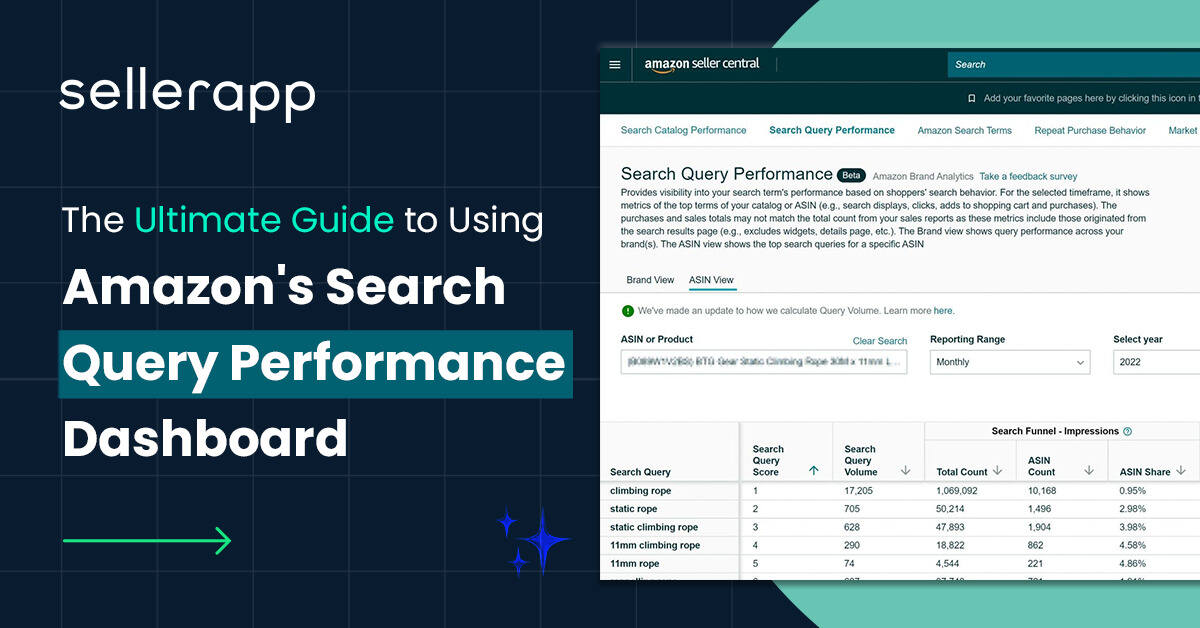
This is where SellerApp’s proprietary Search Query Performance Reports come into play. These reports are the best judge of which keywords to choose because they provide an accurate, data-driven view of keyword performance, prepared over an extended period.
By taking advantage of this dataset, our PPC managers can confidently identify high-performing and revenue-driving keywords, ensuring Single Keyword Campaigns (Amazon) target only the most profitable opportunities.
In a way Single Keyword Campaigns (Amazon) give you a dual advantage. They maximize revenue during seasonal peaks and defend your strategic keywords by keeping your listings visible against competitors.
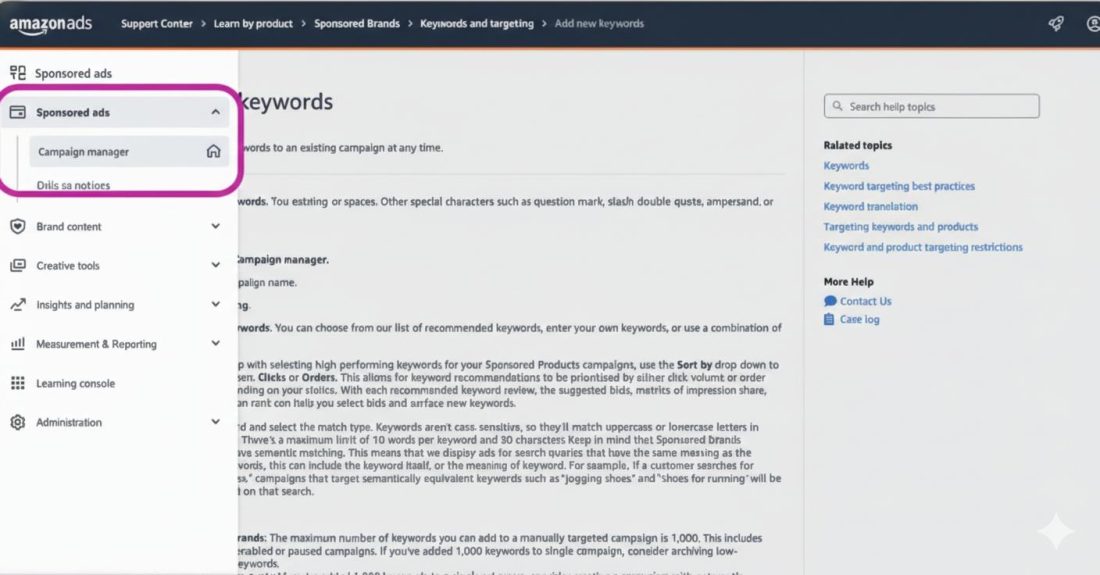
Isolate the keyword’s performance first. Create a clean, consistent campaign for keyword chosen for SKCs.
Create this configuration:
Why exact match first, you may think.
It is because the exact match type isolates the keyword’s performance. If you use broad or phrase matches too early, clicks and conversions could be coming from other variations, making it impossible to know what’s actually working.
This also prevents cross-campaign cannibalization, where two campaigns compete for the same keyword.
Changing multiple multipliers simultaneously makes it impossible to know which adjustment actually drove performance. By testing one placement at a time, you can clearly measure the impact.
Imagine you launch a Single Keyword Campaign for the keyword “wireless earbuds” with a base bid of $1.50. You notice Top-of-Search often gets clicks, but haven’t boosted it yet. So, you increase the TOS multiplier by 30% keeping ROS as-is.
Observe 7–14 days of performance (clicks, conversions, ACoS) and after that if you see TOS improving as well as conversions, you might further increase the bid. If it underperforms, roll back or shift budget to ROS.
Here’s a rule not everyone woult tell you about Single Keyword Campaigns (Amazon).
Search Keyword Campaigns should only be used to scale keywords that are already proven to perform well. They are not for testing or finding new keywords. To discover new keywords, you should run separate campaigns using broad match, phrase match, or automatic targeting. These campaigns help identify which keywords generate clicks, conversions, and revenue. If this trial and error seems too exhausting, you can always leverage the Search Query Performance report that you can download from Amazon Seller Central.
Once you find a keyword that has enough data showing it converts consistently and meets profitability goals, you can then move it into a Single Keyword Campaign to focus your budget and maximize results.
Treat the budget as the capital you’ll invest to achieve a conversion and ranking outcome.
A simple, transparent way to estimate a starting daily budget is to:
A well-funded SKC at TOS can generate enough sales to move your product from page 2 to page 1 for a target keyword. On the other hand, even a small number of daily conversions (e.g., 5–10) can signal to Amazon that this keyword is relevant, accelerating organic ranking growth.
For Example,
Start conservative (e.g., 50–75% of this estimate) and scale up as you validate performance.
Note:
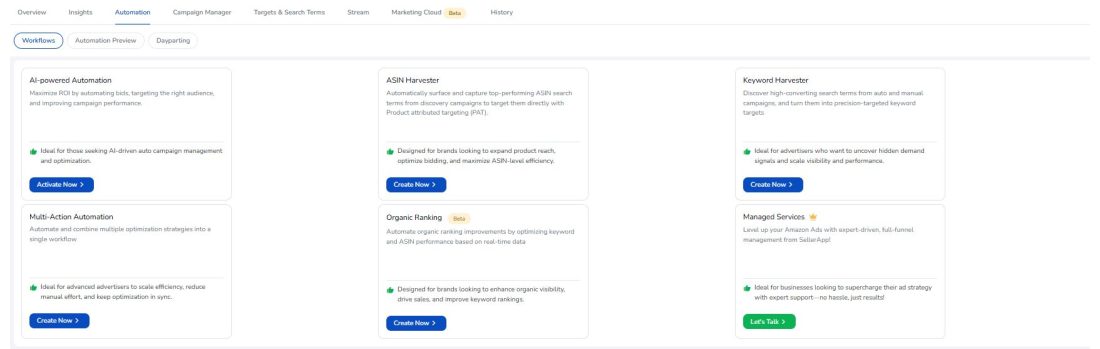
Automation allows campaigns to remain precise and profitable without constant human intervention, while saving time and minimizing human error. Here is what you can do with automation to run successful Single Keyword Campaigns (Amazon).
So, using automation, you can set conditions like if ACoS exceeds your target by more than a set tolerance (e.g., 5%) reduce bids by 15% while keeping you competitive enough to continue receiving clicks.
Single Keyword Campaigns (Amazon) are dynamic. Having an explicit pruning and consolidation cadence is essential while running these campaigns.
Pruning rules:
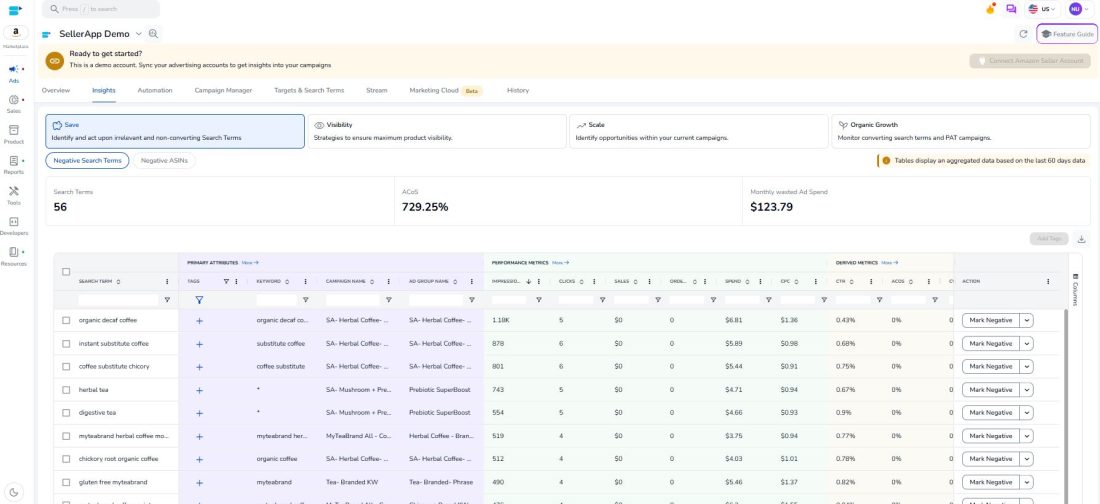
If you run broader phrase/broad discovery campaigns in parallel, add the SKC’s keyword as a negative (phrase/exact) in discovery campaigns to prevent it from stealing traffic. Within a campaign, add negative terms that prove irrelevant from search term reports.
Even exact Amazon Ads Single Keyword Campaigns can get triggered by close variants, depending on Amazon’s close variant handling. Maintain a negative list for common irrelevant terms for your category for transparency.
Good structure leads to fast decisions. Use labels to track the performance of these campaigns better, maybe by category or portfolio.
Labeling taxonomy follows this template:
Apply labels at campaign level for grouping: SKU, Category, Season (e.g., Q4), PortfolioPriority (P1, P2).
If you’re wondering what it may look like if we follow the
‘SKC-[Category]-[SKU]-[KeywordShort]-EX’ format for a kitchen tool brand:
SKC-Kitchen-12345-CastIronSkillet-EX
In a world where most sellers spread their spend thin across hundreds of terms, Amazon Ads Single Keyword Campaigns let you concentrate power on the few that actually move the needle.
If you treat them like a portfolio of high-conviction assets, managed with precision, monitored with data, and scaled with intent they’ll do more than optimize campaigns by becoming the backbone of your growth strategy on Amazon.