
The most expensive items on Amazon are not what you would expect. There is a common buying pattern among most people. They open Amazon looking for something practical, like a phone charger, a kitchen gadget, or maybe a book they have been putting off buying.
But there is another side of Amazon hiding in plain sight, and you can find it out easily by sorting any category from price: high to low.
Now, you are suddenly looking at a $1.6 million baseball, a $32 million painting made by a blind artist, and a diamond necklace with a price tag that would make anyone assume that it was a mistake.
But surprisingly, these are real listings, and shockingly, they have real buyers.
Now, if you’re wondering what is the most expensive item on Amazon? We’ve compiled a list that can help you out.
We covered 13 of the most expensive items on Amazon, ranging from jewelry and fine art to sports memorabilia, rare coins, luxury tech, and home decor. We’ve gone a step further and even reviewed each to find out why it costs what it does and what any Amazon seller or buyer, regardless of price point, can take away from it.
Quick Guide:
If you’re standing, we recommend you sit down. Especially as this list of expensive items on Amazon can make you feel like the ground is slipping out from under your feet.
Many of these listings rotate on and off Amazon’s marketplace due to their one-of-a-kind nature, authentication reviews, or completed sales.
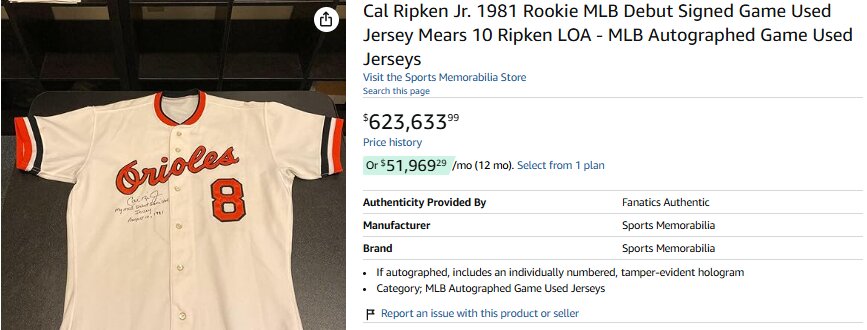
The first on the list of most expensive items on Amazon is the actual game-worn jersey from Cal Ripken Jr.’s 1981 MLB debut, signed by Ripken himself. He was a former American baseball player, regarded as one of the best shortstops in baseball history.
Graded MEARS 10, this is the highest possible rating from the most respected game-used equipment authentication organization and is verified by Fanatics Authentic with an individually numbered, tamper-proof hologram.
You must be thinking, why is this listed as the most expensive item sold on Amazon? It is mainly because of three factors converging.
The takeaway for sellers is that every sentence in your listing is a direct barrier to a buyer leaving your page to Google the terminology, finding a competitor, and not coming back. You have to explain what your credentials mean and not just what they are.
This is described as the only Frank Chance single-signed baseball on the listing, authenticated by PSA with a Certificate of Authentication included. Frank Chance was a Hall of Fame first baseman and player-manager for the Chicago Cubs, known for his leadership and his. 296 career batting average, and his ferocity both on and off the field.
During the offseason, he worked as a prizefighter. The professional boxers of the era called him “the greatest amateur brawler of all time.”
The baseball is listed as one of the most expensive item on Amazon because Chance played in baseball’s Deadball Era before memorabilia culture existed. He died in 1924. The supply of anything bearing his signature has been permanently closed for over a century.
PSA authentication on a piece described as the only one of its kind on earth converts historical scarcity into a defensible price. Without the PSA certification, this is a historically interesting baseball. With it, it’s a $363K artifact with no comparable alternative anywhere in the market.
For sellers, when supply is permanently closed, a player is deceased, a model is discontinued, and an era is over, the price is no longer set by the market. It’s set by the buyer who wants it most. Your listing’s job in that scenario shifts entirely. You’re not competing on price or features. You’re building the case for why this specific piece, at this specific moment, is the only one that will ever exist.
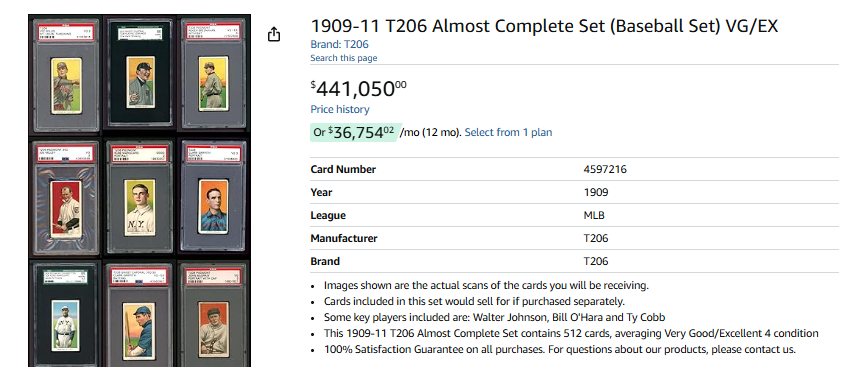
Hands down, the most iconic baseball card set ever produced had 407 cards, all in collectible condition, founded by the Mickey Mantle #311 card.
The Mantle card alone, in high grade, sells for millions individually. A complete set of this magnitude, assembled across decades of collecting, is extraordinarily rare to find in a single listing.
The price puts it on the list of the most expensive items on Amazon. Completeness commands a premium that individual cards never capture. The effort, knowledge, and decades of acquisition required to build a full 1952 Topps set is itself a form of value, and the market prices it accordingly. The Mantle is the crown jewel, but the completeness is what justifies the listing price over the sum of individual cards.
A buyer acquiring this set is acquiring both the collection and the work that built it.
Sellers should lead with their most compelling asset. If you’re selling a bundle, kit, or set, never bury the headline item inside a list. Your best piece should drive the opening image, the title, and the first sentence of copy.
Everything else supports it. Buyers decide in seconds whether to keep reading; give them the best reason immediately.
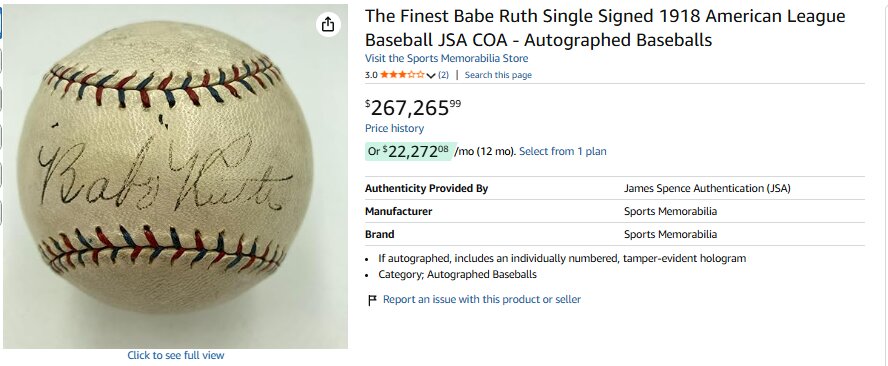
A single-signed baseball from Babe Ruth, dated to 1918, his final season with the Boston Red Sox before the sale to the Yankees that Red Sox fans still call “The Curse.” Carefully authenticated and presented as one of the finest examples of a Ruth single-signed ball still in existence.
Ruth’s signatures are not rare in the way that Frank Chance or Josh Gibson signatures are rare enough to exist that the market has comparables. What drives the price here is condition and date specificity.
A 1918 Ruth ball predates his Yankees era, predates his home run records, and represents a specific historical moment that fewer authenticated pieces document. The combination of signature clarity, ball preservation, and provenance specificity is what separates a $240K Ruth ball from a $40K one.
As a seller, in a category with multiple comparable items at different price points, your listing’s job is to explain the gap. If Ruth balls range from $40K to $240K, a buyer at the high end needs to understand why this one sits there and not at the bottom. That explanation lives in the specific details date, condition, signature placement, and provenance not in broad authenticity statements. The more specific your copy, the more defensible your price.
This is a rare historical financial document, an uncanceled stock certificate issued by Banco de Londres y Mexico, bearing the Queen Victoria stamp, complete with original dividend coupons. Interestingly, only 7 known copies exist. It is not a postage stamp in the traditional collecting sense. It is an original financial instrument from 1905, undisturbed and uncanceled, with dividend coupons still attached.
There are only seven known copies. That number does all the heavy lifting. When only 7 of anything survive from a documented historical financial institution, the price is set by the buyer who wants it most, not by market comparables, because comparable supply essentially doesn’t exist.
The dividend coupons still attached confirm it was never redeemed, adding a layer of historical completeness that a stripped certificate would lack entirely.
Unsupported scarcity language like “limited edition,” “rare find,” and “one of a kind,” which does almost nothing because buyers have been conditioned to distrust it. Verifiable scarcity with a documented source behind it multiplies perceived value immediately and removes the skepticism that vague claims create.
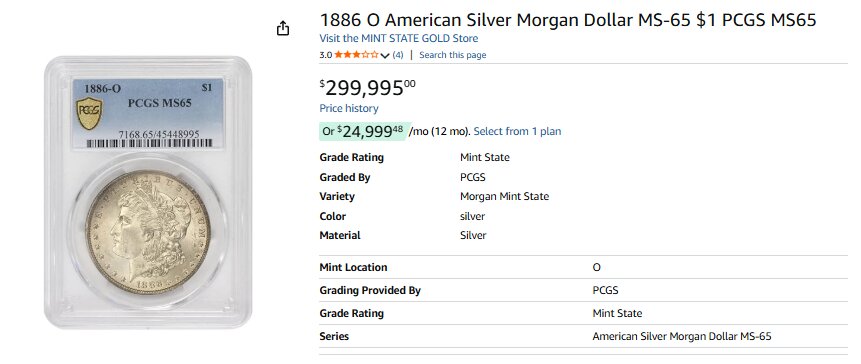
A Morgan Dollar minted in New Orleans in 1886, graded MS-65 by the Professional Coin Grading Service (PCGS), is in near-perfect condition with only minor imperfections visible under magnification. The “O” mint mark, which designates New Orleans production, is a single letter that accounts for a significant portion of the price.
There are three factors that make it stack. The O mint mark New Orleans production runs were lower than Philadelphia or San Francisco, making surviving examples rarer. The MS-65 grade jump from MS-64 to MS-65 is not marginal because coins at 65 are exponentially rarer and command exponentially higher prices.
The PCGS slab is the gold standard of coin grading, whose certification is itself a recognized and tradeable document in the collector market. This coin isn’t just rare. It’s rare in the right ways, verified by the right organization, at the right grade.
Industry-specific grading systems are a foreign language to buyers outside the category. If your product carries a certification, grade, or standard that is meaningful within your niche but opaque to outsiders, explaining it plainly in your listing is the bare minimum.
If a buyer has to leave your page to understand what MS-65 means, they may not come back. Explain it yourself and keep them there.
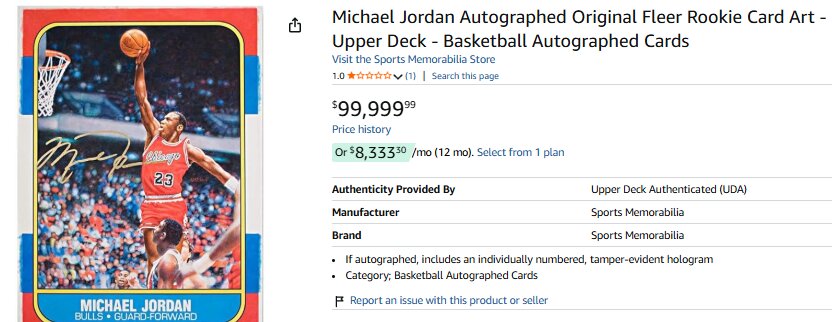
The most iconic basketball card ever produced, Jordan’s rookie card from the 1986–87 Fleer set, autographed and listed by Sports Memorabilia.
Widely credited with shifting the entire trading card hobby’s center of gravity from baseball to basketball, this card defines the category the way the 1952 Topps Mantle defines baseball cards.
Cultural weight plus condition plus signature. At PSA 10 gem mint, unautographed, this card reaches millions. A $99,999 autographed listing suggests a strong but not perfect grade, still firmly investment-grade.
The Sports Memorabilia seller brand carries its own weight here. A card at this price from an unknown seller is a terrifying deal. From an established memorabilia house, it can lead to conversion.
Your seller identity is part of the product at high price points. A $99,999 card listed by an unknown account is a different transaction entirely from the same card listed by a named, established memorabilia house.
If you are selling high-ticket items, your seller name, history, and verifiable reputation need to be visible and prominent within the listing itself, not just on your seller profile page, because most buyers won’t navigate there.
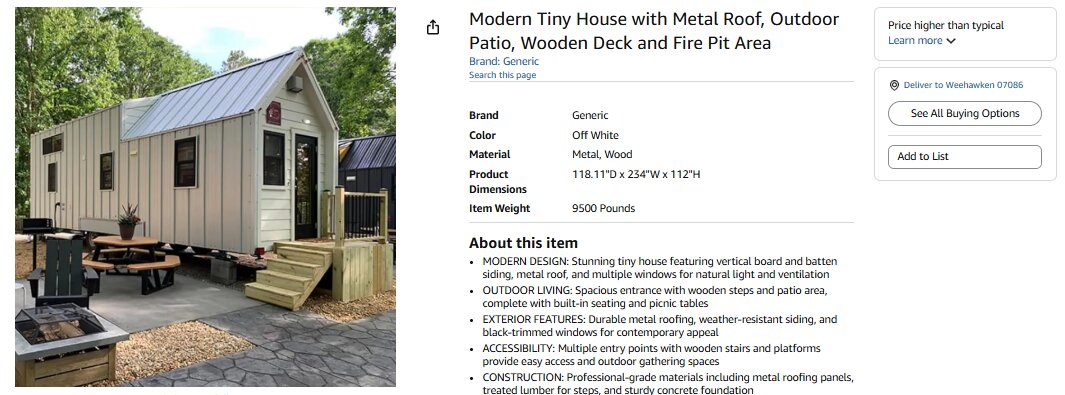
A fully customizable mobile home offering three bedrooms, dual lofts, and a sofa bed, sleeping up to six people. Exterior options include wood-grain steel or cedar siding, with white, charcoal, or black trim.
Built-in washer/dryer space, smart storage throughout, and eco-friendly materials. It does not include land, plumbing hookups, or assembly.
This is the only item on this list that isn’t a collectible, and that’s precisely why it belongs here. It represents Amazon’s quiet expansion into B2C high-ticket goods that have nothing to do with rarity or provenance.
The price is driven by materials, customization, and the sheer audacity of listing a house on a platform most people use for batteries and shampoo. What’s remarkable is that it works; the tiny house category on Amazon has grown significantly, driven by buyers who value Amazon’s trust infrastructure and logistics convenience, even at this price point.
Amazon’s trust infrastructure is worth more than most sellers realize. A buyer spending $94,500 on a tiny house could go directly to a manufacturer, but they choose Amazon because the platform’s checkout, payment protection, and seller accountability framework lower the psychological risk of a major purchase.
So if, as a seller, you are selling expensive items in a category where buyers are more likely to budge before making a purchase, then being on Amazon becomes more like a trust decision. How trustworthy your brand and products will appear to the buyers. You can use it explicitly in your listing copy.
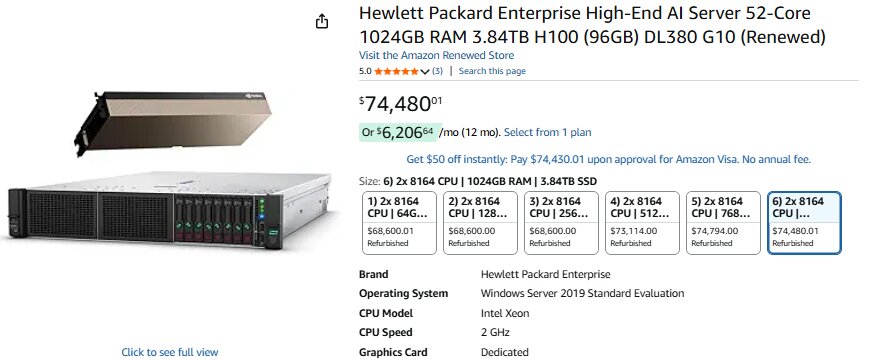
A high-end enterprise AI server built for demanding data processing and advanced AI workloads. Specifically, 52 cores. Here, a 52-core server means it has 52 processing units working at the same time, allowing it to handle massive data and complex AI tasks much faster and more efficiently
Listed directly on Amazon with free shipping. Enterprise-level support is not included unless specifically stated in the listing; buyers should verify support terms before purchasing.
The cost reflects the processing architecture, memory capacity, and the infrastructure investment required to build machines capable of handling serious AI workloads. What’s notable is that it’s listed on Amazon at all.
The B2B purchasing behavior on Amazon is underestimated by almost every seller not actively participating in it. A procurement manager ordering a $75K server on Prime because it can arrive in 2 days is not an outlier; it’s a documented pattern in enterprise buying.
B2B buyers on Amazon are real, motivated, and have purchasing authority. They make decisions on specifications.
If you sell industrial or enterprise products, your listing needs to function like technical documentation, with exhaustive specs, compatibility details, support terms, and lead times clearly stated. A $75K server listed like a consumer product is leaving serious conversion on the table.
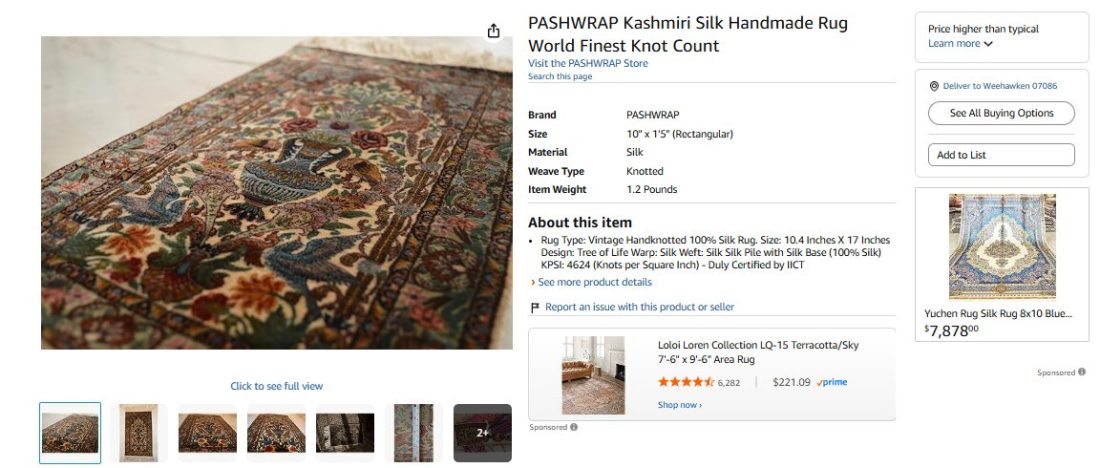
A handmade rug crafted entirely from pure Kashmiri silk, featuring the traditional Tree of Life design with a knot density of 4,624 knots per square inch. At that density, a single square foot contains thousands of individually hand-tied knots, work that takes a master artisan months to complete.
Four pillars drive rug pricing, and this listing hits all of them. Pure Kashmiri silk commands a significant premium over wool. Knot density of 4,624 knots per square inch is exceptional; most commercial rugs sit under 200.
There are several rugs in this category; then why is this so expensive? Let us break it down for you. If you look closely, the design is intricate and complex. The Tree of Life pattern requires consistent precision across tens of thousands of individual knots. And machine irrepeatability, every knot was tied by a human hand; above that, the labor cannot be approximated. Remove any one pillar and the price drops. All four together justify the number.
Sellers should be mindful that if an amount is associated with a product and there is no clear justification for the number, it will not help with purchases. For this product, 4,624 knots per square inch is powerful, but only when you explain that a standard rug has under 200. Every technical detail in your listing should include a plain-English explanation of why it matters to the buyer, not just what it measures.
A full-size electric guitar signed by all four members of the Rolling Stones, Mick Jagger, Keith Richards, Charlie Watts, and Ronnie Wood, accompanied by a letter of authenticity.
Here is a thing, though. Full-band signatures are inherently rarer than individual ones, and Charlie Watts’ death in August 2021 permanently changed the valuation on every authenticated Stones piece bearing his signature.
The existing inventory of four-signature Stone pieces is now fixed. No new ones will be created. The letter of authenticity present in this listing matters, though JSA or Beckett certification would carry more weight than a generic COA and would likely support a higher price point.
External events permanently change the value of what you’re selling, and your listing needs to reflect that in real time. Watts’ death made every authenticated four-signature Stones piece more scarce overnight.
If something changes in your product’s world, a figure passes, a brand gets acquired, or a model is discontinued, update your listing immediately to reflect the new scarcity reality. Listings that don’t account for market-shifting events are priced in yesterday’s world.
A handcrafted diamond necklace featuring VS1–VS2 clarity stones set in 14K white gold. The VS1–VS2 clarity means the diamond has very tiny inclusions that are hard to see even under magnification, so it looks clean and sparkly to the naked eye while maintaining strong value.
Even though it is not listed in Amazon’s jewelry category in 2026, it represents the high end of fine jewelry available through the standard Amazon marketplace rather than Amazon Luxury Stores.
VS1–VS2 clarity is a specific, verifiable grade. Diamonds at this clarity level have only minor inclusions invisible to the naked eye, placing them firmly in the investment-quality range. The 14K white gold setting adds material value.
The price reflects genuine material cost and craftsmanship rather than brand premium, which is both the strength and the weakness of this listing. The price must be justified entirely by the specification and documentation.
In jewelry, third-party diamond grading (GIA, AGS) is crucial. The same stone, graded versus ungraded, can differ by multiples in perceived and actual value.
If you sell fine jewelry and your listing doesn’t clearly state the grading body and the specific grade in the title and first bullet point, you are competing against certified stones at a structural disadvantage, regardless of your actual quality.
The last game bat was used by Roberto Clemente in 1972, the final season of his career before his death on a humanitarian mission on December 31, 1972. Stamped with Clemente’s name and accompanied by a PSA Certificate of Authenticity. Listed by Sports Memorabilia.
He was a Hall of Fame baseball player for the Pittsburgh Pirates, famous for his 3,000 hits, championship career, and humanitarian legacy.
The “last game bat” provenance is one of the most powerful narratives in sports memorabilia, and Clemente’s death makes it permanent. He died at 38 on New Year’s Eve, delivering aid to earthquake victims in Nicaragua.
In 1973, he became both the first Caribbean and first Latino-American player inducted into the Baseball Hall of Fame, with the standard five-year waiting period waived immediately after his death. The bat is not just a piece of equipment. It is the last physical object he used professionally before his death that made him a humanitarian icon. The PSA certification confirms what it is. The story explains what it’s worth.
Provenance attached to a specific historical moment, the last game, the debut, or the record-breaking at-bat commands a premium that general provenance never reaches.
If your product has a documented connection to a specific, verifiable moment in history, that moment is the most valuable thing in your listing. Build every sentence around it. The object is the evidence, and the moment is the product.
The obvious question nobody asks out loud is: why on earth would a serious buyer spend $561,000 on Amazon when Christie’s, Sotheby’s, and Heritage Auctions exist specifically for this?
We have listed three reasons, and none of them is what you’d expect:
1. The listing is a discovery tool & not a checkout page
At these price points, no serious buyer is clicking “Add to Cart.” They find the listing, verify the seller is legitimate, and contact the seller outside Amazon entirely, avoiding the referral fee on a transaction that could run into six figures.
The listing does its job the moment a collector Googles the item and finds a verified seller. Everything after that happens offline.
2. Amazon’s verification infrastructure changes what a buyer is willing to risk
Outside Amazon, a $200,000 collectibles purchase means wiring money to a stranger and hoping for the best.
The same purchase through a verified Amazon seller, with seller history, buyer reviews, and account accountability, feels structurally different even when the actual transaction never goes through Amazon’s checkout. The platform’s reputation builds trust before a single message is exchanged.
3. Expensive listings are the passive price base for everything beneath them.
This is the most underappreciated dynamic in high-ticket Amazon selling, and it works whether the expensive listing ever sells or not.
When a buyer lands on a category page and sees a $561,000 jersey at the top, something shifts psychologically before they’ve read a single word. The brain immediately recalibrates what “expensive” means in this category.
A $2,500 signed bat that would have felt like a significant purchase five minutes ago now reads as an accessible entry point. A $15,000 game-worn jersey feels mid-range. The expensive listing at the top doesn’t just turn heads; it makes everything below it look affordable.
This is called price anchoring. It’s a documented cognitive bias with decades of behavioral economics research behind it. The first number a buyer sees in a category disproportionately influences every subsequent price evaluation. Retail stores use it deliberately, placing a $4,000 watch next to a $900 one to make the $900 feel like the sensible choice. Amazon’s open marketplace creates it accidentally, at scale, across every category where expensive listings exist.
If you had to take away anything from this, make sure it is this one. When you’re building a listing, look at what sits above you in the category before you look at what sits beside you.
The listing above yours is shaping how buyers feel before they read a single word you’ve written. If you can position yourself as the anchor, even temporarily, you’re not just competing for one sale. You’re influencing the price expectations of every buyer who enters the category.
If you are a seller reading this, here are five takeaways you can apply to your business, regardless of what you sell.
1. Product Authentication is important to justify the pricing
Professional Sports Authenticator, James Spence Authentication, Professional Coin Grading Service, Memorabilia Evaluation and Research Services, and Gemological Institute of America certifications are not badges of credibility; they are pricing mechanisms.
The same coin, graded versus ungraded, can differ by ten times in price.
The same signed baseball with one authentication body versus two commands a measurably higher price, not because the second certification adds new information, but because it adds a second independent party willing to put their institutional reputation behind the claim.
Every certification you add to a listing is a documented, verifiable reason to charge more. Buyers do not pay more because they trust you. They pay more because a recognized outside institution has removed the need to trust you at all.
2. How storytelling matters more than technical details for expensive items on Amazon
Look at the Cal Ripken Jr. jersey versus the Hewlett-Packard Enterprise server. The server listing needs exhaustive technical specifications, including cores, memory, and compatibility, because the buyer is making an infrastructure decision, and emotions are irrelevant.
The jersey buyer is not purchasing fabric and thread.
They are purchasing the weight of a 1981 debut and what it represents in baseball history. Listing copy that leads with specifications on an emotionally driven product asks the buyer to do the interpretive work themselves.
Most will not bother. The listings on this page that command the highest prices are not the most technically detailed; they are the ones where the human story behind the object is impossible to miss. If your product has a founding story, a craft tradition, or a historical moment attached to it, and your listing leads with dimensions and materials instead, you are competing on price by default.
3. Verifiable scarcity can make better conversions than claimed scarcity
As we have already discussed in the previous section, creating scarcity like “Only 7 known copies” requires $241,000 because the number is sourced, documented, and independently verifiable. A buyer can research it, confirm it, and trust it. But a listing with a claim of scarcity, like “Limited quantities available,” commands nothing because buyers have been conditioned by a decade of false urgency to dismiss it on sight.
The mechanism is the same; scarcity drives price, but the execution is entirely different. Claimed scarcity asks buyers to take your word for it. Verifiable scarcity gives them the tools to confirm it themselves and arrive at the same conclusion independently. One closes premium sales. The other gets ignored.
4. Your seller identity is part of the product
A $99,999 Michael Jordan rookie card listed by an unknown account is fundamentally different from the same card listed by Sports Memorabilia, an established, named memorabilia house with documented history and a verifiable reputation.
At high price points, buyers are not just evaluating what they are buying; they are evaluating who they are buying it from and what recourse they have if something goes wrong. Your seller name, history, and publicly visible reputation are not background details.
They are active components of the purchase decision. If your seller profile is thin, anonymous, or unverifiable, your listing is working against itself regardless of how strong the product is.
5. Your product specifications without context will not help with sales
4,624 knots per square inch is a number. 4,624 knots per square inch, compared to a standard commercial rug’s 200, is a reason to pay $50,000. The difference between those two sentences is the difference between a specification and a value argument.
Every technical detail in a listing carries latent persuasive power that only activates when the buyer understands what the number means relative to something they already know. Grading scales, knot densities, carat weights, and core counts.
None of them sells on its own. Which suggests that the moment you give a buyer a comparison that makes the specification meaningful, the number starts justifying itself. Translate every specification into plain language before your competitor does.
The most expensive items on Amazon have nothing in common with the cheapest ones except one thing: trust. The expensive items on Amazon exist just to make the mechanics of that competition impossible to ignore.
For a product priced at $561,000, you cannot get away with a blurry thumbnail and three bullet points. At $241,000, you cannot claim scarcity without documenting it. And at $99,999, you definitely cannot hide behind an anonymous seller account.
What is interesting is that the lessons these listings teach are not exclusive to sellers who are selling products at these price points. A brand selling $49 kitchen gadgets faces the exact same fundamental challenges. They have to build trust quickly, justify the price visually, make the story impossible to miss, and give buyers a documented reason to choose you over the listing next to yours. The mechanics do not change with the price.
The gap between a $29 listing and a $29,000 listing on Amazon is almost never the product alone. It is the story, the proof, and the positioning. These 13 most expensive items on Amazon, whether they sell tomorrow or sit untouched for years, are not unusual.
If you’re considering selling expensive products, understanding product categories is essential. This is where SellerApp’s detailed reports and insights can help you understand where you actually stand before you price high.
And for brands ready to operate confidently in premium segments, SellerApp’s full account management services bring together positioning, listing optimization, and advanced advertising strategy to ensure that higher pricing is supported by stronger fundamentals.