
The Amazon NARF program (North American Remote Fulfillment) represents a fundamental shift in how U.S. sellers approach cross-border expansion.
Instead of managing separate warehouses, country-specific inventory pools, and fragmented operations, sellers can now access Canadian and Mexican demand using a single, U.S.-based FBA inventory without incurring capital costs for international stock placement.
Until recently, expanding into Amazon.ca or Amazon.com.mx required sellers to absorb risk upfront. For example, shipping inventory internationally, navigating local compliance, rebuilding pricing structures, and hoping demand materializes.
While traditional local FBA expansion still has its place for mature brands, it creates friction for sellers who want to efficiently validate international demand.
The Amazon NARF program flips this equation by enabling demand-first expansion, allowing sellers to test, learn, and scale before making permanent operational commitments.
This guide is designed for U.S.-based sellers who want to go beyond surface-level explanations. It will break down how the Amazon NARF program actually works under the hood, how fees and fulfillment logic impact real profitability, which product categories perform best, and where sellers commonly lose margin or visibility.
Most importantly, you’ll also learn how to utilize the Amazon NARF program as a strategic testing layer, combining inventory, pricing, and advertising data to determine when remote fulfillment is the more effective approach and when local FBA expansion is the smarter move.
As Amazon continues to push unified accounts, remote fulfillment infrastructure, and cross-marketplace buying behavior, sellers who understand how to use the Amazon NARF program strategically, not passively, will be better positioned to capture international growth without sacrificing control, margins, or operational clarity.
Quick Guide:
At its core, the Amazon NARF program (North American Remote Fulfillment) is Amazon’s way of separating marketplace reach from physical inventory location, but only within North America.
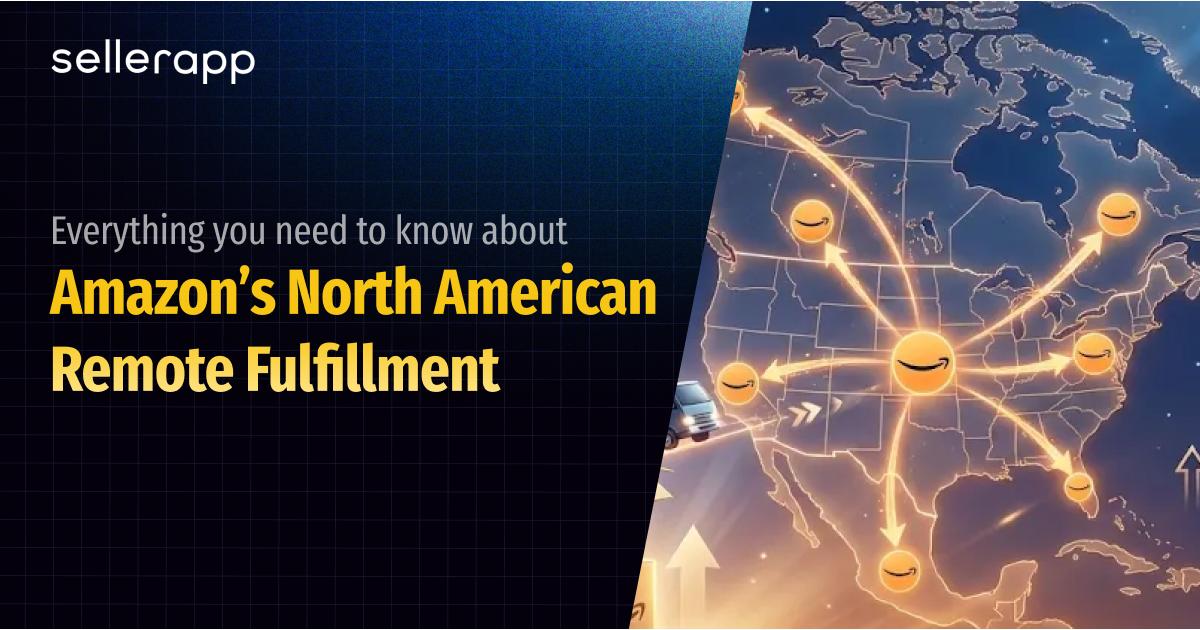
Suppose you stock your product in a U.S. Amazon warehouse in Texas. A customer in Toronto or Mexico City searches for that product on their local Amazon site, buys it as if it were a domestic listing, and Amazon simply ships that same U.S. unit across the border.
You didn’t send inventory to Canada or Mexico, you didn’t open new warehouses, and you didn’t manage separate stock pools. The sale still came from your U.S. inventory, just through a different storefront
Instead of asking sellers to place inventory inside Canada or Mexico to sell on Amazon.ca or Amazon.com.mx, NARF allows eligible U.S. FBA inventory to be remotely fulfilled across borders from U.S. fulfillment centers.
This distinction is important because, under NARF, inventory does not move unless a customer order triggers it.
There is no proactive stock transfer, no local warehousing in CA or MX, and no need to forecast demand on a market-by-market basis. Your U.S. FBA units remain your single source of truth, while Amazon handles cross-border fulfillment, customs processing, and last-mile delivery behind the scenes.
What enables this model is Amazon’s global SKU and unified inventory logic. When you enroll in NARF, Amazon links your U.S. ASIN to its corresponding marketplace listings in Canada and Mexico.
These listings are not standalone SKUs with separate inventory groups; instead, they end with demand that is connected to the same U.S.-held stock. Realistically, this means:
This structure is intentional. Amazon is optimizing for seller liquidity and catalog depth, not localized speed. Delivery times are longer than domestic FBA, but Amazon offsets this by prioritizing selection in underpenetrated markets and making cross-border buying feel native to shoppers.
It’s also important to understand what the Amazon NARF program is not.
The Amazon NARF program is often confused with Remote Fulfillment with FBA Export, but the two programs serve fundamentally different purposes. FBA Export focuses on global outbound demand, shipping individual orders from the U.S. to dozens of international destinations where Amazon does not operate full marketplaces. NARF, by contrast, is a marketplace-native solution.
Listings appear directly on Amazon.ca and Amazon.com.mx, participate in local Buy Box dynamics, and integrate into regional search and advertising systems. The customer experience is rooted in the local marketplace, despite the fact that fulfillment is cross-border.
Compared to traditional FBA expansion, the differences are even more strategic. Local FBA requires sellers to preposition inventory, manage country-specific pricing and taxes, and absorb demand risk upfront.
The Amazon NARF program removes that commitment layer. It allows sellers to validate product-market fit, price elasticity, and conversion behavior in Canada and Mexico before deciding whether those markets justify dedicated inventory.
Seen through this lens, the Amazon NARF program is less a logistics program and more a controlled exposure mechanism. It gives sellers reach without permanence, data without overcommitment, and optionality without fragmentation.
Sellers who treat it as a simple “turn it on and forget it” feature miss its real value. Used deliberately, NARF becomes a testing ground that informs smarter, more capital-efficient decisions for international expansion.
The Amazon NARF program does not create demand. It reveals demand that already exists but remains inaccessible due to structural friction.
Understanding whether the Amazon NARF program makes sense for a U.S. seller requires abandoning top-line marketplace comparisons and instead analyzing how demand, competition, and pricing behave under constrained selection environments.
Amazon.ca and Amazon.com.mx are not “smaller versions” of Amazon.com. They are structurally different ecosystems shaped by thinner catalogs, slower seller expansion, and asymmetric product availability.
In Canada, demand is primarily driven by selection gaps rather than novelty. The marketplace consistently under-indexes on long-tail SKUs, replacement parts, and accessory products that U.S. sellers often consider commoditized.
These items may be buried under price wars in the U.S., but in Canada, they frequently surface organically because fewer sellers have bothered to localize or expand their offerings. The result is a demand curve that favors catalog completeness over launch velocity.
Mexico presents a different pattern. Demand skews toward availability-driven conversion. Shoppers often encounter U.S.-origin products as the only viable option within a category, particularly in electronics accessories, home utilities, and personal care. Price sensitivity is higher, but elasticity is nonlinear: once a product clears an implicit affordability threshold, conversion jumps sharply. Sellers who misinterpret this behavior often over-discount without unlocking additional volume.
The critical insight is that NARF demand tends to emerge after U.S. product-market fit is already established. Products that struggle to convert domestically almost never improve cross-border. Conversely, SKUs with stable U.S. conversion rates often find disproportionate traction because they solve a problem that local sellers in CA or MX simply haven’t addressed.
The commonly cited 20–30% incremental revenue uplift understates NARF’s value because it treats cross-border sales as a flat multiplier rather than a distributional effect. In practice, revenue gains are unevenly concentrated across a subset of SKUs, typically those with:
These SKUs often experience a form of demand smoothing. Canadian and Mexican sales frequently peak during periods when U.S. demand softens, particularly outside major U.S. promotional windows. This temporal offset can stabilize cash flow and inventory turns in ways sellers don’t anticipate when modeling NARF purely on unit economics.
Category performance under the Amazon NARF program also follows structural logic. Electronics accessories succeed not because of trendiness, but because cross-border compatibility collapses buyer hesitation.
Health & beauty products thrive when they meet compliance thresholds, as repeat demand compounds quickly in underserved categories. Home goods perform well when they are utilitarian rather than aesthetic; function travels better than taste across borders.
What advanced sellers notice is that margin dilution is not a linear process. While per-unit fulfillment costs increase, advertising costs often decrease at a faster rate. When blended, contribution margin frequently remains intact or improves slightly, especially for sellers who do not chase aggressive rank gains and instead let organic discovery do the work.
Lower competition in Canada and Mexico is often framed as “fewer sellers bidding,” which is technically true but strategically incomplete. The deeper advantage lies in algorithmic calm. Rankings move slower. Buy Box ownership is stickier. Listings degrade more gradually.
This stability changes how pricing should be approached. On Amazon.com, repricing is often a defensive reaction to dozens of micro-movements daily. Under NARF, pricing can be intentional. Sellers who hold price rather than chase volume often maintain Buy Box control because Amazon prioritizes reliable fulfillment and historical conversion over marginal price differences.
Advertising benefits compound this effect. Lower CPCs matter less than lower noise. With fewer advertisers flooding auctions, keyword intent is cleaner and campaign learning cycles shorten. A modest Sponsored Products budget can achieve what would require heavy spending in the U.S., especially for exact-match, utility-driven terms.
Advanced sellers also exploit pricing disparity. Cross-border shoppers implicitly accept a premium for U.S.-sourced products, particularly when alternatives are scarce. Sellers who simply convert USD to CAD/MXN often leave margin on the table. Those who price for positioning, not parity, extract far more value without sacrificing conversion.
Advertising within the Amazon NARF program requires a fundamentally different mindset from domestic campaign scaling.
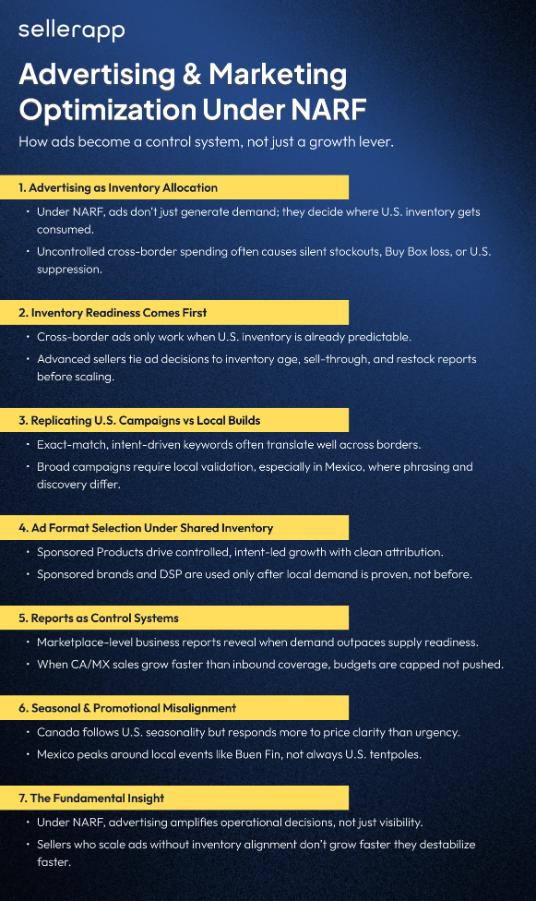
Because every order placed in Canada or Mexico pulls from the same U.S. inventory pool, advertising is no longer just a demand-generation lever, as it becomes an inventory-allocation mechanism.
Sellers who ignore this coupling often experience silent stockouts, Buy Box instability, or suppressed U.S. performance without realizing advertising was the root cause.
The first constraint advanced sellers apply is inventory visibility. Before launching or expanding ads in Canada or Mexico, U.S. inventory health must already be predictable. Sellers who rely on aggressive domestic turns or thin inbound buffers quickly discover that even modest cross-border ad spend can destabilize restock cycles.
This is why mature operators tie advertising decisions directly to the Inventory Age, Sell-Through, and Restock Inventory reports. When inbound coverage cannot absorb incremental demand, ads are delayed, throttled, or limited to exact-match only.
Deciding whether to copy U.S. campaigns or build region-specific ones depends on the stability of intent, not convenience. Exact-match campaigns built around functional, utility-driven keywords tend to translate well across borders because the underlying buyer problem remains the same. In these cases, U.S. search term reports already provide enough signal to justify replication. Broader campaigns behave differently.
In Canada, translated U.S. terms often work; however, in Mexico, early search term data frequently reveals alternative discovery paths shaped by language nuances and local phrasing. Advanced sellers treat early, low-volume reports as strategic intelligence rather than noise, adjusting their structure before scaling their spending.
Ad format selection under the Amazon NARF program must also reflect the shared-inventory constraint. Sponsored Products remain the primary tool because they align tightly with purchase intent and provide clean attribution.
Sponsored brands can be effective once brand search demand is proven locally, but deploying them prematurely often accelerates awareness without improving conversion, increasing inventory draw without corresponding efficiency.
DSP, when available, is best used as a validation layer rather than a scaling engine. Retargeting or interest-based audiences in Canada or Mexico helps sellers understand whether brand equity transfers across borders, allowing them to make informed decisions about committing to local inventory or expanding ad budgets.
Reporting discipline is what separates controlled NARF growth from accidental overexposure. Advanced sellers monitor marketplace-level business reports to compare conversion rates, unit session percentages, and traffic quality between the U.S., Canada, and Mexico. When advertising-driven sales in CA or MX grow faster than restock recommendations, it signals a mismatch between demand amplification and supply readiness. Rather than pushing harder, experienced sellers pause, reprice, or cap budgets until inbound inventory realigns.
Seasonality adds another layer of complexity. Canada generally follows U.S. seasonal rhythms but responds more strongly to pricing clarity than urgency-based promotions. Mexico often peaks around local events such as Buen Fin, which can outperform U.S. tentpole events for certain categories. Sellers who mirror U.S. Prime Day strategies cross-border without adjusting budgets or inventory buffers often distort demand signals and misinterpret short-term spikes as sustainable growth.
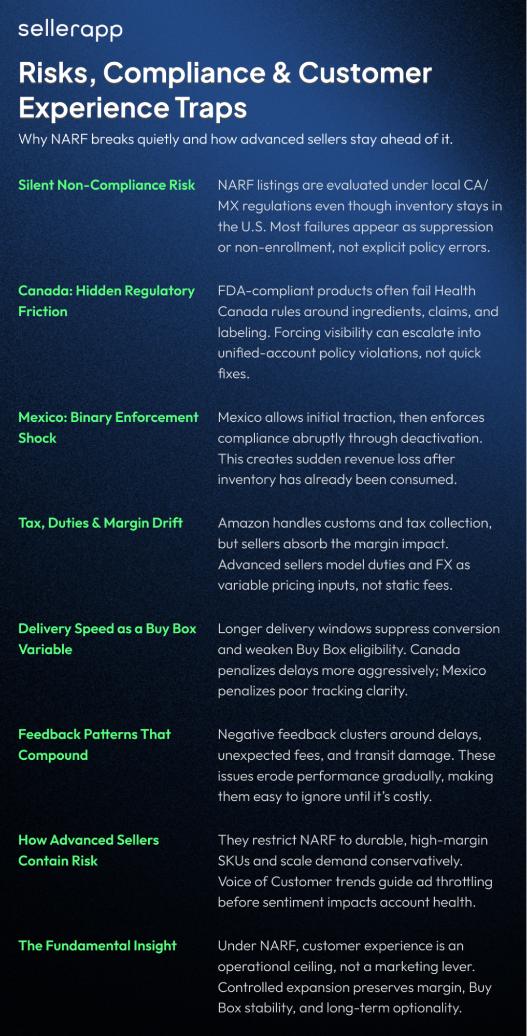
The most underestimated risk in the Amazon NARF program is not logistics cost or delivery speed; it is silent non-compliance. Because NARF listings are marketplace-native, every ASIN is evaluated against local regulatory frameworks, even though the inventory remains in the U.S. Sellers often assume that U.S. approval implies cross-border eligibility. In practice, this assumption is what triggers most NARF failures.
Canada is the clearest example. Health, wellness, and ingestible products that fully comply with FDA standards are frequently non-compliant under Health Canada regulations. Ingredient restrictions, dosage thresholds, bilingual labeling requirements, and claims language can all disqualify a product from the market.
Amazon often responds not with explicit rejections but with suppressed listings or non-enrollment. Sellers see no errors, just missing demand. Attempting to “force” visibility through listing edits or incorrect documentation can escalate into policy violations that affect the unified North America account, not just the Canadian marketplace.
Mexico introduces a different compliance surface. While fewer categories are restricted, enforcement tends to be more binary in nature. Products either clear COFEPRIS and customs filters, or they do not. The risk here is not gradual suppression but sudden deactivation after initial traction, which can create inventory drawdowns without sustained revenue.
Tax and import duty obligations add another layer of complexity. Under NARF, Amazon acts as the importer of record, handling customs clearance, duty calculation, and tax collection at checkout. This simplifies execution, but it does not eliminate seller responsibility.
Sellers must still track landed cost impacts on margin, currency effects on revenue recognition, and the way duties influence effective pricing. Advanced sellers treat these costs as variable inputs in their pricing models rather than static fees, especially when exchange rates fluctuate.
From the buyer’s perspective, NARF Amazon introduces a tradeoff: broader selection in exchange for longer delivery windows. From Amazon’s perspective, this tradeoff is tolerated only as long as customer experience remains predictable. Sellers who ignore this balance often see downstream consequences in Buy Box eligibility and voice-of-customer metrics.
Extended delivery times can suppress conversion, but more importantly, they amplify dissatisfaction when expectations are misaligned. Canadian shoppers, in particular, are accustomed to Prime-level delivery and are more likely to penalize perceived delays through feedback or A-to-Z claims, even when delivery estimates were technically met. Mexican buyers tend to be more tolerant of longer delivery windows but less forgiving of communication gaps or unclear tracking updates.
Negative feedback patterns reported by sellers on Amazon.ca tend to cluster around a few key themes: frustration with delivery times, unexpected duties or fees (even when disclosed), and damage to packaging during cross-border transit. These issues rarely trigger immediate account action, but they slowly erode Buy Box stability and listing performance.
Advanced sellers mitigate these risks indirectly. Rather than chasing faster delivery through aggressive advertising, they manage expectations through pricing, selective SKU enrollment, and conservative demand scaling. Products with fragile packaging, high return sensitivity, or narrow margin tolerance are often excluded from NARF entirely.
For those that remain, sellers monitor Voice of the Customer trends at the ASIN level and intervene early, reducing ad exposure or adjusting pricing before negative sentiment compounds.
The deeper insight is that under NARF, customer experience is an operational constraint, not a marketing outcome. Sellers who treat it as such preserve both account health and long-term cross-border optionality. Those who don’t often learn too late that the cost of recovering trust is far higher than the cost of controlled expansion.
The Amazon NARF program is often framed as a default first step into international selling, but for advanced U.S. sellers, the more important question is not when to use NARF, but when not to. NARF is a tool, not a strategy. Its value depends entirely on what it replaces, what it delays, and what risks it introduces into an otherwise stable U.S. operation.
Direct expansion into Amazon.ca or Amazon.com.mx through local FBA represents a fundamentally different commitment. Inventory is pre-positioned, delivery times align with domestic Prime standards, and listings compete on an equal footing with local sellers. This approach favors brands that already understand regional demand, pricing elasticity, and compliance requirements.
NARF Amazon, by contrast, optimizes for optionality. It trades delivery speed for inventory centralization and operational depth for flexibility. For sellers testing demand or extending mature U.S. SKUs into thinner catalogs, this tradeoff is efficient.
For sellers already seeing consistent cross-border volume, however, NARF Amazon can become a bottleneck. Longer delivery windows, cap conversion, and higher per-unit fulfillment costs quietly erode margin at scale. At a certain volume threshold, NARF stops being a bridge and starts being friction.
Advanced sellers recognize this inflection point early. When cross-border sales reach a level where delayed delivery is the primary conversion limiter rather than awareness or price, local FBA becomes the superior option even if it increases operational complexity.
One of the least discussed risks of the Amazon NARF program is performance coupling. Because the U.S., Canada, and Mexico all draw from the same inventory pool, demand shocks in one market affect the others. Aggressive advertising or seasonal spikes in CA or MX can accelerate U.S. stockouts, destabilize restock cycles, and weaken Buy Box ownership in the U.S.
Pricing dynamics can also backfire. The Amazon NARF program allows sellers to price higher in CA or MX to absorb fees, but doing so may expose arbitrage opportunities or distort brand positioning across markets. Conversely, pricing too aggressively to chase volume can compress margins without delivering durable market share gains, especially when delivery times remain slower than those of local competitors.
In these scenarios, NARF fails because it puts value back into the core U.S. business, reducing predictability and control.
There are clear situations where traditional expansion outperforms the Amazon NARF program. Products with strong brand pull, repeat purchase behavior, or time-sensitive use cases benefit disproportionately from local fulfillment. Categories where delivery speed is part of the value proposition, such as consumables, replacement parts with urgent needs, or seasonal items, often underperform under NARF, even when demand exists.
Traditional expansion is also superior when regulatory complexity has already been resolved. If labeling, compliance, and tax structures are known quantities, the marginal cost of local FBA decreases significantly. At that point, continuing to rely on NARF introduces unnecessary friction rather than reducing risk.
The strategic lens is simple but often ignored: NARF is most powerful when it delays commitment, not when it replaces it. Sellers who treat NARF as a permanent solution often stall growth. Sellers who treat it as a diagnostic phase, one that informs pricing, inventory placement, and expansion timing, use it to graduate into stronger, more defensible international operations.
Used selectively, the Amazon NARF program preserves flexibility. Used indiscriminately, it constrains scale.
The Amazon NARF program isn’t a shortcut to international scale. It shows you where demand really exists, where your pricing holds up, and where your operations start to strain once borders disappear. Used effectively, it provides clarity. Used carelessly, it quietly adds complexity where you least expect it.
Most sellers don’t fail with the Amazon NARF program because the program is flawed. They fail because they treat it like a passive feature instead of an active decision. Inventory gets stretched, ads run without guardrails, and compliance issues surface only after listings disappear or feedback starts creeping in. By the time the problem is obvious, the damage is already done.
This is where having the right data makes a real difference. Tools like SellerApp help sellers stay ahead of the curve, rather than reacting after the fact. Being able to see which keywords are actually driving demand in Canada or Mexico, which SKUs are quietly draining inventory, and where ad spend is creating more risk than return changes how the Amazon NARF program feels on a day-to-day basis. It moves you from guessing to knowing.
The Amazon NARF program works best when it’s treated as a learning phase, rather than a permanent solution. Let it show you which products travel well, which markets are worth deeper investment, and where local FBA makes sense next. With clear visibility and disciplined execution, the Amazon NARF program becomes less about “selling internationally” and more about making smarter decisions without losing control of the business you’ve already built.