


Do you also check your rankings and ad performance in the morning, focusing on the terms that used to convert but don’t anymore? You simply modify a bid, reload the website, and proceed to resolve this. The information seems a little outdated by the time you shut down Amazon Seller Central.
Even if they don’t realize it yet, the majority of professional sellers have silently incorporated Amazon AI capabilities into their everyday routines.
As of 2026, Amazon’s sales have surpassed a level that most dashboards don’t display. Nowadays, observable week-to-week demand volatility rather than season-to-season volatility affects about one in three active U.S. ASINs.
Advertisements will convey a similar narrative. In contrast to the early 2020s, the overall CPC increase has decreased, but bid efficiency has subtly grown more vulnerable. According to internal agency targets for 2026, keywords that were profitable but are no longer in line with live search intent account for more than 40% of lost ad spend.
Listings have also evolved in ways that most optimization tips don’t account for. These days, short-term engagement loss affects Amazon’s ranking systems more quickly than long-term keyword authority.
This implies that a listing with high historical relevance but diminishing click-through rates may become less visible more quickly than a more recent, less-optimized rival that better fits the language buyers use now. Amazon’s algorithm is now improving its understanding of what customers mean.
Inventory pressure has exhibited a similar trend. Stockouts already discourage future ranking recovery more aggressively than they did even two years ago, so by 2026, merchants with lean supply chains will have to make a more difficult trade-off.
Manual optimization used to be adequate. Nowadays, though, it’s frequently the cause of sellers stalling, as nobody can always keep an eye on everything.
In order to compete in a market where completing everything by hand is no longer rewarded, this guide offers sellers a useful look at where AI truly helps and where it doesn’t.
Quick Guide:
Most days start the same way. You open Amazon Seller Central, check the ranking of your products, then take a look at ads, tweak them a bit, maybe second-guess a keyword, and move on, right?
Honestly, you are just not the only one; that is the reality of selling on Amazon in 2026.
The Amazon marketplace moves faster than any one person can track. Not season-to-season, but fast day-to-day. Search behavior shifts. Competitors are testing pricing. Reviews start leaning one direction before you even realize there’s a pattern. By the time a metric actually drops enough to catch your attention, the cause is usually already a few steps behind you.
This is where you should start considering Amazon AI tools, not because they’re trending, but because they notice things before humans realistically can.
You react to a spike in ACoS instead of the intent shift that caused it. Rewriting a product bullet point on your Amazon listing after conversion dips instead of seeing the engagement softening days earlier. You fix problems once they’re evident, not when they’re still quiet and cheap to solve.
AI changes that sequence. So when sellers search for Amazon AI tools, they’re asking:
Slow leaks are a financial aspect that sellers don’t discuss adequately. The majority of losses in 2026 are not the result of a single failure. They result from the accumulation of minor inefficiencies. a term that gradually ceases to convert. In order to steal clicks, a rival is slightly raising the price. Buy Box consistency is subtly harmed by a fulfillment glitch. These linger because none of them feel urgent by themselves.
The “this isn’t broken yet, but it’s headed there” moments are effectively identified by Amazon AI algorithms. More money can be saved by it alone than by any one optimization.
And there’s the part about burnout. The majority of vendors normalize this aspect, but they definitely shouldn’t.
Seller Central was never meant to be a full-time mental load. Yet scaling often means refreshing dashboards, pulling reports, and checking performance just in case something changed. You’re always half-working, even when you’re technically done for the day.
The right Amazon AI tools change that dynamic. Instead of you checking everything, the system checks itself and taps you on the shoulder only when something actually needs judgment. Not noise. Not every fluctuation. Just the moments where a decision matters.
When used properly, Amazon AI tools don’t tell you what to do. They give you back the headspace to do it well. They handle the scanning, the pattern-spotting, and the number-watching so you can focus on the parts of the business that still require instinct, experience, and taste.
Selling on Amazon today isn’t about doing more work. It’s about deciding what to automate, rather than doing things manually.
Every vendor eventually encounters the same obstacle. It takes longer than it should to conduct product research. Listings don’t move, but they feel “done.” Ad expenses increase without an apparent cause. Even though you’re occupied all day, things seem to be moving slowly. Not because you’re irresponsible, but rather because selling on Amazon has now subtly evolved into a game of continual surveillance.
AI truly begins to matter at this point. Not as a quick fix, but as a means of surviving the volume of choices required by contemporary selling.
Usually, the initial breakthrough is product discovery. Validation prior to Amazon AI tools required exporting data, switching between tools, and relying more on instinct than you’d like to acknowledge. Surprises were frequent, and it could take days to feel secure in a product. When AI is incorporated, the process shifts from searching for statistics to signal interpretation. Faster, more informed judgments with fewer blind spots are made possible by the convergence of trends, demand stability, competitive gaps, and review sentiment.
Listing creation is another area where sellers feel stuck. Writing a listing used to feel like a one-time task. You optimized, indexed, waited, and hoped rankings would move. Listing creation is another area where sellers feel stuck. Writing a listing used to feel like a one-time task, and some sellers now use an AI humanizer to make AI-assisted copy sound more natural and buyer-friendly. You optimized, indexed, waited, and hoped rankings would move. If they didn’t, it was hard to know why. Keyword coverage becomes intentional instead of reactive. Indexing occurs more efficiently because listings are structured correctly from the outset. Over time, sellers see their catalogs gain visibility without the need for constant rewrites. With some brands reporting that organic visibility across their listings has grown threefold simply because relevance has improved.
Inventory and pricing are quieter stressors, but no less damaging. Without AI, most sellers realize something’s wrong only after it hurts when stock runs out, storage fees pile up, or the Buy Box disappears. AI tools don’t eliminate risk, but they shorten the distance between signal and action. Demand shifts are spotted earlier, pricing decisions are less emotional, and inventory planning stops being a guessing game.
Advertising is where the emotional relief is most obvious. Before AI, Amazon PPC management was a relentless task. You check search term reports, tweak bids, and pause keywords, and still feel like money leaks out in places you can’t see. AI automation doesn’t just move faster; it watches constantly. Wasted spending gets cut before it compounds. Budget flows toward what converts. Sellers who’ve adopted AI-driven ad optimization often see a drop in wasted spend of as much as sixty percent, not because they spend less, but because their spend finally has direction.
Customer feedback used to be something sellers skimmed when things went wrong. Now, AI reads reviews at scale. Patterns appear that humans miss. Repeated complaints, subtle friction points, and expectation gaps become visible early enough to fix them. Over time, listings become clearer, products improve, and returns decline quietly.
The final shift happens at the decision level. Before AI, insights were everywhere: Seller Central, ad dashboards, spreadsheets, and gut feelings. Decisions were reactive because signals arrived late. AI brings those signals together. Instead of reacting to drops or spikes, sellers start seeing movement as it begins. The work becomes calmer. More deliberate.
One mid-sized U.S. brand described the change best after integrating AI across its workflow. They weren’t trying to grow faster; they were trying to stop burning out. Their creative team had been recycling the same few ad assets until their performance began to fade. With an AI-powered creative studio, they were suddenly testing hundreds of creatives each month. Creative fatigue stopped being a mystery because underperforming assets were replaced before they dragged results down.
At the same time, AI automation in their ad account cleaned up inefficiencies they didn’t know existed. Search terms that never converted were removed automatically. Bids are adjusted based on performance signals, not habit.
Wasted spend dropped sharply by nearly sixty percent without shrinking reach. As listings became more closely aligned with buyer intent, indexing improved. Organic visibility across the catalog climbed, reducing reliance on paid traffic just to stay afloat.
Most sellers don’t wake up wanting “Amazon AI tools.” They want fewer blind spots and fewer expensive mistakes. The tools below are popular, not because they sound advanced, but because they remove specific friction from day-to-day Amazon selling.

Sellers who require a single solution that links research, listings, PPC, and performance insights instead of managing five different dashboards are the ideal candidates for SellerApp.
The way the automation operates across functions is what distinguishes SellerApp. Keyword data is not a stand-alone entity. Ad performance is fed by listing optimization. Visibility and ranking decisions are influenced by PPC analytics. This fills in gaps that typically cost money over time for vendors who manage several ASINs.
In reality, sellers utilize SellerApp to make fewer decisions by hand. “Waste” is found early in the search. Performance signals, not habits, are used to modify PPC budgets. Faster improvements in listing relevance have a direct impact on organic visibility and indexing speed.
This is why many sellers report cutting wasted ad spend by as much as sixty percent while simultaneously seeing their catalog’s organic reach grow significantly.
There’s also a practical side to SellerApp that matters once ad spend starts getting serious. Automation isn’t treated like a black box. Sellers can set clear rules around bids, budgets, and performance thresholds, and the system acts on those rules automatically. No constant bid nudging. So you can save up your late nights for binging and not budget checks.
Furthermore, SellerApp leverages AI to identify performance trends that are difficult to overlook at scale. This greatly improves the accuracy of dayparting when used with streaming data and Amazon Marketing Cloud. Advertisements don’t just run nonstop because they usually do. Spend moves toward the hours when customers actually make purchases and retreats during periods of low-intent traffic.
The impact is unexpectedly immediate. Fewer advertisements during off-peak hours. Reduce the amount of money wasted on non-converting search phrases. improved visibility during the most important windows. This eventually improves both organic and sponsored performance since low-quality clicks no longer inflate listings.
The reason this holds up is data quality. SellerApp’s proprietary tech, combined with direct access to Amazon’s APIs as an official partner, means decisions are based on real marketplace signals, not delayed reports or rough estimates.
For sellers past the trial-and-error phase, this kind of automation doesn’t feel like giving up control. It feels like finally getting out of the way of the parts that shouldn’t need daily attention.
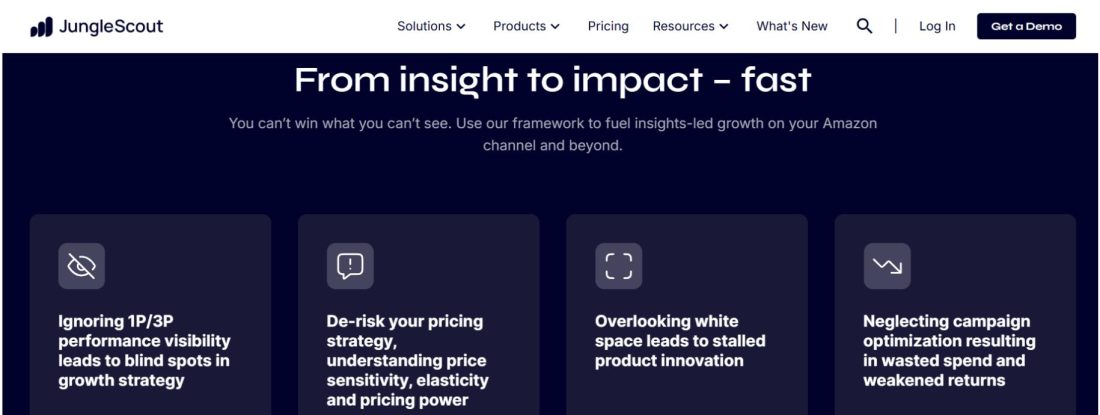
For sellers who want to be sure they’re not making a clear error before making a purchase, Jungle Scout is a good place to start. Beginners or early-stage sellers who are still learning how Amazon demand and competition actually behave would find it most beneficial.
Validation is most helpful there. Sellers can examine whether a product has sold consistently, how crowded the niche is, and how pricing has evolved over time, rather than making assumptions based solely on gut feeling or a single statistic like search volume. It provides basic yet significant answers to: Has this ever worked? Are there already too many vendors in this area? Does demand continue, or is it waning?
This is important since the majority of unsuccessful product launches don’t fail because no one wants the product. They fail because vendors underestimate the level of competition, enter the market at the wrong time, or commit capital to inventory before fully comprehending the market. Jungle Scout lessens those costly, early errors.
Ideation, early growth, or pre-launch planning before inventory is ordered and decisions become difficult to reverse are the greatest times to employ it.
After takeoff, Jungle Scout comes to a stop. It is not designed to manage continuing advertising systems, maintain massive catalogs, or make daily optimization decisions across hundreds or even thousands of ASINs.
This is where SellerApp functions differently.
Mid-market and enterprise brands that are currently selling at scale and require more detailed marketplace data to make decisions utilize SellerApp. SellerApp provides answers to questions like “Is this a decent idea?” and “What’s truly happening right now?” by using indicators such as a customized opportunity score linked to visibility and revenue impact, BSR movement, and expected daily order velocity.
Because of its depth, SellerApp is frequently utilized in the background. It is used by numerous Amazon agencies as a white-label client account management solution. To support forecasting, advertising strategy, and catalog-wide decisions, major CPG businesses use API access to seamlessly integrate SellerApp’s marketplace data into their internal systems.
3) ChatGPT

ChatGPT isn’t an Amazon tool in the traditional sense. If you open it expecting it to run your business, you’ll probably close it thinking it’s overrated. That’s not what it’s good at.
Where ChatGPT actually earns its keep is when something feels off, and you can’t quite name it. Ads are spending but not converting. A competitor suddenly leapfrogs you. Reviews keep circling the same complaint, but reading them one by one is frying your brain. That’s usually when sellers open ChatGPT.
It’s become the go-to “let me think this through out loud” tool. You paste in a few listings, some search terms, maybe a chunk of reviews, and start asking better questions. Not “fix this,” but “what am I missing?” That alone saves hours of second-guessing.
For listings, it works best when you don’t treat it like a copywriter. Sellers who say, “Write me a listing,” usually get something generic. The ones who get value feed it real buyer language. category context, and constraints, then clean it up themselves. The human touch still matters. ChatGPT just gets you closer without starting from a blank page.
At this point, most experienced sellers aren’t using it for brilliance. They’re using it for clarity. It reduces the mental load. It helps you calm down before you touch bids, prices, or creatives you’ll regret changing later.
But it’s important to be honest about what it can’t do. ChatGPT doesn’t see the Amazon marketplace. It doesn’t know what’s actually converting today, which keywords are leaking money, or how aggressive competitors are being right now. Once the question becomes specific ads, pricing, and inventory timing, you need tools that live inside Amazon data, not outside it.
Think of ChatGPT as the place you sort out your thinking. The execution still belongs to tools built for Amazon, backed by real marketplace signals. Used that way, it stops being a gimmick and quietly becomes something you rely on almost every day.
Amazon’s A+ Content AI is useful once you already know what you’re trying to say. It doesn’t give you a brand voice or a positioning strategy, but it does save you from rebuilding the same A+ layouts over and over again.
For sellers managing large catalogs, that alone is a relief. You can spin up structured, compliant A+ pages quickly and keep things consistent instead of chasing formatting issues or reinventing layouts for every ASIN. It cuts busywork, not thinking.
Where it really earns its keep is testing. Want to try a different feature order? Highlight a new benefit? Shift emphasis from lifestyle to specs? A+ Content AI makes it easy to put ideas live and see what actually moves conversion instead of debating them internally for weeks.
But it’s not the whole picture. A+ Content AI doesn’t know why shoppers are landing on your listing, what keywords you’re leaking, or how your competitors are framing the same promise. It won’t tell you if your bullets are misaligned with search intent or if your A+ is reinforcing the wrong expectations.
That’s why sellers who care about brand growth don’t stop at generation. They pair A+ creation with deeper listing optimization tools like SellerApp, where keyword data, review patterns, and performance signals shape what the content should say before AI helps build it.
Used this way, A+ Content AI becomes a speed layer, not a strategy shortcut. You move faster, test more, and improve steadily without losing control of the story you’re telling.

Perpetua is best suited for sellers and brands with large ad budgets who require sophisticated, rule-based automation.
Its strength lies in bid optimization, campaign structuring, and performance scaling across portfolios. For sellers managing complexity at scale, Perpetua reduces the manual overhead of daily PPC management, allowing teams to focus on strategic decisions rather than constant adjustments.
It’s especially effective when paired with clear goals and oversight; AI executes, and humans steer.
Read More: 10 Perpetua Alternatives Worth Trying if You’re Serious About Amazon PPC
Teikametrics is usually something sellers come across once advertising stops feeling manageable. Not broken, not wildly unprofitable, just constantly demanding attention. You’re checking campaigns multiple times a day, reacting to swings, and still wondering whether the system is actually moving in the right direction.
At its core, Teikametrics is an advertising optimization platform built to take that pressure off. It’s designed around the idea that Amazon ads shouldn’t be managed in isolation. Bids, competition, seasonality, and inventory all influence each other, and Teikametrics tries to account for those relationships instead of treating each lever separately.
In real use, it feels less like a reporting tool and more like an active manager in the background. The system continuously watches search term behavior and performance shifts, adjusting bids before inefficiencies compound. Sellers who use it long enough often say the biggest benefit isn’t higher performance overnight, but fewer surprises. Campaigns drift less. Waste gets caught earlier. Decisions feel more grounded.
One thing Teikametrics does well is reframe how success is measured. Rather than pushing sellers to chase clean-looking ACoS numbers, it emphasizes outcomes that align more closely with profitability. Tools like predictive bidding and SmartACOS are meant to keep advertising decisions tied to real business impact, not just efficiency on paper. For sellers in competitive categories, that distinction matters more than most realize.
Teikametrics tends to work best once a seller already understands their economics and has stable listings in place. It’s not meant for early experimentation or idea validation. It’s meant for tightening and scaling what already exists. Sellers who benefit most are usually past the learning curve and now dealing with the harder problem of maintaining control as spend and competition increase.
For many, Teikametrics doesn’t feel flashy or exciting. It feels steady. And when ad spend grows into something that can quietly damage margins if left unattended, that steadiness is often the real value.
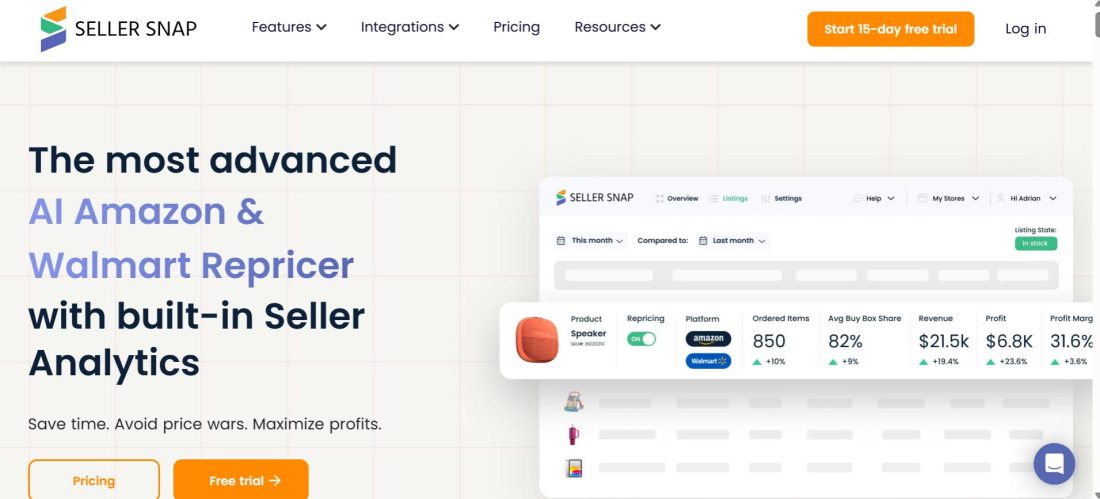
Seller Snap is best for sellers who want to protect margins while staying competitive in Buy Box battles.
Instead of simple rule-based repricing, it uses AI to understand competitor behavior and price elasticity. This helps sellers avoid constant undercutting while maintaining competitiveness.
It’s particularly useful in categories with high pricing volatility, where manual repricing quickly becomes unmanageable.
The mistake many sellers make is choosing tools by feature lists. The smarter approach is choosing tools based on where you’re losing time, money, or clarity.
SellerApp works when you need automation across the funnel. Jungle Scout helps before you commit. ChatGPT supports thinking and iteration. Amazon A+ Content AI speeds up brand presentation. PPC and pricing tools take over repetitive optimization once the strategy is clear.
AI doesn’t replace sellers. It replaces the parts of Amazon that sell products quietly, draining energy and profit when done manually.
8) AMZ Prep

AMZ Prep is not an AI tool in the way PPC or research platforms are, but it still earns a place in an Amazon AI tools stack because of how it uses data and automation to solve one of the most expensive problems sellers face: logistics friction.
AMZ Prep operates as a tech-enabled fulfillment and prep network. Where the intelligence comes in is how it standardizes prep, routing, and compliance across warehouses so sellers aren’t making manual decisions every time inventory moves. For sellers scaling beyond a few SKUs, the real risk isn’t prep errors themselves; it’s inconsistency. One missed label, one delayed inbound, one wrong carton configuration, and listings go stranded or suppressed.
AMZ Prep reduces that risk by turning prep into a repeatable system. Inventory is routed based on destination, compliance requirements, and turnaround constraints. Sellers don’t need to think through edge cases every time they restock. That reduction in decision load matters more than people realize once volume picks up.
It’s most useful for sellers doing regular replenishment, running multiple ASINs, or selling across regions where prep rules and inbound workflows change. AMZ Prep doesn’t optimize keywords or ads, but it quietly removes a layer of operational chaos that often bleeds into lost sales, missed launches, and stockouts.
9) Quartile

Quartile is a performance-driven advertising platform built for sellers and brands spending serious money on Amazon ads. It uses machine learning to make continuous bidding and budget-allocation decisions across large catalogs, a process that breaks down very quickly when managed manually.
What makes Quartile an actual Amazon AI tool is that its models learn directly from Amazon advertising signals at scale. It analyzes keyword-level performance, placement behavior, conversion trends, and competitive pressure, then adjusts bids dynamically to keep spend aligned with performance goals. This isn’t recommendation-only software. It actively executes changes.
Quartile is typically used by high-spend sellers, agencies, and brands that care more about enforcing consistency than micromanaging campaigns. The AI is designed to answer practical questions like where the budget should be concentrated right now, which keywords deserve more exposure, and which areas are quietly wasting money.
It works best when there is enough data for the models to learn from. Smaller accounts won’t feel the full impact. But at scale, where human optimization lags behind volume, Quartile’s strengths lie in speed and discipline. Adjustments happen faster than weekly reviews, and inefficiencies don’t get weeks to compound.
Quartile doesn’t replace strategy. It enforces it. Sellers still decide targets and constraints, but the system handles execution without fatigue. That’s why it’s often adopted once advertising moves from “manageable” to “mission critical.”
Amazon AI tools are most effective when applied with intention. The sellers who get results aren’t using it everywhere at once; they’re using it in tight loops, with clear checkpoints and expectations. These strategies reflect how AI is being applied in practice, not just in theory.
The goal here isn’t speed for the sake of speed. It’s compressing the decision cycles that usually drag launches out for months.
The process starts with trend analysis. Instead of validating a product on static demand numbers, AI is used to spot direction, whether interest is rising, flattening, or already peaking. This helps sellers avoid launching into markets that look good on paper but are already cooling off.
Once the product is locked, listing creation moves fast but deliberately. AI helps structure the listing around real buyer intent rather than a hunch. Keywords are grouped by meaning, not just volume, so indexing happens earlier and relevance builds faster. The listing isn’t treated as “done”; it’s treated as version one.
PPC automation comes next, but cautiously. AI handles bid adjustments and search term monitoring from day one, so early budget leaks don’t spiral out of control. Instead of waiting weeks to prune waste, the system learns quickly which terms are signals and which are noise.
The final loop is review sentiment. As soon as feedback starts coming in, AI scans reviews for patterns. Even five or ten reviews can reveal expectation gaps worth fixing early, before scale locks them in.
Time to first meaningful sales, keyword indexing speed, early conversion rate stability, and wasted ad spend in the first two weeks.
A launch that feels controlled instead of chaotic. Fewer post-launch corrections, faster organic traction, and a listing that improves while it scales, not after.
Most sellers don’t struggle to scale ads. They struggle to scale profitably.
This strategy starts by letting AI take over the parts humans are worst at: constant monitoring. Instead of adjusting bids based on instinct or habit, AI watches performance at the search-term level and reacts faster than a weekly optimization ever could.
The key shift is how success is measured. Instead of obsessing over a single ACoS number, sellers track performance by campaign role. Some campaigns are allowed to discover, some to defend, and some to scale. AI helps enforce those boundaries consistently.
Waste is handled aggressively but quietly. Poor-performing search terms are identified and cut before they drain the budget for weeks. Budgets are reallocated toward pockets of demand that convert reliably, even if they don’t look impressive at first glance.
Scaling happens gradually. Spending increases only when efficiency holds. AI makes this possible by surfacing trend signals early; when conversion rates soften or competition intensifies, adjustments happen before margins collapse.
ROAS by campaign type, frequency of wasted keyword pruning, margin stability as spending increases, and impression growth without conversion drop-offs.
Ad spend grows, but stress doesn’t. Sellers scale with confidence because inefficiencies are automatically contained, rather than being discovered too late.
Reviews are one of the most underused data sources on Amazon, not because sellers ignore them, but because reading hundreds of reviews manually doesn’t scale.
AI changes that by grouping feedback into sentiment clusters. Instead of individual complaints, sellers see patterns: recurring confusion, unmet expectations, quality perceptions, or usage issues.
Once clusters are identified, the work becomes straightforward. Complaints about misunderstandings of the product are addressed in bullets. Packaging feedback influences images or A+ content. Featured praise gets elevated higher in the listing so future buyers see it sooner.
Over time, this creates a feedback loop. Listings become clearer. Buyer expectations align better with reality. Reviews improve not because sellers chase ratings but because fewer buyers feel misled.
Sentiment clusters → identify expectation gap → update bullets or visuals → monitor changes in review tone and conversion.
Stronger listings, fewer negative surprises, and a product that quietly improves without constant reinvention.
AI works best when used in loops, rather than as one-off actions. Each strategy relies on the same principle: shortening the distance between the signal and the response.
That’s what separates sellers who feel constantly behind from those who feel in control even as they scale.
Amazon AI tools don’t usually fail sellers. Sellers fail with AI mostly because expectations are off.
Mistake 1: Mistaking Amazon AI tools for a strategy maker
One of the most common mistakes is letting AI make strategic decisions instead of using it to validate thinking. You’ll see this all over Reddit: sellers plugging numbers into a tool, getting a green signal, and launching without really understanding why the opportunity looked good.
When the product struggles, the conclusion is often “AI doesn’t work,” when the real issue was skipping judgment. AI excels at analysis and identifying patterns, gaps, and anomalies. It’s terrible in context. A strategy still requires a human who understands category behavior, capital risk, and long-term positioning.
Mistake 2: Over-automating Amazon ai tools for sellers
Another mistake shows up once sellers start seeing results: over-automation without boundaries. There are numerous Reddit threads from sellers who turned on full PPC automation, walked away, and returned weeks later to find inflated spending or campaigns drifting away from their original goals.
AI optimizes for what you tell it to optimize for. If guardrails aren’t clear about budget caps, campaign roles, and margin limits, it will chase performance that doesn’t always align with business reality. Automation should reduce effort, not remove oversight entirely.
Mistake 3: When Amazon AI tools fail because of data drift
Then there’s data drift, which almost no one discusses until it causes problems. Amazon data is not static. Buyer behavior shifts, competitors adapt, and seasonality sneaks up quietly. Sellers often trust AI outputs blindly without realizing the inputs have changed. A keyword that converted beautifully in Q2 might bleed money in Q4. A pricing strategy that worked last year may fail after a category is flooded with new entrants. Reddit is full of posts that start with “This worked for months, then suddenly tanked.” The AI didn’t break; the environment changed.
The fix isn’t to use less AI. It’s to use it more intentionally.
Strong sellers treat AI like a junior analyst who never sleeps. They let it surface insights, flag issues, and handle repetition, but they still set direction. They review trends regularly, reset assumptions when seasons change, and check whether the system is optimizing for the right outcome.
Sellers who struggle with AI are typically seeking relief from the mental burden of thinking. The sellers who succeed use it to think better, faster, calmer, and with fewer blind spots.
Measurement Framework: Best Amazon AI tools
If AI is doing its job, you shouldn’t need complicated dashboards to prove it. The signal appears in a handful of numbers that either move or remain unchanged.
The mistake many sellers make is tracking everything. The smarter move is tracking what changes when AI is introduced.
The first thing to watch is ACoS, but not in isolation. ACoS should stabilize or improve as automation learns. If it swings wildly week to week, something’s off. ROAS adds context, especially at the campaign level, because it tells you whether increased spending is actually producing a return, not just traffic.
Click growth matters more than most sellers realize. If impressions rise but clicks don’t, the AI may be expanding reach without relevance. When AI is working, click volume grows alongside efficiency, not at the expense of it.
If spending increases while ACoS worsens and clicks stay flat, that’s not scaling; it’s leakage.
Listings give clearer signals than sellers expect. CTR is the fastest indicator. When AI-driven listing updates work, click-through rate lifts first, often before rank changes are visible. That tells you the listing is better at matching buyer intent.
Keyword rank delta matters, but only for terms that actually convert. Watching a handful of core keywords move steadily upward is far more meaningful than tracking dozens that don’t drive sales.
If indexing improves but CTR doesn’t, the listing is being seen but not chosen.
Stockout frequency is the simplest metric here. If AI forecasting is effective, stockouts become rarer and more predictable. You don’t eliminate them entirely, but they stop surprising you.
The real win is fewer emergency decisions. When you’re no longer rushing air shipments or killing ads unexpectedly, the system is working.
If stockouts still happen without warning, the forecast isn’t being trusted or isn’t accurate enough yet.
Buy Box percentage tells the story quickly. If AI pricing tools are effective, Buy Box share stabilizes or improves without constant price drops.
Watch for patterns. If Buy Box share rises while margins hold, pricing logic is sound. If Buy Box wins spikes only when prices fall, the system may be competing too aggressively.
Winning the Buy Box isn’t a success if profitability disappears with it.
Review sentiment trend is more useful than the star rating alone. When AI is feeding real customer feedback back into listings or product changes, the tone of reviews slowly shifts.
Fewer repeated complaints. More consistent expectations. Less emotional language. These changes don’t happen overnight, but when AI review analysis is working, negativity becomes less repetitive.
If the same complaints keep showing up month after month, nothing is actually being acted on.
You don’t measure AI by how advanced it sounds. You measure it by whether fewer things surprise you.
Better ads leak less money. Listings get chosen more often. Inventory problems surface earlier. Pricing feels steadier. Reviews stop repeating the same frustrations.
If those things aren’t happening, the AI isn’t broken; it’s just not being used with the right expectations or guardrails.
Amazon AI tools are winning because they remove lag.
The sellers pulling ahead right now aren’t doing radically different things. They’re just seeing problems earlier, acting faster, and wasting less energy on work that doesn’t scale. That’s what modern AI does best. It shortens the gap between what’s happening in your account and when you respond to it.
The danger is treating AI like a shortcut. Tools don’t fix weak fundamentals, unclear goals, or poor discipline. But when the basics are in place, the right AI system becomes leverage. It absorbs the monitoring, pattern-spotting, and repetitive optimization that quietly drain time and margin.
This is where a platform like SellerApp fits naturally into a serious seller’s stack. Instead of stitching together product research, keyword insights, listing optimization, and PPC decisions across multiple tools, SellerApp consolidates these signals into a single workflow. The result isn’t just automation; it’s clarity. Less guesswork, fewer late surprises, and decisions that feel intentional instead of reactive.
If you’re already selling on Amazon and feeling overwhelmed by watching dashboards more than growing your business, that’s usually the signal to stop doing everything manually. Start by automating what slows you down the most, measure the impact, and build from there.
Read More:
How to Improve Your Amazon Order Defect Rate (ODR)
10 Pacvue alternatives: What They Offer and Which One Fits Your Advertising Strategy?
Why the Amazon Haul Program Is the Next Big Opportunity for Sellers
The Amazon Kindle Direct Publishing Guide for sellers