

Are you sure that you are prepared to thrive in your Amazon business in 2026? As we move into 2026, the Amazon marketplace is more competitive than ever, with over 2 million active sellers fighting for customer attention.
This is where the Amazon Seller Calendar 2026 comes as a strategic asset for you.
This Amazon seller calendar for 2026 tells you exactly when to order inventory from overseas suppliers, when to ramp up your Amazon PPC budgets, when to launch Amazon seasonal products, and when to pull back to avoid wasted ad spend.
More importantly, it gives you the time needed to capitalize on high-traffic events like Prime Day, Black Friday, and seasonal shopping spikes that can generate 40-60% of your annual revenue in just a few weeks.
Now, when Amazon’s marketplace dynamics are constantly evolving. New fee structures, updated inventory limits, stricter product compliance requirements, and changing consumer behaviors mean that last year’s calendar isn’t enough.
The sellers who plan 3-6 months consistently outperform those who operate reactively. When you know that Q4 inventory must be ordered by late August, you avoid the stockouts that kill your search rankings.
When you prepare Prime Day deals in May instead of June, you secure better Lightning Deal slots. When you optimize listings for “Valentine’s Day gifts” in early January instead of February 10th, you capture early-bird shoppers at lower PPC costs.
This calendar is not just a list of dates. It’s a month-by-month action plan with specific deadlines, inventory planning guidelines, tax reminders, and strategic opportunities that successful sellers use to stay ahead.
Whether you’re a seven-figure seller managing multiple brands or just launching your first product, this calendar will help you turn seasonal demand into predictable revenue, avoid costly mistakes, and make 2026 your most profitable year on Amazon yet.
Let’s dive into the critical dates, deadlines, and opportunities that will define your success in 2026.
Quick Guide:
Strategic planning for Amazon success means knowing not just the holidays but also the critical deadlines and preparation that determine whether you capitalize on demand or watch from the sidelines.
Here’s your month-by-month breakdown of 2026’s key dates, seller deadlines, and actionable strategies.
Key Dates:
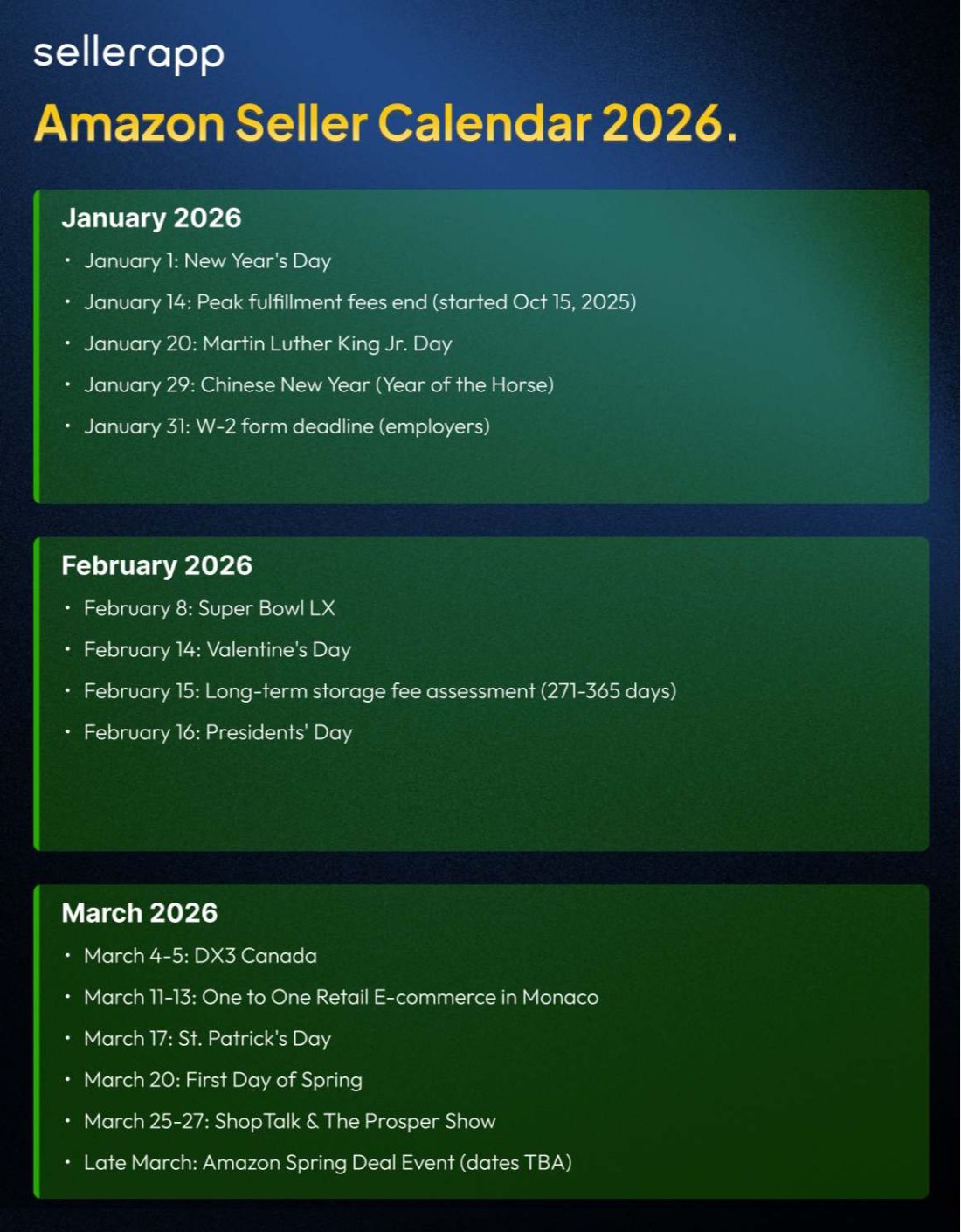
The new year begins with fresh opportunities as customers embrace New Year’s resolutions and post-holiday shopping patterns shift completely. After seven years of working with Amazon sellers, we have noticed a pattern that many sellers view January as a recovery month from Q4’s intensity, but we always suggest that sellers recognize it as prime time for specific product categories and critical business planning.
Chinese New Year (January 29) creates a critical supply chain disruption. Factories typically close January 24 and don’t fully resume until February 8; that’s 14-16 days of zero production, plus another 2-3 weeks to return to full capacity as workers come back. If you need Q1 inventory, orders must be placed by mid-December 2025.
Additionally, review 2025 Q4 performance data by January 31 to identify your top 20% products by revenue and profit margin. These deserve priority inventory investment. Remove old inventory before February 15, or long-term storage fees hit ($6.90 per cubic foot or $0.15 per unit).
Moreover, target your old inventory under 10% of the total by March 1. File W-2 forms by January 31 and gather all tax documentation for your accountant. Optimize listings for New Year keywords (“2026 planner,” “fitness equipment,” “meal prep”) and run aggressive PPC campaigns January 1-15 while CPCs are low. Check your IPI score, and if it is below 450, take immediate action to improve it before Q1 storage limits are determined.
Key Dates:
February is one of the shortest months, but it’s packed with seller opportunities and critical deadlines. Valentine’s Day dominates the first half of the month, driving over $26 billion in U.S. consumer spending across jewelry, flowers, chocolates, romantic gifts, apparel, and home décor; the average person spends $185 for valentines (versus $147 for Mother’s Day). Early-period shoppers (February 1-10) convert at higher rates and are less price-sensitive than last-minute buyers.
Super Bowl LX (February 8) creates a concentrated 48-hour spike in party supplies, snacks, TVs, and fan gear, with most purchases happening 24-48 hours before kickoff. Presidents Day weekend launches the year’s first major retail sale event, strong for furniture, home goods, and spring product promotions. The February 15 storage fee deadline is critical; any inventory stored 271-365 days gets charged $6.90 per cubic foot or $0.15 per unit (whichever is greater).
It would be essential to ship Valentine’s inventory by late January to capture early shoppers. Launch bundles by February 1 and optimize for “last minute Valentine’s gifts” searches February 12-14. For the Super Bowl (February 8), promote party supplies, electronics, and grilling items February 5-9. Clean up inventory before the February 15 storage fee assessment; remove or liquidate anything over 250 days old.
Presidents Day weekend (February 14-16) works for winter clearance (30-40% off) and spring product launches. File Q1 sales tax returns by the April 30 deadline in most states. If attending eTail Palm Springs or eCommerce Fair Tokyo, focus on networking with suppliers, learning logistics innovations, and understanding emerging consumer trends before they hit the Amazon marketplace.
Key Dates:
March marks the critical seasonal transition from winter to spring. Winter product demand reduces 60-80% from peak, while outdoor furniture, gardening supplies, camping gear, and spring cleaning items see search volume increases of 40-50%. Aggressively discount remaining winter inventory 25-35% to free capital and FBA space when you calculate 12 months of storage fees ($10.44-28.80 per cubic foot annually) plus opportunity cost mean liquidation almost always beats holding until next season.
St. Patrick’s Day (March 17) creates a concentrated week-long opportunity for party supplies, green apparel, Irish-themed gifts, and beer accessories, with most sales happening March 14-17. Amazon’s Spring Deal Event typically occurs in late March (estimated March 23-27), generating 15-20% of summer Prime Day’s volume as a Prime member-exclusive sales event.
Products launched in March have a strategic advantage; they build ranking momentum through April and hit peak performance May-July when demand maximizes. Ideal categories include outdoor furniture, gardening tools, camping equipment, grilling accessories, pool supplies, and lawn care products.
Products launched in May or June miss this critical ranking-building period and face maximum competition. For Spring Deal Event participation, Amazon requires 4-5 star ratings with a minimum of 5 reviews, a 15-20% discount from the recent lowest price, and sufficient inventory (3-4x normal daily sales). Increase PPC budgets 150-200% during the event, focusing spend on products with active deals.
Key Dates:
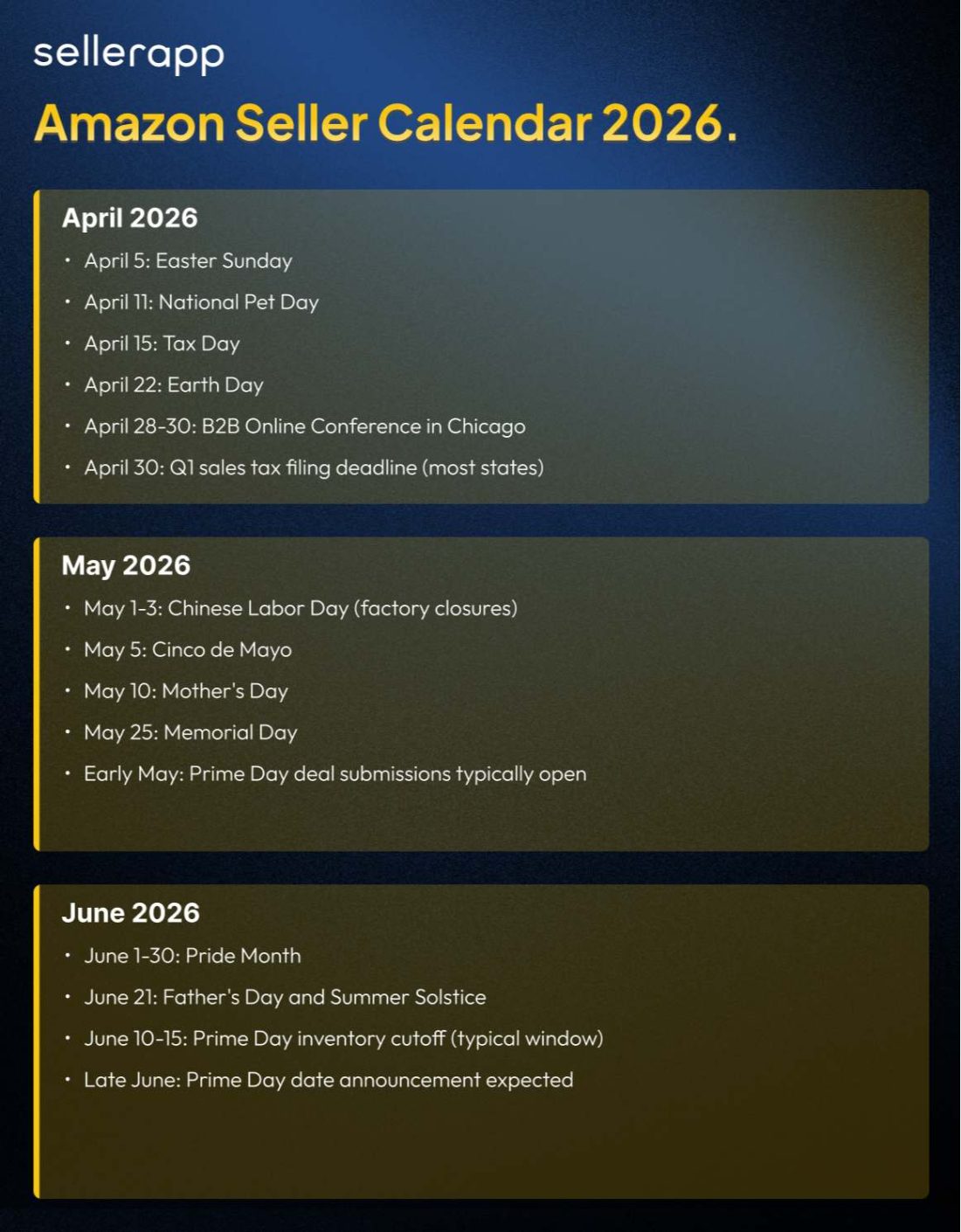
Easter drives $24 billion in consumer spending, second only to Christmas for gift-giving holidays. Candy, baskets, decorations, children’s toys, and apparel experience massive demand spikes March 25-April 5, with peak shopping concentrated in the final 10 days before Easter Sunday. Early shoppers (March 28-April 2) convert at higher rates and are less price-sensitive, while last-minute shoppers (April 3-5) pay premium prices for guaranteed delivery.
Top-performing products include Easter candy and chocolate, decorative baskets and stuffers, egg decorating kits, spring apparel, and religious items. Earth Day (April 22) has grown significantly as eco-conscious consumers actively filter for sustainable product listings with “recycled,” “biodegradable,” “plastic-free,” or “sustainable” keywords and see a 150% increase in visibility April 19-25. Tax Day creates urgency for office supplies, organizational products, and business tools as people scramble to meet filing deadlines.
April is when Prime Day preparation officially begins. Amazon typically opens Lightning Deal and Deal of the Day submissions in early May, with deadlines approximately 7-10 days before the July event. Start identifying which products have sufficient inventory (need 4-5x normal daily sales, ideally 5-6x), can sustain 20-30% discounts without destroying margins, have a minimum of 15-20 reviews with a 4+ star average, and maintain Prime eligibility.
Key Dates:
Mother’s Day ranks as the second-largest gifting holiday, with over $35 billion in consumer spending. Consumers spend an average of $254 per person. Categories like jewelry, beauty products, kitchen items, flowers, apparel, and personalized gifts dominate sales May 5-10. Early-period shoppers (May 1-7) demonstrate higher conversion rates and lower price sensitivity, while last-minute purchasers (May 8-10) prioritize fast shipping and convenience over price comparisons.
Mother’s Day shoppers are making emotional purchases to express appreciation, creating a willingness to pay premium prices for products positioned as special or meaningful. Gift-worthy presentation matters significantly; products that appear gift-ready with attractive packaging convert substantially better than generic listings.
Chinese Labor Day (May 1-3) creates manufacturing disruptions affecting summer inventory planning. Factories typically close April 30-May 5 when including surrounding weekends, with production resuming quickly but experiencing 1-2 weeks of reduced capacity during ramp-up. If you need June-July inventory, including Prime Day stock, orders must be placed by April 15 to account for this closure plus standard 45-60 day lead times.
Memorial Day weekend (May 23-25) marks the unofficial start of summer, driving demand for grilling equipment, outdoor furniture, camping supplies, patriotic decorations, coolers, and beach accessories. This three-day weekend is perfect for flash sales positioning products for summer season launches.
Mother’s Day inventory must reach FBA by April 25 to capture early shoppers. Start PPC campaigns May 1 with moderate budgets, then increase 300-400% for May 8-10 when CPCs spike 200-350% (accept 30-40% ACoS during this final push if margins support it). Target “Mother’s Day gifts 2026,” “gifts for mom,” and category-specific terms like “jewelry for mom” or “spa gifts for Mother’s Day.”
Key Dates:
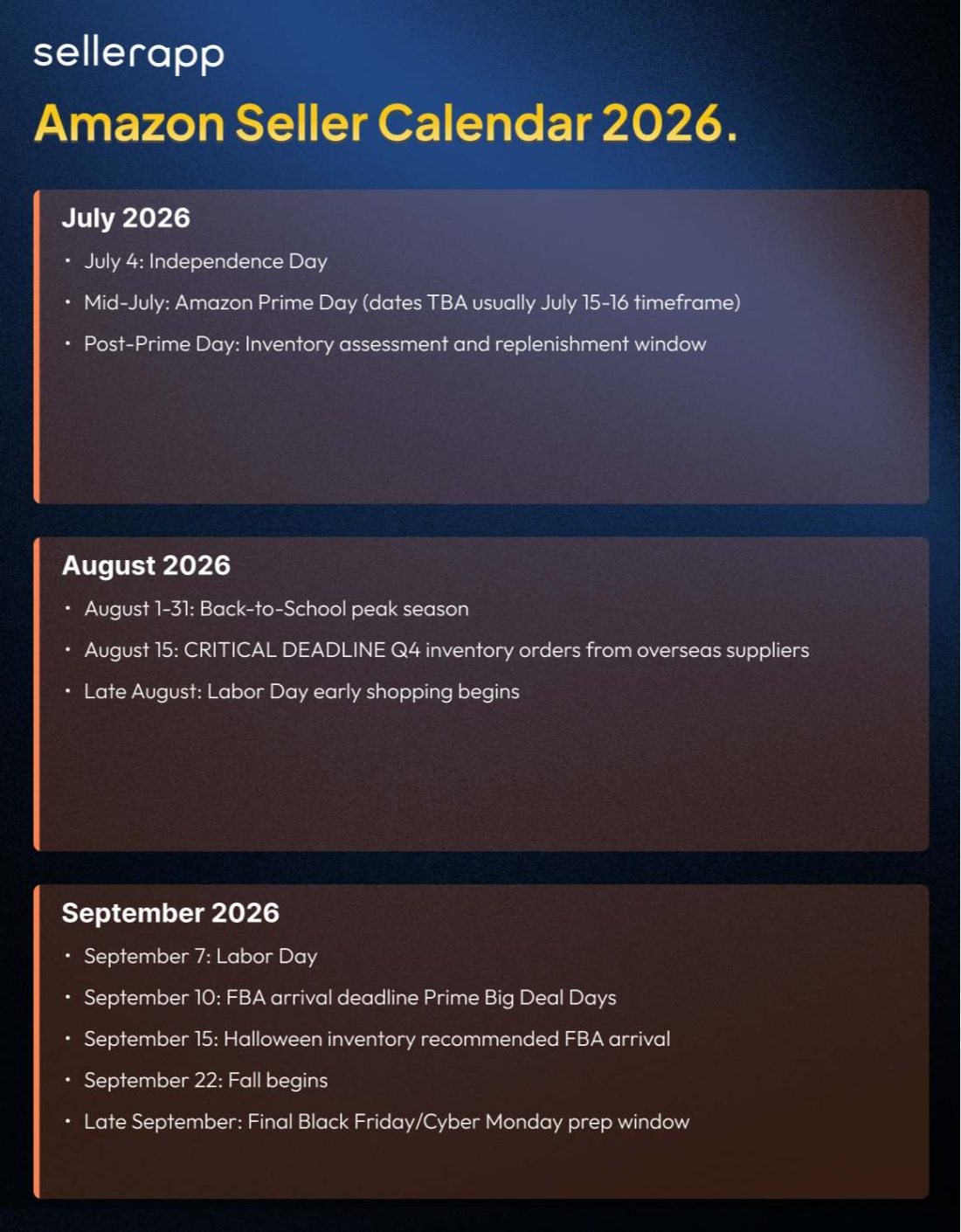
June’s critical focus is ensuring Prime Day inventory reaches FBA by Amazon’s hard deadline, typically between June 10 and 15 (the exact date varies annually; verify in Amazon Seller Central). Products arriving after this cutoff won’t be Prime-eligible for the event, causing you to miss the year’s second-biggest sales opportunity while competitors capture market share.
The recommended ship date is June 1 to account for potential delays in production, shipping, customs clearance, or FBA receiving. This deadline catches sellers off guard every year because they calculate based on normal FBA receiving times (3-5 days) without accounting for June volume increases as thousands of sellers rush inventory for Prime Day simultaneously. Missing this deadline means watching from the sidelines while your category competitors generate 3-5x normal sales velocity and build ranking momentum that persists 60+ days post-event.
Father’s Day generates approximately $22 billion in consumer spending, 20-30% less volume than Mother’s Day, but still significant across tools, electronics, grilling supplies, sports equipment, automotive accessories, and apparel. Father’s Day shoppers demonstrate more concentrated last-minute purchasing behavior compared to Mother’s Day, with the heaviest sales occurring June 18-21.
Key Dates:
Prime Day is Amazon’s largest self-created shopping event, generating over $14 billion in global sales (2025 data). The event has expanded from 48 hours to 96 hours in recent years, creating sustained elevated traffic throughout the extended period. For products participating in Lightning Deals or Deal of the Day placements, expect sales velocity to spike 3-5x normal daily rates, with aggressive discounts (25-30% off) potentially driving 7-10x velocity.
Independence Day (July 4) creates a secondary sales opportunity in outdoor products, grilling equipment, party supplies, and patriotic-themed apparel, with most purchases concentrated July 1-4. Prime Day operates on momentum: products that sell well early get pushed higher in search results, recommended placements, and deal browsing, creating compounding visibility effects throughout the event.
The critical mistake sellers make is underestimating Prime Day inventory needs. Calculate conservatively: normal daily sales × 6 (to account for the higher end of the velocity range) × 4 days (full 96-hour event) × 1.2 safety factor. Example: if you normally sell 30 units/day, you need (30 × 6) × 4 × 1.2 = 864 units minimum.
Yes, this seems highly competitive, but the downside of overstocking (holding 100-200 extra units costing maybe $40 in storage fees for 2 months) is minimal compared to the downside of stocking out mid-event (losing $5,000-15,000 in sales plus a 30-40% ranking drop persisting 60+ days).
You can set up automatic alerts when stock drops below 3 days of supply at current velocity. If stockout risk emerges mid-event, reduce advertising spend immediately to preserve remaining inventory for post-event continued sales.
Key Dates:
Back-to-school represents the third-largest retail season, with over $38 billion in consumer spending ($890 average per family). School supplies, electronics, dorm essentials, organizational products, and clothing peak August 1-20, with heavy mobile browsing from parents multitasking.
However, the most critical aspect of August isn’t back-to-school sales; it’s the absolute final window for ordering Q4 holiday inventory from international suppliers without risking November-December stockouts. Products ordered from Chinese manufacturers by mid-August arrive in October, accounting for the Chinese Golden Week closure (October 1-7), 45-60 day ocean freight transit time, and 7-14 day FBA receiving processing time. Orders placed after August 15 risk arriving after Black Friday inventory cutoffs, eliminating participation in the year’s highest-revenue period.
The math will be mathing as orders are placed on August 1, complete production by September 8, experience the Golden Week shipping pause September 28-October 8, depart October 10, arrive on the US West Coast October 31, clear customs November 3, and deliver to FBA November 7, making them available for Black Friday (November 27) with a comfortable 3-week cushion.
The same order placed just 19 days later on August 20 completes production on October 8 during Golden Week, ships on October 15 after the backlog clears, arrives on November 20, and delivers to FBA on November 25, barely making Black Friday with zero margin for delays.
Key Dates:
September is your last relatively calm operational period before Q4 intensity begins. Labor Day weekend (September 5-7) generates moderate sales increases across outdoor products, furniture, and end-of-summer clearance items. Halloween inventory must reach FBA by mid-September to capture early October sales and build search ranking momentum before the October 20-31 peak shopping period.
The deadline that catches sellers unprepared every year is Prime Big Deal Days. Amazon’s October Prime event requires inventory arrival by September 10 for minimal split shipments or September 19 for distributed split, meaning you need to ship in late August to meet these deadlines. This is your final opportunity to review IPI scores and take corrective action before Q4 capacity requirements hit; sellers with IPI below 450 face storage restrictions during their busiest season.
Halloween shopping concentrates in the final 11 days (October 20-31), with 70% of monthly sales volume occurring in this compressed window, but inventory must arrive September 15 to establish ranking position and capture early shoppers. Top categories include costumes (adult and children’s), decorations (indoor and outdoor), candy and treat bags, party supplies, and seasonal lighting.
Key Dates:
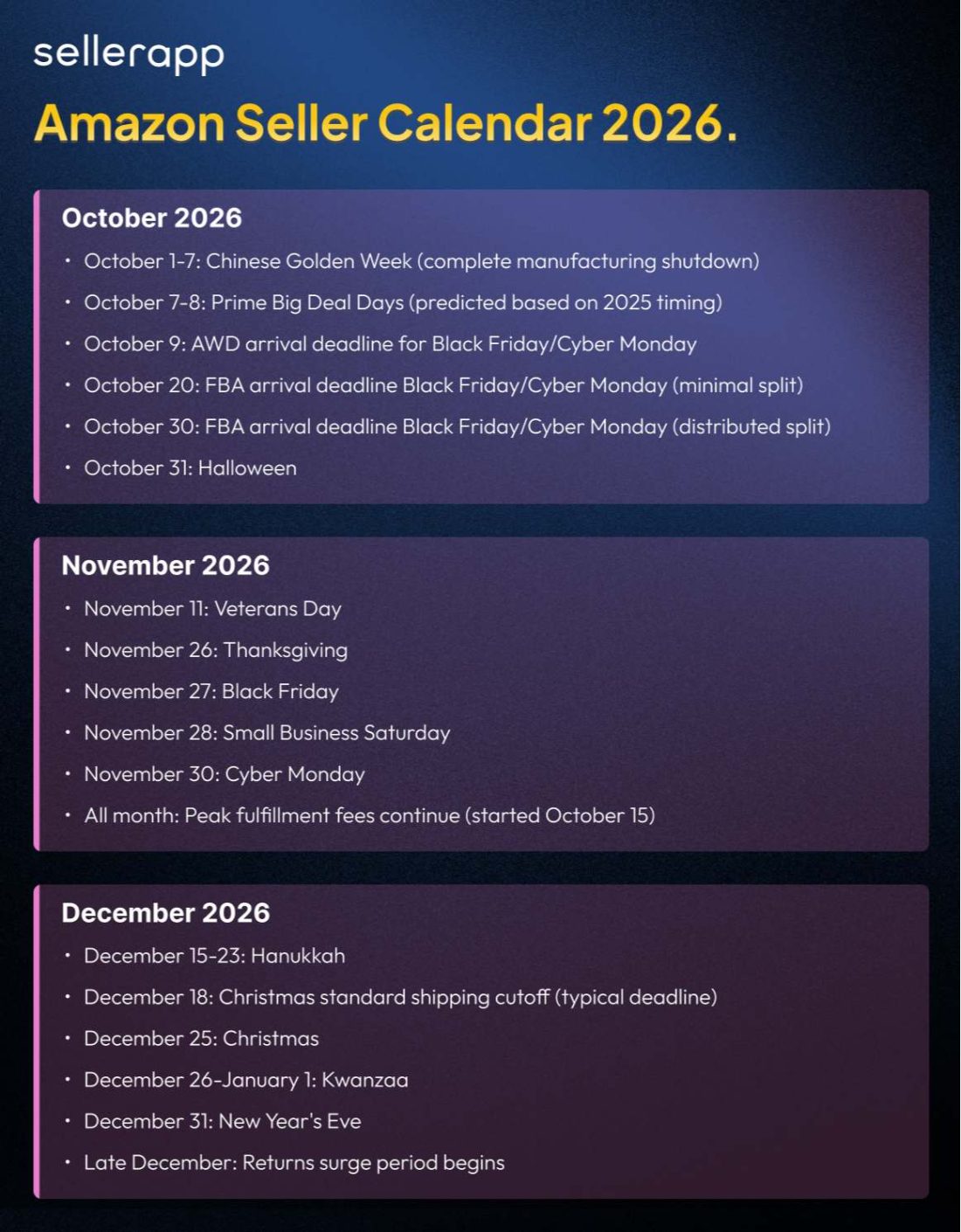
October marks the beginning of Q4 intensity with multiple critical deadlines that determine your holiday season success. Prime Big Deal Days (predicted October 7-8) generate approximately 40-50% of summer Prime Day’s transaction volume and apply similar execution protocols with hourly inventory monitoring, increased PPC budgets, and accelerated customer response times. Halloween sales concentrate Oon ctober 20-31, with the final 11 days representing 70% of monthly volume; consider raising prices 5-10% October 28-31 when demand peaks and last-minute urgency is highest.
Chinese Golden Week (October 1-7) creates a complete manufacturing shutdown; any inventory needs for November-December should have been ordered in August as recommended. The most critical aspect of October is the series of absolute final deadlines for Black Friday/Cyber Monday inventory: October 9 for AWD, October 20 for FBA minimal split, and October 30 for FBA distributed split. After October 30, FBA receiving processing extends from the standard 3-5 days to 14-21 days, meaning inventory arriving after this date will not be available for Black Friday.
Key Dates:
November is the most intense sales period of the year. The Thanksgiving through Cyber Monday period (“Cyber Week,” November 25-30) generates 25-40% of annual revenue for most Amazon sellers, with traffic, conversion rates, and competition all peaking simultaneously. Cost-per-click rates reach annual highs (3-5x baseline, some keywords 10x), Buy Box competition intensifies as competitors implement aggressive repricing strategies, and customer service volume increases 300-400% versus baseline months.
Cyber Monday often outperforms Black Friday on Amazon because customers return to work with desktop computers, and Prime shipping becomes critical for guaranteed Christmas delivery. The week represents a compressed Super Bowl of e-commerce, where months of preparation either pay off spectacularly or planning failures become painfully expensive.
The operational demands of Cyber Week require military-level execution precision. Buy Box percentage must be monitored every 2-4 hours as competitors undercut prices; use automated repricing if possible while maintaining manual oversight of margin floors. Inventory levels require checking every 4 hours: if approaching the stockout threshold, reduce PPC spend to extend inventory runway; if you have excess, increase ad budgets to move inventory before the December slowdown. .
Key Dates:
Early December continues holiday shopping momentum through the Christmas shipping cutoff (typically December 18 for standard shipping; verify exact date and shipping method cutoffs in Seller Central as they vary by region and product category). Amazon advertises guaranteed Christmas delivery for orders placed by this date, creating a hard cliff where traffic and sales drop 60-70% after the cutoff as remaining shoppers shift to last-minute in-store purchases, digital gift cards, or accept post-Christmas delivery.
The post-Christmas period (December 26-31) experiences dramatic return rate increases of 20-30% on average versus the 5-10% baseline, with apparel categories potentially reaching 40% as unwanted gifts come back. Many sellers waste significant PPC budget in late December maintaining high spend on drastically reduced traffic, when scaling back 50-70% after December 20 would preserve cash for January operations.
The psychology of late December shoppers differs entirely from holiday gift buyers. December 19-31 traffic primarily represents gift card redemption (peaked December 26-January 15) and self-purchase behavior rather than gift-giving, requiring different messaging and positioning. Products with excess inventory should run aggressive clearance pricing (30-50% discounts December 26-31) to move stock before aged inventory penalties hit; the loss from discounting is almost always less than long-term storage fees plus the opportunity cost of capital tied up for 12 months.
Amazon continuously evolves its policies to balance marketplace efficiency, seller compliance, and customer protection. The following changes represent significant operational shifts that will impact how sellers manage inventory, control costs, and maintain account health throughout 2026. Enterprise sellers should integrate these policy changes into strategic planning immediately.
Effective Date: January 15, 2026
FBA Fulfillment Fee Increases: Amazon announced an average increase of $0.08 per unit across FBA fees, representing less than 0.5% of the average item selling price. However, the actual impact varies significantly by product size tier and price point:
Small Standard-Size Items:
Large Standard-Size Items:
Large Bulky Category: Amazon split the “Large Bulky” tier into “Small Bulky” and “Large Bulky” to offer lower fees for smaller items in this class. However, the Ships in Product Packaging (SIPP) discount for bulky items has been eliminated. Products unable to ship in their own packaging now incur packaging fees averaging $2.07 per unit.
Additional Fee Increases:
Storage Fee Changes:
Low-Price FBA Program: Products under $10 receive enhanced discounts: $0.86 per unit (increased from $0.77 in 2025)
For a seller moving 10,000 units monthly in the small standard $28 price tier, the $0.25 per unit increase equals $30,000 annually in additional fulfillment costs.
If you’re sourcing products from China, then let’s be honest, most Amazon sellers are. For this, the Chinese national holidays aren’t just dates on a calendar. They’re critical deadlines that can make or break your entire quarter. Miss one of these deadlines, and you could be watching your competitors make millions in sales during Black Friday while your inventory sits on a boat somewhere in the Pacific.
Here’s what you need to know about the three major Chinese holidays that will impact your 2026 inventory planning.
Chinese New Year isn’t a day off. It’s a complete shutdown. While the official holiday is January 29, factories typically close around January 24 and don’t fully resume until February 8. That’s two full weeks of zero production. But it takes another 2-3 weeks for factories to get back to full capacity as workers trickle back from their home provinces.
The entire country essentially goes on pause. Your supplier isn’t answering emails. Production lines are dark. Nothing ships.
If you need inventory in Q1 2026, whether that’s for Valentine’s Day, a product launch, or just maintaining stock levels, your orders need to be placed by mid-December 2025. This gives you 30 days for production, accounts for the 2-week closure, and leaves 45-60 days for ocean freight. Cut it any closer, and you’re gambling with air freight rates that can eat your entire profit margin.
You’ll be out of stock in February and March. Your IPI score takes a hit. Your search ranking drops. And by the time inventory arrives, you’ve lost the momentum that takes months to rebuild.
Labor Day is officially three days, but Chinese factories treat it like a full week off when you factor in surrounding weekends. The closure runs roughly from April 30 through May 5. It’s not as disruptive as during the Chinese New Year; the workers don’t travel as far, so production ramps back up faster. But the timing creates a real problem if you’re planning for summer sales.
This deadline is critical for one reason: Prime Day. If you’re participating in July’s Prime Day event, your inventory absolutely must reach FBA by mid-June. Orders placed in March account for the Labor Day closure and give you the buffer you need to hit Amazon’s Prime Day inventory cutoff.
This also affects Father’s Day inventory (June 21) and anyone selling outdoor, camping, pool, or summer seasonal products.
You miss Prime Day, the second-biggest sales event of the year. For many sellers, Prime Day represents 10-15% of annual revenue. Miss the inventory deadline, and you’re sitting on the sidelines while your competitors capture that traffic and build ranking momentum that carries through the rest of the summer.
Golden Week is the holiday that kills Q4 for unprepared sellers. Factories shut down completely October 1-7, with many extending closures from September 28 through October 8. This happens at the absolute worst time, right when you need maximum production capacity for Black Friday and Christmas inventory.
Here’s the problem: anything produced in October arrives in late November at the earliest. By then, you’ve already missed Black Friday’s inventory cutoff (October 30 for distributed inventory, October 20 for minimal split). You’re dead in the water for the most profitable selling period of the year.
This is the deadline that separates successful sellers from those who stumble through Q4. Orders placed by early August give you 30 days for production, account for the Golden Week shutdown, and provide 45-60 days for ocean freight. Your inventory arrives in late October, meeting Amazon’s Black Friday deadlines with a small buffer for delays.
You stock out during Black Friday, Small Business Saturday, and Cyber Monday, the week that often represents 25-40% of your annual revenue. Your search ranking craters from the stockout. Customers buy from competitors. And even after inventory arrives in December, it takes months to rebuild the ranking you lost.
We see this every single year: sellers who miss the August deadline spend September and October panicking, paying emergency air freight rates ($6-8 per unit extra), or just accepting that they’ve lost their most important sales period.
Amazon sellers must follow a structured timeline as they prepare strategically for the holiday season, keeping the Amazon monthly calendar in consideration. Sellers can maximize their sales potential and customer satisfaction during this peak period by meticulously planning tasks such as product assortment, inventory management, listing optimization, and marketing strategies.
If you want to leverage seasonal selling or thrive among ambitious sellers in general, you’ll have to navigate through the complexities of maintaining an Amazon Seller Holiday Calendar.
You need to stay proactive with promotions, follow Amazon’s guidelines, and ensure seamless customer service. And these are the very basics. To help you prepare effectively, SellerApp offers a comprehensive listing service where you can enhance your product visibility with keyword-focused content, high-quality images, and holiday-specific A+ content. The intuitive dashboard provides real-time insights into your sales, inventory, and performance metrics, allowing you to make informed decisions and stay ahead of the competition.
So align your selling strategies with the Amazon calendar 2025, and make the holidays more enjoyable with increased revenue. Or you can simply outsource your PPC marketing campaign responsibilities to SellerApp PPC Agency, where our team of experts ensures your products are getting the best visibility at the right time and with targeted ad spends. In addition to that, to make the most out of the peak season demands, our PPC experts can design targeted campaigns that are customized for your needs so that you can achieve maximum sales and visibility. Check out our seasonal and event-based campaign management services here.
Read More:
Advanced Amazon PPC Strategies For Explosive Sales: Seller Guide
What Should Every Seller Know About Profit and Loss Statements on Amazon