


Amazon URL structure is one of those things that doesn’t make it onto the agenda until something breaks. And when it does, it usually breaks quietly. You’re sitting in a post-campaign review watching three different reports tell three different stories about the same sales period. The ads console shows one ROAS. Amazon Attribution shows another. The brand referral bonus report doesn’t match either. And everyone in the room has a different explanation.
Nine times out of ten, the answer traces back to how your Amazon URL structure was built.
For sellers managing influencer programs, paid social, and off-Amazon traffic at the same time, the link format isn’t a minor technical detail someone in campaign ops handles quietly. It determines whether a sale gets attributed to sponsored ads, logged as external demand, credited toward your brand referral bonus, or swallowed into untrackable direct traffic in Brand Analytics.
Use the wrong format across channels without any governance in place, and you end up with misallocated budgets, duplicate affiliate payouts, and optimization calls based on numbers that were never measuring what you thought they were, and the worst part is, nothing tells you it’s happening. Sales keep coming in. Ads keep spending. Influencers keep posting. The attribution just slowly stops reflecting reality.
Quick Guide:
If you are one of the sellers juggling multiple campaigns, influencer partnerships, and cross-channel ads, understanding the Amazon URL structure is important. They determine how every click is tracked and reported across your teams.
However, URLs don’t affect A10 ranking, which is more customer-centric and engagement-focused. The Amazon URL structure, however, influences which internal reports register a purchase and how conversions flow through Ads Console, Amazon Attribution, and Amazon Brand Analytics.
Every URL behaves differently. For example, a canonical /dp/ASIN link behaves differently from an ad-console URL, an a.co short link, or an influencer storefront link, and inconsistent usage across channels can create subtle but costly misalignments.
When URL formats aren’t standardized, the same sale can appear in Ads Console as paid traffic, in Amazon Attribution as external demand, and in Brand Analytics as “Direct / Other.” This disconnection can lead to real operational challenges for your team; for instance, marketing teams may misinterpret campaign performance, finance may misattribute revenue, and operations may spend hours chasing fake inefficiencies.
This means that beyond Amazon’s internal reporting, URLs also influence shopper behavior.
Clean, consistent Amazon URL structure ensures that every channel, campaign, and influencer touchpoint is traceable and auditable, giving teams a shared view of reality and allowing sellers to scale.
What is Flutter about the Amazon URL structure? Amazon product URLs look very simple. These were the exact words from a seven-figure seller who recently partnered with us. But when you start crawling Amazon URL structure across campaigns, agencies, and influencer programs, you quickly realize there’s a lot more happening behind a single link than it looks.
When you break a real U.S. Amazon URL apart, you can see which pieces Amazon treats as permanent identifiers and which ones exist only to guide traffic, credit, or analytics.
For sellers operating at scale, this distinction matters. Not because URLs change rankings but because they determine how Amazon classifies demand after the click.
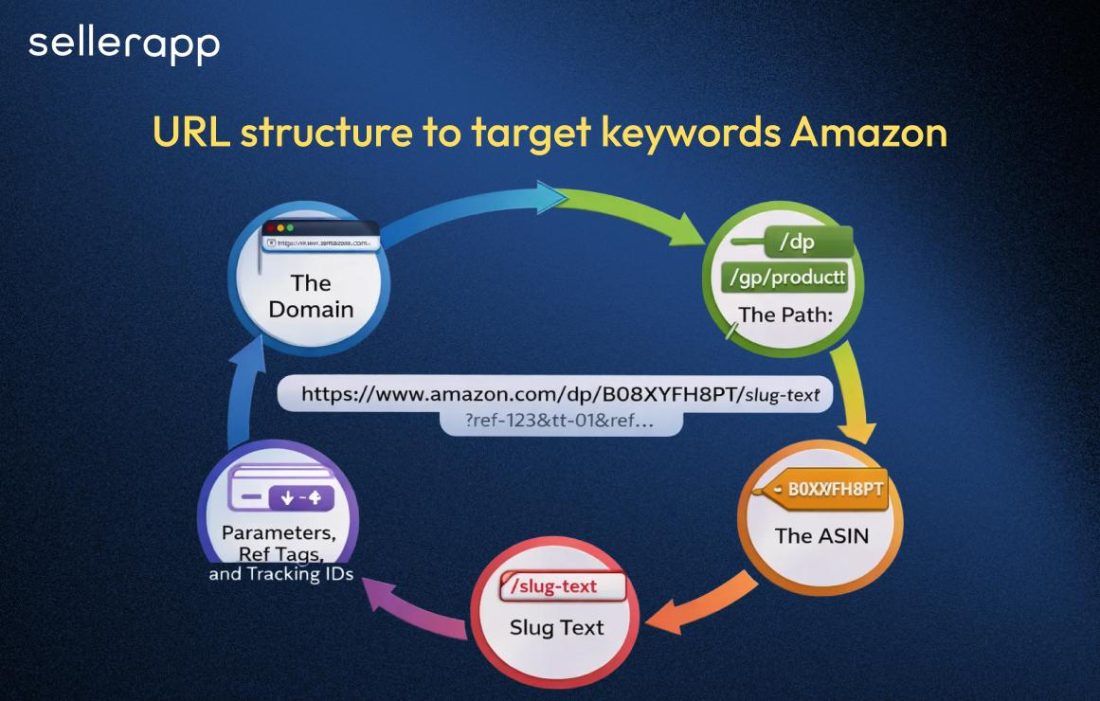
Whether a product loads on amazon.com, smile.amazon.com, or m.amazon.com, Amazon resolves all of them back to the same underlying product entity. The domain does not affect ranking, product relevance, or catalog identity.
Where it does matter is session behavior.
Mobile domains, Smile links, and regional hosts exist as UX layers. Amazon normalizes them early in the request lifecycle, but the entry point still influences how a session is stitched together, especially when traffic crosses devices or entry surfaces. From an algorithmic standpoint, the domain is ignored.
From a tracking point of view, it can affect continuity, attribution windows, and how Amazon interprets the source of a visit before normalization.
The first meaningful structural fork in an Amazon URL appears in the path:
Both resolve to the same product page. Both load the same content. But they are not treated identically under the hood.
/dp/ is Amazon’s modern, preferred canonical format. It’s shorter, more stable, and less exposed to legacy experiments. /gp/product/ exists because Amazon never breaks old infrastructure; it is a compatibility layer that still works, still indexes, but no longer represents the clean internal standard.
Amazon rewrites both formats internally, but it logs the original request before normalization. That distinction doesn’t matter for ranking. It doesn’t matter when you’re reconciling attribution paths, traffic sources, and reporting anomalies across tools.
The ASIN is the entire point of the URL.
Amazon extracts it first. Everything else is optional.
You can remove the domain variants, strip the slug, and delete query strings, and the page will still load as long as the ASIN remains intact. ASIN placement, whether it appears immediately after /dp/ or deeper in a longer path, does not change product identity.
This is why two URLs that look completely different to a human can land on the same PDP while behaving very differently in reporting. Amazon resolves the ASIN, then decides what to do with the rest of the request.
The product title text embedded in the URL path exists for one reason: humans.
It improves readability, aligns with old-school SEO expectations, and makes links feel trustworthy when shared. Amazon does not use slug keywords as a ranking signal. It does not penalize mismatches. It does not “correct” relevance based on slug content.
Once the ASIN is resolved, the slug is ignored. Sellers fixate on this because it resembles SEO. But internally, it’s a dead weight.
Ref tags and query parameters don’t affect ranking, but they do affect classification, which indicates they tell Amazon where the traffic came from and which internal system should receive credit for the conversion.
Some parameters identify ad units. Some tie sessions to influencer storefronts. Others signal off-Amazon traffic eligible for Brand Referral Bonus or affiliate commissions. Amazon does not treat these signals equally.
Some are persisted through the session. Some are evaluated only on entry. Some are dropped immediately after resolution. Crucially, Amazon logs the raw request before it rewrites the URL you see in the browser.
This is where sellers get it wrong. They assume that because Amazon “cleans” URLs, upstream signals disappear.
| URL Component | Example | What It Is | What Amazon Does With It | What Sellers Should Know |
|---|---|---|---|---|
| Domain | amazon.com | Marketplace host | Routes traffic to the U.S. marketplace | amazon.com, smile.amazon.com, and m.amazon.com all resolve to the same product backend. Domain choice does not change the product identity. |
| Alternate Domains | smile.amazon.com, m.amazon.com | Interface-level variants | Normalizes to the same PDP internally | These domains don’t create duplicate products or SEO variants inside Amazon. They’re UI-level, not catalog-level. |
| Path Type | /dp/ | Canonical product detail path | Treated as the standard PDP format | /dp/ASIN is Amazon’s preferred modern structure. This is the cleanest form to use when sharing links. |
| Legacy Path Type | /gp/product/ | Older PDP path format | Redirects to the same PDP | Still valid, still resolves, but functionally legacy. No known advantage over /dp/. |
| ASIN | B01234XYZ | Unique product identifier | Primary lookup key for the PDP | This is the only required component. Everything else in the URL is optional decoration or tracking. |
| Slug Text (Title Words) | Organic-Turmeric-Capsules-Inflammation-Support | Human-readable text derived from title | Ignored for PDP resolution | Amazon does not rely on this text to identify the product. It exists for readability and external SEO, not internal ranking. |
| Ref Tags | ref=sr_1_5 | Referral and UI context | Used transiently during session | Often dropped after page load. Indicates how the user arrived (search position, widget, etc.). |
| Search Parameters | keywords=turmeric, qid=1700000000 | Search-state metadata | Used to reconstruct UI state | Not persisted as canonical data. Helpful for analytics context, not product identity. |
| Affiliate Tag | tag=affiliate-id-20 | Amazon Associates tracking ID | Logged for commission attribution | Determines who gets paid for the referral. Does not change ranking or PDP behavior. |
| Other Tracking IDs | linkCode=ogi, camp=1789 | Campaign-level tracking | Varies by system | Some are logged by attribution or affiliate systems; many are ignored once the session starts. |
Understanding Amazon’s URL structure is important because each URL format helps Amazon acquire context, such as where the shopper came from, what they are looking for, and their intent to buy.
Here we have listed different types of Amazon URL structure for Amazon sellers.
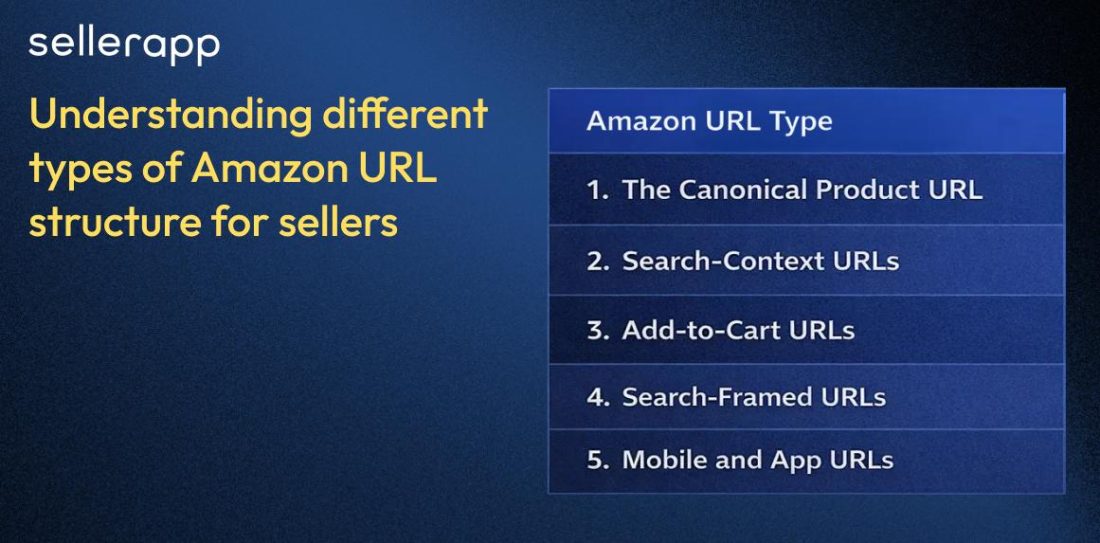
Every product on Amazon resolves back to a single, stable address tied to the ASIN. This is the URL Amazon treats as the reference point for indexing and external visibility.
A canonical product URL usually appears as
https://www.amazon.com/Noise-Cancelling-Headphones-Bluetooth/dp/B08N5WRWNW
Those descriptive words are primarily for search engines, not shoppers. Google sends Amazon billions of visits annually, and this is the format external crawlers are most likely to index. All other URL versions eventually collapse back into this canonical form at the ASIN level.
When a shopper finds a product through Amazon search, they don’t land on the clean canonical URL. Instead, Amazon generates a search-context URL that records the keyword, the product’s position, and the session timing.
A typical example looks like
https://www.amazon.com/Noise-Cancelling-Headphones/dp/B08N5WRWNW/ref=sr_1_4?keywords=noise+cancelling+headphones&qid=1700000000&sr=8-4
These parameters allow Amazon to attribute the click and analyze relevance. They don’t create duplicate listings, and they don’t fragment rankings or reviews. Once the click is logged, the additional context is discarded, and the interaction is credited to the same ASIN record.
Some Amazon URLs are designed to reduce friction rather than provide information. Add-to-cart URLs place the product directly into a shopper’s cart without requiring them to view the product page first.
An example looks like
https://www.amazon.com/gp/aws/cart/add.html?ASIN.1=B08N5WRWNW&Quantity.1=1
These links are commonly used in email campaigns, SMS promotions, and high-intent external traffic where the buyer already knows the product. While they don’t directly influence ranking, they often improve checkout completion by removing unnecessary steps in the buying process.
Some URLs appear to be standard search result pages but are structured to include a specific ASIN within a keyword search.
For example:
https://www.amazon.com/s?k=noise+cancelling+headphones&field-asin=B08N5WRWN
These URLs don’t affect rankings, but they can reveal whether a product is indexed and competitive for a keyword. Sellers often use them to validate organic visibility before committing budget to PPC campaigns, especially for new or long-tail search terms.
When shoppers access Amazon through mobile browsers or the Amazon app, they’re often served device-specific URLs such as
These URLs aren’t separate pages. They’re alternate entry points optimized for mobile experiences. Amazon may rewrite or redirect them depending on device, login state, or experiment cohort, but all activity still resolves to the same ASIN internally.
A common misconception is that using the “wrong” URL can harm rankings or split SEO value. Amazon doesn’t evaluate products at the URL level. Rankings, reviews, and sales velocity are all calculated at the ASIN level.
URLs exist to capture shopper behavior and patterns. Once Amazon records where a shopper came from and what they interacted with, the URL format becomes irrelevant.
Clean canonical URLs are best for blogs, press mentions, and long-term external links. Search-context URLs are useful for diagnosing keyword visibility. Add-to-cart URLs work best for high-intent promotions. Mobile URLs are outside the seller’s control and don’t require optimization.
Understanding this distinction allows sellers to use URLs intentionally rather than treating them as interchangeable links.
Amazon’s URL structure observes behavior across search, ads, affiliates, mobile, and external traffic at a massive scale. Once you see URLs as metrics rather than optimization levers, most of the myths surrounding Amazon URL “SEO tricks” disappear.
We have listed down common myths about Amazon URL structure so that you can avoid them.
A lot of sellers still talk as if having search terms directly in an Amazon URL magically bumps your product up in search results. This idea probably started from old discussions around Super URLs or “search-find-buy” tactics, where sellers believed that driving traffic through URLs containing keywords would signal relevance to Amazon.
Sellers who used classic Super URLs years ago shared this on Reddit: they noted it seemed like they helped rankings back in the early days, but that effect has largely disappeared as Amazon’s systems have evolved. Some users report that these links no longer affect Best Seller Rank or keyword positioning the way they once did, and experts point out that Amazon’s ranking logic now focuses almost entirely on ASIN performance metrics like conversion rate and sales velocity rather than specific URL text.
In short, having keywords in a URL doesn’t directly boost ranking today. At best, it reflects where someone searched from, not that Amazon treats that as an SEO signal.
Another common belief is that long, parameter-packed Amazon URLs, the ones with “ref=”, timestamps, or session info, reduce conversions because they look unwieldy or sketchy.
Reddit sellers often see long URLs when sharing product links captured from Amazon search sessions. But most experienced sellers will tell you that shoppers don’t really care about the URL string when they’re clicking from an ad, a social post, or an email; they care about whether the product page loads quickly and looks trustworthy once it’s open. In fact, Amazon itself doesn’t display the full search parameters most of the time unless you copy the link manually, so buyers rarely see the messy version except behind the scenes.
The real driver of conversion isn’t the length of the URL text; it’s the product page quality, images, pricing, and social proof. So while long URLs might feel ugly, they don’t actually cause lower conversions on Amazon.
Most sellers worry that if you share multiple different URLs that point to the same product, Amazon will punish you for duplicate content, a misunderstanding that likely comes from web SEO applied to Amazon.
On brand-owned websites like Shopify and Magento, duplicate pages can create indexing issues, and tools like canonical tags are used to consolidate signals. Amazon doesn’t have that problem at the catalog level. Each product is defined by a single ASIN, and all valid URL variations resolve to that same internal product record for ranking and merchandising.
However, Amazon still evaluates URL parameters at the entry level for attribution and channel classification before normalizing the page.
A Reddit user once asked why their Amazon product wasn’t getting indexed externally on Google. The top replies explained that it doesn’t matter which URL you share; Google indexes the canonical URL, and Amazon’s internal system doesn’t penalize listings for having multiple paths leading to the same ASIN.
In other words, Amazon doesn’t have “duplicate URL penalties” the way the open web does. Multiple links pointing to the same product don’t hurt you; they just don’t change anything either.
This one sounds logical if you come from traditional SEO. In the traditional sense, you use one clean, friendly link for search engines and another tracking link for ads and analytics.
But on Amazon, every link you send, whether from PPC, social media, or email, ultimately resolves to the same ASIN record internally. Amazon strips or logs tracking parameters after the click and then ranks and sells the ASIN regardless of the link format.
Reddit users who have experimented with search engine indexing point out that Google respects the canonical ASIN URL for external SEO, but that doesn’t mean Amazon rankings themselves are affected by which version you use in your ad campaigns.
So you don’t need a separate “SEO URL” and “ads URL” for Amazon itself; you just need to track performance externally using analytics tools if you want insight into your traffic sources.
Most experienced Amazon sellers don’t think about Amazon URL structure the way beginners are taught to. On Reddit, especially in longer threads on r/FulfillmentByAmazon and r/AmazonSeller, Amazon product URL structure are rarely discussed as a ranking strategy. They’re talked about as something you fix once you’ve already been burned.
One seller summed it up bluntly in a thread about messy product launches: “Amazon doesn’t give you one product page. It gives you twenty versions of the same page and lets you ruin your own reporting.”
The Catalog Problem Nobody Warns Sellers About
That comment resonated because it reflects how URLs actually behave at scale. Every ad click, category jump, or filtered search can spawn a slightly different version of the same PDP. None of them are wrong, but together they create chaos.
Smart sellers treat URLs as part of catalog management. They decide early which version of the product page they consider canonical and set it as the default everywhere it matters. Internal teams, agencies, affiliates, influencers, and analytics tools all perform better when they’re not dealing with five “different” pages that all lead to the same ASIN.
Another seller put it more practically: “I don’t care which URL Amazon prefers. I care which one my team uses, so we stop arguing over numbers.”
When Ads Enter the Picture, Fractured URLs Get Expensive
That mindset becomes even more important once ads enter the picture. A recurring frustration on Reddit is sellers thinking a campaign stopped working, only to later realize the data was fractured across multiple URLs. One PPC-focused thread described a seller who swore Google Ads traffic was converting poorly until they noticed half the traffic landed on URLs that stripped their attribution parameters. Amazon credited the sales, but external analytics showed a drop-off that wasn’t real.
As one commenter explained it, “The sale still happens, but your tools don’t see it, so you end up killing a campaign that was actually profitable.”
That’s the kind of mistake URL discipline quietly prevents. Fewer URLs mean fewer blind spots. It doesn’t directly improve conversion, but it dramatically improves decision-making.
The “This URL Converts Better” Is Almost Always the Wrong Conclusion
This is also why veteran sellers are skeptical of claims like “This URL converts better than that one.” On Reddit, those posts get challenged fast. Someone will point out that the traffic source changed, the link was shared in a different context, or the audience’s intent wasn’t the same. The URL itself seldom deserves the credit.
One longtime seller phrased it plainly: “People love blaming the URL because it’s visible. The real variables are invisible: traffic quality, timing, and audience intent.”
What URL Control Actually Looks Like When You’re Scaling
Where URL control really matters is when sellers scale beyond a single dashboard. Once you’re running Sponsored Products, DSP, external traffic, influencer links, and third-party analytics tools side by side, inconsistency becomes expensive. Reddit is full of stories of sellers assuming a tool was broken because numbers didn’t line up, only to realize later that different campaigns were pointing to different versions of the same PDP.
Smarter operators reduce variables rather than adding them. Ads, external traffic, and analytics tools all point to the same clean product URL unless there’s a documented reason not to. Any deviation is intentional and traceable. That’s how they maintain trust in their data.
One seller described it less politely: “Once you stop trusting your numbers, you start making emotional decisions. URL mess is how that starts.”
Once you really understand Amazon URL structure, you understand that they’re not there to impress the algorithm.
Amazon will always collapse multiple URLs into a single canonical product entity internally. Rankings, reviews, and Buy Box eligibility don’t fall apart just because there are ten different URLs for the same ASIN.
This is where serious sellers gain an edge. They don’t hover around myths about keywords in URLs or obsess over whether a shorter link converts better. They standardize on a single clean product URL, document it, and route ads, external traffic, and reporting around that decision. The result isn’t higher rankings overnight; it’s clearer attribution, faster decision-making, and fewer false alarms when performance shifts.
But wait, did you really think this was all in this article? Take a look at our platform, where SellerApp’s Amazon PPC Agency takes over the kind of campaign management that actually benefits from clean attribution data, keyword-level spend analysis, placement optimization, and scaling decisions that aren’t based on mixed signals.
For brands running influencer programs, paid social, and multi-channel external traffic simultaneously, SellerApp’s Full Service Marketing Agency connects all of it: strategy, execution, and reporting under one roof, so you’re not reconciling three dashboards at the end of every month, wondering which number to trust.
A clean Amazon URL structure is one of those simple choices that never shows up in case-study headlines, but it’s a foundation every serious seller eventually builds, usually after learning the hard way that unclear data costs more than bad traffic.