

Recently, one of our clients asked me: “Is Temu legit enough to risk my inventory?” She’d seen the explosive growth, the Super Bowl ads, the constant social media buzz. But she’d also read about the lawsuits, the data privacy concerns, the quality complaints. She wanted a straight answer about whether Temu is legit and safe for sellers.
Here’s what I told her, and what I’m going to tell you. Yes, Temu is legit in the sense that it’s a real company backed by a publicly traded parent worth $128 billion. The platform processes real transactions. Sellers receive real payments. Buyers get actual products delivered to their doors.
But is Temu safe? That’s where the straight answer gets complicated. Is it safe to buy from Temu when multiple states are suing the platform for data privacy violations? Is Temu safe when Kentucky’s Attorney General claims the app can install malware and send data to Chinese authorities? Is it safe to buy from Temu when EU testing found 4 out of 5 products violated safety regulations?
The question “is Temu legit and safe” actually contains multiple distinct questions, each with different answers. Is Temu legit as a business entity? Yes. Are Temu scams a real concern? Absolutely. Is Temu safe for building a long-term brand? Depends on your brand positioning. Is it safe to buy from Temu quality-wise? Wildly inconsistent.
For sellers trying to figure out whether Temu is legit enough to invest time and inventory, the real question isn’t about legitimacy. It’s about whether you can make money on a platform facing intense regulatory scrutiny while operating at massive losses and compressing margins to compete with Amazon.
I spent eight weeks researching whether Temu is legit and safe from every angle. Court documents from multiple state lawsuits. Federal regulatory filings. EU safety investigations. Forums where sellers share actual revenue data. Interviews with merchants who’ve been asking “is Temu legit” since 2022 and now generate anywhere from $5,000 to $200,000 monthly.
Here’s what I learned: The question “is Temu legit and safe” misses the point. The platform is legitimate but risky. The real question for sellers is whether those risks are acceptable given the potential returns, and whether you’re comfortable with customers constantly asking “is Temu safe” and “is it safe to buy from Temu” about your products.
TL;DR Everything Sellers Need to Know About Whether Temu Is Legit and Safe
The bottom line on whether Temu is legit: Yes, Temu is a legitimate publicly traded company (NASDAQ: PDD) backed by PDD Holdings worth $128.79 billion. But when sellers ask “is Temu legit and safe,” they’re really asking multiple questions that have very different answers in 2026.
Is Temu safe? The platform processes secure payments and delivers real products, making Temu safe for basic transactions. But is it safe to buy from Temu when considering data privacy? Multiple U.S. state attorneys general have filed lawsuits alleging Temu collects excessive data and potentially shares it with Chinese authorities, which raises serious questions about whether Temu is safe from a privacy perspective.
Temu scams are a real concern for both buyers and sellers. Phishing emails, fake customer service, counterfeit products, and review manipulation schemes all fall under Temu scams that plague the platform. The question “is it safe to buy from Temu” gets complicated when you consider that EU testing found 79% of randomly purchased products violated safety regulations.
So is Temu legit and safe enough to build a business on? That depends on your risk tolerance. The platform is legitimate as a business entity, but whether Temu is safe for your brand and whether you can actually make money requires understanding everything from regulatory risks to margin compression to quality control challenges.
Your Critical Seller Checklist:
2026 Statistics That Answer “Is Temu Legit and Safe”:
Three Ways to Approach Whether Temu Is Legit and Safe:
When people ask “are Shein and Temu the same,” the answer is no but they face similar scrutiny. When they ask “is Amazon better than Temu,” the answer depends on what you’re optimizing for. And when they ask “how is Temu different from Wish,” the answer is that Temu is actually succeeding where Wish failed.
This comprehensive guide examines everything about whether Temu is legit and safe from a seller perspective, including the reality of Temu scams, why buyers constantly ask “is it safe to buy from Temu,” and whether the question “is Temu legit” even matters if you can’t make money at their price points.

When sellers first ask “is Temu legit,” they’re usually trying to determine if this is a real business or some kind of elaborate scam. So let’s establish the foundational facts about whether Temu is legit as a company.
Temu launched in September 2022, created by PDD Holdings, which also owns Pinduoduo (one of China’s largest ecommerce platforms). PDD Holdings is publicly traded on NASDAQ under ticker symbol PDD with a current net worth of $128.79 billion. So when people ask “is Temu legit,” the answer from a corporate legitimacy standpoint is yes—this is a substantial, publicly traded company subject to SEC oversight and regulatory scrutiny.
But here’s where the “is Temu legit” question gets interesting for sellers. The business model makes no traditional economic sense, which is why so many people question whether Temu is legit as a sustainable platform.
Traditional ecommerce operates on straightforward economics. Companies buy products from manufacturers, mark up prices to cover overhead and generate profit, and consumers pay those prices. Everyone makes money. The model works because the math works.
Temu said “what if we just ignored profitability entirely” and created something that defies basic retail logic. The platform connects Chinese manufacturers (and increasingly U.S.-based sellers after 2026 tariff changes) directly with consumers, eliminating virtually every middleman. No traditional markups. No domestic warehousing costs initially. Just factory-to-consumer pricing where Temu takes a tiny commission and subsidizes everything else through investor capital.
In 2023, while proving Temu is legit as a business, the company lost $3.56 billion. Their gross merchandise volume hit $15.33 billion, meaning they burned money on essentially every transaction. In 2024, GMV reached $29.5 billion and is projected to hit $41 billion in 2026. Yet the company continues operating at massive losses.
When sellers ask “is Temu legit,” this loss-making model is often what confuses them. How can a company that loses billions annually still be considered legitimate? The answer is that Temu is legit because Chinese investment capital is subsidizing the entire operation, betting on long-term market dominance over short-term profitability.
This is the same strategy Uber used against taxis, the same approach Amazon employed against bookstores. Operate at massive losses, undercut every competitor’s prices, train consumers to expect impossibly low costs, capture market share at any expense, then slowly raise prices once you’ve dominated the market.
For sellers, this creates a bizarre situation. You’re entering a marketplace where proving Temu is legit matters less than understanding that the platform operator doesn’t need profits because someone else is funding the operation. That “someone” has interests that may not align with your success as a seller.
“When a business model makes no economic sense on the surface, look deeper at what’s actually being subsidized. Sometimes the product isn’t what’s being sold—it’s the data being collected and the market share being captured for future exploitation.” – Dilip Vamanan, Co-Founder of SellerApp
Last year’s April 2025 tariff changes fundamentally altered whether Temu is legit as originally conceived. President Trump suspended the de minimis exemption that allowed duty-free imports under $800 from China. Temu’s entire cost structure depended on that exemption.
Overnight, the platform had to prove Temu is legit in a new way. They paused U.S. ad campaigns, removed significant catalog portions, and saw prices double or triple on many products. More importantly, they pivoted hard to onboarding U.S.-based sellers who could fulfill from domestic warehouses.
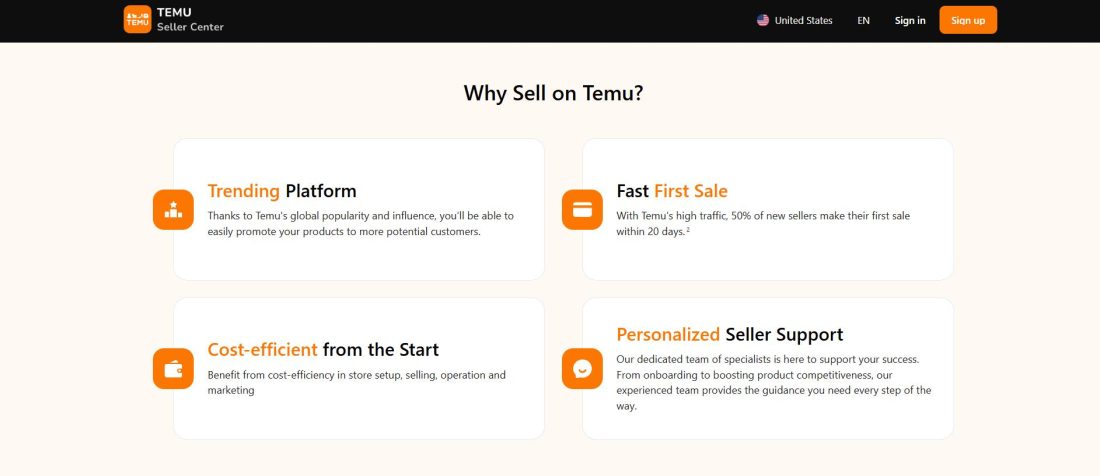
This created the current opportunity. Temu needs American sellers to replace their China-direct model, which is why they’re offering lower commission rates (2-8% versus Amazon’s 15%+) and simplified onboarding. The platform still drives massive traffic—167 million monthly active users globally—making it legitimate from a market reach perspective.
But is Temu safe for sellers to build on? That’s different from whether Temu is legit as a business. The platform is real, but is it stable? Is it compliant? Is it trustworthy from a data perspective? Those questions about whether Temu is safe have very different answers than whether Temu is legit as a company.
If “is Temu legit” establishes that the company is real, then “is Temu safe” examines whether sellers should actually do business there. And this is where things get seriously complicated.
Multiple U.S. state attorneys general filed lawsuits against Temu in 2025 alleging violations ranging from data privacy breaches to deceptive trade practices to selling products made with forced labor. These aren’t customer complaint lawsuits. These are state law enforcement officials using consumer protection laws to go after Temu’s fundamental business practices.
When sellers wonder “is it safe to buy from Temu” or “is Temu safe for my business,” these legal actions provide critical context.
The FTC and DOJ filed suit alleging Temu violated the INFORM Consumers Act, which requires online marketplaces to clearly disclose seller information and provide reporting mechanisms for suspicious activity. Temu settled for $2 million and agreed to compliance measures.
Here’s why this matters for whether Temu is safe: $2 million represents 0.0068% of Temu’s $29.5 billion GMV in 2024. When a company treats regulatory fines as rounding errors, it signals that rapid growth matters more than compliance. For sellers asking “is Temu safe,” that’s a red flag about operational priorities.
Alleged Temu installs malware collecting sensitive data beyond privacy policy disclosures, employs deceptive trade practices, infringes intellectual property, uses forced labor in manufacturing, and manipulates reviews. The lawsuit claims Temu’s software hides data collection during security checks.
This one went further. Kentucky’s AG claimed Temu’s app functions as actual malware that can “infect devices, steal personal data, and send it directly to the Chinese government.” The complaint alleges Temu collects precise GPS, Wi-Fi, camera access, and communications data, then potentially shares it with Chinese Communist Party authorities due to Chinese national security laws requiring data cooperation.
Kentucky also accused Temu of infringing Kentucky brand trademarks (Buffalo Trace, Churchill Downs), selling counterfeit products, using deceptive marketing, and employing forced labor.
The first state action, with claims similar to Nebraska and Kentucky around data collection and deceptive practices.
For sellers evaluating whether Temu is safe, these lawsuits create specific risks:
Your products appear on a platform facing malware and forced labor allegations. Even if claims are dismissed, the association can damage brand reputation, especially for premium or ethically-sourced products. When customers ask “is it safe to buy from Temu,” they’re often questioning whether your products are legitimate.
If states force operational changes to prove Temu is safe, your business could be disrupted. Policy changes for compliance might affect listings, pricing, or operational ability. Sellers need stability, but platforms proving they’re safe through regulatory compliance often undergo disruptive transformations.
If you register through Pinduoduo, you’re subject to Chinese data security laws requiring companies share information with Chinese authorities for “national security” purposes. When sellers ask “is Temu safe” for their business data, this legal framework is relevant.
Multiple lawsuits allege Temu inadequately polices counterfeit products. If you sell branded goods, you compete with knockoffs. If you sell generic products, successful designs get copied. The question “is it safe to buy from Temu” often arises because buyers can’t distinguish legitimate products from counterfeits.
Now, these lawsuits don’t mean Temu will shut down tomorrow or that selling there is illegal. Temu denies all allegations vigorously. The cases are ongoing, nothing is proven in court yet.
But when evaluating whether Temu is safe and whether Temu is legit enough for your business, these legal actions matter. You’re potentially building operations on a platform that multiple state law enforcement agencies claim operates outside consumer protection laws.
“The question isn’t whether Temu is legit as a business entity. When multiple state AGs actively pursue a platform, smart sellers evaluate whether the regulatory risk is acceptable for their situation. Being legitimate doesn’t mean being safe from operational disruption.” – Brij Purohit, Co-founder of SellerApp
Some sellers see these concerns about whether Temu is safe as disqualifying. Others view them as typical growing pains for a fast-scaling platform that will eventually achieve stable compliance. The key is understanding that even though Temu is legit as a company, questions about whether Temu is safe have legitimately concerning answers based on current legal proceedings.
Understanding Temu scams is crucial for sellers because these scams affect whether buyers think “is it safe to buy from Temu” and whether you can build a sustainable business when fraud is prevalent.
Temu scams come in several distinct categories, and sellers need to understand all of them:
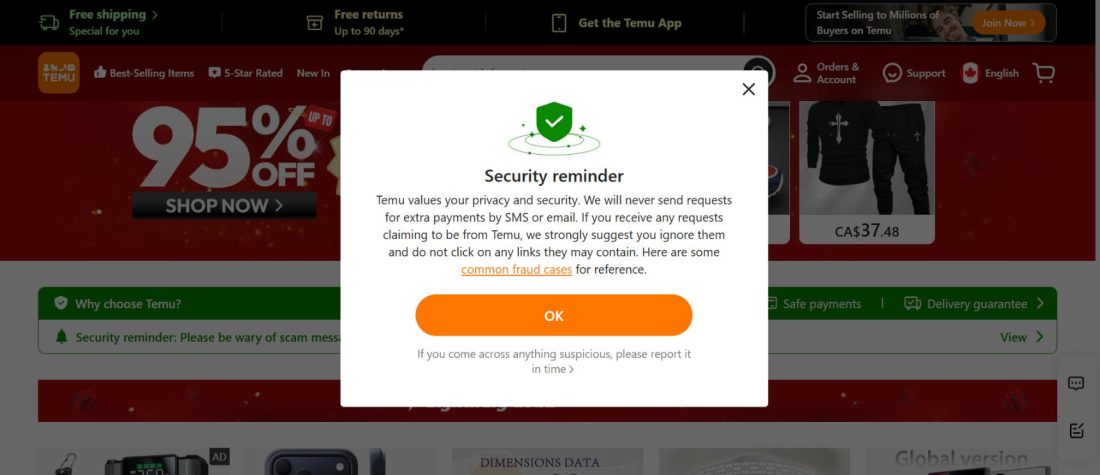
Phishing and Fake Customer Service: The most common Temu scams involve fraudsters impersonating platform customer service. Scammers send emails or texts claiming issues with orders or accounts, then harvest personal information or payment details. The FTC penalty revealed Temu didn’t provide adequate reporting mechanisms, making it harder for sellers and buyers to flag these Temu scams.
Counterfeit Products and IP Theft: These Temu scams involve sellers listing knockoff products or stealing successful designs. Multiple lawsuits allege Temu inadequately polices IP infringement. For legitimate sellers, these Temu scams mean competing with products that look identical but cost one-third your price.
Review Manipulation: Nebraska’s lawsuit specifically called out Temu scams involving fake reviews and misrepresented ratings. The complaint alleges Temu compensates users for positive reviews and mischaracterizes negative reviews as “five star” ratings. These Temu scams undermine trust in the entire review system.
Fake Temu Apps and Websites: Some Temu scams create replica apps or websites designed to capture login credentials and payment information. These aren’t officially on Temu’s platform but capitalize on the brand name. Sellers need awareness because these external Temu scams affect overall platform reputation.
Brushing Scams: These Temu scams involve sending unsolicited packages to create fake purchase histories and boost seller ratings. While not unique to Temu, these scams are documented on the platform and contribute to distorted marketplace metrics.
When customers ask “is it safe to buy from Temu,” they’re often referencing these various Temu scams they’ve read about online. For sellers, this creates a marketing problem. You need to establish that even though Temu scams exist, your specific products are legitimate.
The prevalence of Temu scams also affects whether the platform is safe for building a long-term business. When fraud is common enough that buyers consistently question “is Temu safe,” you’re fighting uphill against platform reputation issues beyond your control.
The EU investigation that found 79% of products violating safety regulations feeds into perceptions about Temu scams. While safety violations aren’t technically scams, buyers lump them together when deciding “is it safe to buy from Temu.” If most products fail safety tests, the platform feels scammy even when individual sellers are legitimate.
For sellers evaluating whether Temu is legit and safe, understanding that Temu scams are prevalent helps contextualize the business environment. You’re not just competing on price and product quality—you’re competing against an ecosystem where buyers have been trained to question “is Temu safe” for everything from data privacy to product authenticity to transaction security.

Sellers frequently ask “are Shein and Temu the same” because both platforms offer ultra-low prices, ship from China, and face similar regulatory scrutiny. Understanding whether Shein and Temu are the same helps position your products appropriately.
The short answer: No, Shein and Temu are not the same, though they share similarities that make the comparison relevant.
Business Model Differences: Shein focuses primarily on fast fashion and apparel, with over 50% market share in adult clothing categories. Temu offers broader product categories (250+ categories) spanning everything from electronics to home goods to pet supplies. So when people ask “are Shein and Temu the same,” the answer is no—Shein is fashion-focused while Temu is general marketplace.
Quality Control: Both face quality concerns, but Shein has longer market history (since 2008) and reported defect rates of 1.8% versus Temu’s 3-8% range. When evaluating whether Shein and Temu are the same from a quality perspective, Shein generally maintains higher consistency due to more established supply chain processes.
Target Demographics: Shein captures fashion-conscious Gen Z buyers willing to pay slightly more for trendy pieces. Temu targets extreme budget shoppers across all demographics. While Shein and Temu share some audience overlap, they’re not the same in terms of buyer psychographics.
Seller Requirements: Shein requires higher minimum order quantities (500-50,000 pieces) compared to Temu’s flexibility (2-500 pieces). For small sellers asking “are Shein and Temu the same” regarding entry barriers, Temu is more accessible.
Commission Structures: Both charge 2-8% commission ranges, so Shein and Temu are essentially the same on fee structures. However, Shein offers more mature B2B integration tools, while Temu is still building seller infrastructure.
Regulatory Scrutiny: When asking “are Shein and Temu the same” from a legal perspective, yes—both face similar investigations around data privacy, forced labor allegations, and product safety concerns. The EU investigates both under Digital Services Act provisions. Multiple states scrutinize both for Chinese ownership and data collection practices.
Shipping Evolution: Both pivoted toward local warehouse fulfillment after 2025 tariff changes. Shein and Temu are similar in adapting from China-direct to domestic fulfillment models, though Temu moved faster with U.S. seller onboarding.
For sellers deciding between platforms, understanding whether Shein and Temu are the same helps clarify positioning:
The question “are Shein and Temu the same” ultimately gets answered: No, but they’re similar enough that both face comparable challenges around legitimacy, safety concerns, and regulatory pressure. Both require sellers to accept ultra-thin margins and compete in environments where buyers constantly question platform safety.
Additional read: How to Sell on Shein: A Detailed Guide

Sellers constantly ask “is Amazon better than Temu” when evaluating platform priorities. The answer depends entirely on what you’re optimizing for, because Amazon and Temu serve fundamentally different strategic purposes.
Is Amazon better than Temu for brand building?
Yes, absolutely. Amazon provides infrastructure for creating sustainable brand equity through advertising, A+ content, and customer loyalty programs. Temu is a volume platform where brand differentiation barely matters—everything competes on price. If your goal is building a recognizable brand, asking “is Amazon better than Temu” gets answered decisively: Amazon wins.
Is Amazon better than Temu for profit margins?
Yes. Amazon fees run 15-30% but prices support 20-40% net margins. Temu fees are only 2-8% but margins rarely exceed 10% because ultra-competitive pricing compresses profits. So when evaluating “is Amazon better than Temu” financially, Amazon provides better per-unit economics despite higher fees.
Is Amazon better than Temu for platform stability?
Absolutely yes. Amazon has 25+ years of established policies, mature infrastructure, and predictable operations. Temu is evolving rapidly with frequent policy changes. For sellers who need stability, asking “is Amazon better than Temu” gets clear answer: Amazon’s consistency matters.
Is Amazon better than Temu for traffic generation?
Amazon maintains dominance with 300 million active users and 200 million Prime subscribers. Temu has 167 million monthly active users globally but dropped significantly in U.S. after tariff changes. When considering “is Amazon better than Temu” for reach, Amazon’s traffic is both larger and more established.
But here’s where “is Amazon better than Temu” gets nuanced:
For clearance inventory
Temu may actually be better. Amazon’s storage fees penalize slow-moving inventory, while Temu’s self-fulfillment model lets you hold product in your own warehouse without platform fees. For liquidation purposes, asking “is Amazon better than Temu” might favor Temu.
For testing new products
Temu’s lower barriers to entry (no FBA prep, lower fees, faster listing) make it useful for validation before Amazon investment. In this specific context, “is Amazon better than Temu” depends on whether you value speed of testing over premium positioning.
For volume over margin
If you’ve optimized operations for high-volume, low-margin sales, Temu’s 2-8% fees beat Amazon’s 15-30%. For sellers who’ve decided that volume matters more than per-unit profit Temu can be more viable.
Most sophisticated sellers don’t ask “is Amazon better than Temu” as either/or question. They use both strategically:
Of course, the answer to “is Amazon better than Temu” is yes for most strategic purposes, but Temu serves complementary functions that Amazon doesn’t address well. It’s not about whether Amazon is better than Temu. It’s about using each platform for what it does best.
“Amazon is where you build equity. Temu is where you move volume. Sellers who confuse the two end up destroying margins on Amazon trying to match Temu prices, or destroying brand perception on Temu trying to maintain Amazon positioning.” – DTC Founder of multiple 8-figure businesses
When customers ask you “is Amazon better than Temu,” the answer for them focuses on trust, shipping speed, and return policies where Amazon excels. When you ask yourself “is Amazon better than Temu” as a seller, the answer depends on your specific business model, risk tolerance, and strategic goals for each platform.
Let’s examine actual seller experiences to answer whether Temu is legit and safe for building profitable businesses. These case studies illustrate the reality beyond asking “is Temu legit” theoretically.
Terry “Buzz” L. runs kitchen gadgets import business in Ohio. After three years on Amazon generating $18,000 monthly with 12% margins, he questioned whether Temu is legit enough to expand there.
His Starting Position:
Month 1 (June): Buzz registered as a U.S. seller after deciding Temu is legit enough for testing. Started with 12 overstock SKUs priced 30-40% below Amazon. First month sales: $4,200. This validated that Temu is legit for transactions and that buyers would purchase his products.
Month 2 (July): Expanded to 25 SKUs with products sourced specifically for Temu price points. Worked with manufacturers to create simplified versions (basic packaging, no boxes). Sales jumped to $14,800. His decision that Temu is safe enough for investment was paying off.
Month 3 (August): Temu promoted several products in flash sales without request. His drawer organizer that sold 8-10 daily moved 180 units in 36 hours during the flash sale. Sales hit $28,400. The question “Is Temu legit?” for serious revenue was answered affirmatively.
Month 4 (September): Invested $800 in Temu advertising, participated in all promotion events. Sales reached $47,200 with 90-120 daily orders. Net margins averaged 8% versus Amazon’s 12%, but absolute profit was $3,700 monthly from Temu versus $2,200 from Amazon.
Result: Four months proved Temu is legit for revenue generation. Monthly business grew from $18,000 to $65,000 by combining platforms, with Temu representing 72% of revenue.
Why This Worked?
Buzz had domestic fulfillment (crucial after last year’s tariff changes), accepted thin margins for volume, sourced specifically for Temu’s budget positioning, and entered during aggressive U.S. seller recruitment. His conclusion: Temu is legit for making money if your model aligns with platform economics.
Risks He Accepted
Buzz also knew about lawsuits questioning whether Temu is safe. He decided the business opportunity outweighed regulatory uncertainty. Kept Amazon active as hedge. Didn’t invest in custom products for Temu, only items redirectable to other channels. Planned to reassess if margins compressed further or if questions about whether Temu is safe intensified.
Jessica P. runs handmade jewelry brand in California with successful Etsy store generating $25,000-$30,000 monthly. When Temu advertised for U.S. sellers, she wondered whether Temu is legit enough for expanding beyond Etsy.
Her Expectations:
Week 1-2: Created 15 listings at standard retail rates, assuming Temu is legit enough that traffic would drive sales despite premium pricing versus platform averages. Sold only 3 items in two weeks. Listings got virtually zero visibility. The question “is Temu safe” for premium products started looking like no.
Week 3-4: Slashed prices 40% to $14.99-$49.99, severely hurting margins. Sales increased to 8-10 weekly pieces but profit margins dropped to $3-$7 per item versus Etsy’s $15-$45. Her belief that Temu is legit didn’t matter if economics didn’t work.
Week 5-8: Quality complaints emerged. Buyers paying $14.99 expected $3 quality, not handmade craftsmanship. Reviews said “overpriced for what it is” and “looks cheap.” These same products had 4.9 stars on Etsy. She also discovered counterfeit versions of her designs at $4.99, making her question whether Temu is safe for intellectual property.
What was the result?
After two months, Jessica pulled all listings. Lost $4,200 in inventory investment, $2,800 in discounting for traction, $5,000 in opportunity cost. Total estimated loss: $12,000. Her conclusion: Even though Temu is legit as platform, it’s not safe for handmade, premium-positioned brands.
Why It Failed?
Brand positioning conflicted fundamentally with Temu’s ultra-budget marketplace. Products requiring buyers to understand and value craftsmanship don’t work where algorithm rewards lowest prices. Inadequate IP protection meant competing with knockoffs of own designs. The question “is it safe to buy from Temu” for handmade goods gets answered negatively by buyer expectations.
Her Conclusion
“Temu is legit for certain products. Typically, generic items, mass-produced goods, clearance inventory. But if you’ve built brand on quality and craftsmanship, this platform destroys your positioning. Buyers aren’t shopping for artisan products. Even though Temu is safe transactionally, it’s not safe for brands built on premium value propositions.”
These contrasting experiences illustrate that asking “is Temu legit and safe” requires context. For Marcus’s volume business model, Temu is both legit and safe enough for profits. For Jessica’s premium brand positioning, even though Temu is legit as company, it’s not safe for her business model. The platform’s legitimacy doesn’t guarantee every seller can succeed there.
Sellers must understand why buyers constantly ask “is it safe to buy from Temu” because these concerns directly affect your ability to sell successfully. When customers question whether it’s safe to buy from Temu, they’re expressing multiple concerns that impact your conversion rates.
Is it safe to buy from Temu regarding data privacy?
This is the primary concern driving searches for “is it safe to buy from Temu.” Multiple state lawsuits allege excessive data collection and potential sharing with Chinese authorities. Kentucky’s claim that the app can install malware makes buyers question whether it’s safe to buy from Temu at all.
For sellers, this means customers may avoid the platform entirely regardless of your product quality. When buyers ask “is it safe to buy from Temu,” they’re not questioning your specific listing—they’re questioning the entire platform’s data practices. You can’t control this narrative, which affects whether Temu is safe for building your business.
Is it safe to buy from Temu regarding product quality?
EU testing found 79% of products violated safety regulations. Eleven of fifteen child products failed safety tests. Two of four electrical adapters posed electrocution risks. When buyers ask “is it safe to buy from Temu” quality-wise, they’re referencing these failures.
As a seller, you suffer from platform-wide reputation even if your products meet safety standards. The question “is it safe to buy from Temu” regarding quality gets answered negatively by widespread testing results, making your individual quality assurance less credible.
Is it safe to buy from Temu regarding transaction security?
While payment processing is secure through standard channels, Temu scams involving phishing and fake customer service make buyers question whether it’s safe to buy from Temu transactionally. The FTC penalty for inadequate reporting mechanisms reinforces concerns.
Sellers face customers who question “is it safe to buy from Temu” even though your individual transactions are secure. You’re marketing against platform-level trust deficit you didn’t create but must address.
Is it safe to buy from Temu regarding receiving actual products?
Most buyers do receive orders, making Temu fundamentally legitimate in this regard. But shipping delays, wrong items, and mismatched descriptions make buyers ask “is it safe to buy from Temu” regarding fulfillment reliability.
For sellers maintaining high standards, you’re competing against platform-wide inconsistency. When customers ask “is it safe to buy from Temu” based on others’ negative experiences, your stellar fulfillment record gets overshadowed by platform reputation.
Is it safe to buy from Temu regarding getting refunds?
Temu offers 90-day returns with Purchase Protection Program, making refunds relatively accessible. But mixed customer service reviews make buyers question whether it’s safe to buy from Temu when they might need support.
Sellers must address this by providing exceptional customer service that counteracts platform-level concerns. When buyers ask “is it safe to buy from Temu” regarding post-purchase support, your responsiveness matters more than platform policies.
Understanding why customers constantly question “is it safe to buy from Temu” helps sellers develop strategies:
The constant buyer question “is it safe to buy from Temu” creates marketing overhead that sellers on Amazon or Etsy don’t face. You’re not just selling products—you’re constantly reassuring customers that even though they’ve read concerns about whether Temu is safe, your specific products and service are trustworthy.
This is exhausting and expensive from a customer acquisition perspective. Every sale requires overcoming platform-level trust deficit. Whether Temu is legit as a business matters less than whether you can consistently convince buyers that it’s safe to buy from Temu specifically from you.
Understanding “how is Temu different from Wish” matters because Wish dominated discount ecommerce from 2010-2019 before declining sharply. Temu essentially replaced Wish in market positioning, but with key differences that explain why Temu succeeds where Wish failed.
Temu invested heavily in modern interface design, personalization algorithms, and gamified shopping mechanics. Wish’s interface felt cluttered and outdated by 2020. When evaluating “how is Temu different from Wish” in terms of user experience, Temu’s investment in UX design is a core differentiator.
Temu established local warehouse operations and onboarded U.S. sellers, creating 6-20 day delivery versus Wish’s typical 15+ day international shipping. The question “how is Temu different from Wish” on logistics gets answered by Temu’s faster, more reliable delivery infrastructure.
Temu has 167 million monthly active users with 68% YoY growth. Wish peaked around 107 million users but declined significantly after 2020. Understanding “how is Temu different from Wish” requires recognizing that Temu is ascending while Wish is contracting.
Temu spent hundreds of millions on Super Bowl ads, social media campaigns, and influencer marketing. Wish reduced advertising significantly during its decline. The answer to “how is Temu different from Wish” includes Temu’s willingness to burn capital on customer acquisition.
Temu offers more structured seller onboarding, clearer policies, and more responsive support than Wish provided during its peak. For sellers evaluating “how is Temu different from Wish,” the infrastructure supporting merchants is notably better on Temu.
Both offer extreme discounts, but Temu subsidizes prices through investor capital more aggressively. Wish allowed individual sellers to set prices, creating inconsistency.
Temu exerts more pricing control to ensure consistent low prices. That’s fundamentally “how is Temu different from Wish”. It’s more aggressive loss-making for market capture.
While both face quality concerns, Temu has slightly better reputation due to Purchase Protection Program, 90-day returns (versus Wish’s 30 days), and more visible quality control efforts. The answer to “how is Temu different from Wish” includes Temu learning from Wish’s quality reputation problems.
Wish peaked way before tariff concerns, Chinese company scrutiny, and data privacy regulations intensified. Temu launched into much more complex regulatory environment, which is ironically “how is Temu different from Wish”. Unfortunately, Temu faces legal scrutiny that Wish largely avoided.
For sellers, this is primarily important because it explains opportunity windows. Wish’s decline created vacuum that Temu filled. Sellers who succeeded on Wish before its collapse often ask “how is Temu different from Wish” to determine if similar business models work.
The practical answer: Temu learned from Wish’s mistakes (shipping times, quality reputation, interface design) but faces challenges Wish never encountered (intense regulatory scrutiny, tariff complexities, data privacy lawsuits). Understanding “how is Temu different from Wish” helps sellers recognize that while the ultra-discount model is similar, the operational and legal environment is fundamentally different.
Most sellers conclude that even though they ask “how is Temu different from Wish,” the core challenge remains the same: Can you make money at price points that feel impossibly low to consumers accustomed to traditional retail? Wish ultimately couldn’t sustain that model. Whether Temu’s differences are enough to succeed long-term remains open question.
After analyzing court documents, seller experiences, regulatory actions, and platform economics, here’s the comprehensive answer to whether Temu is legit and safe for sellers.
Is Temu legit?
Yes, unquestionably. PDD Holdings is a $128.79 billion publicly traded company. Temu processes real transactions, delivers actual products, and maintains legitimate business operations subject to SEC oversight. When people ask “is Temu legit” from a corporate legitimacy standpoint, the answer is definitively yes.
Is Temu safe?
This is where the answer becomes “it depends on context.” Is Temu safe for processing payments? Yes, they use standard secure payment channels. Is Temu safe from a data privacy perspective? Multiple state attorneys general say no, filing lawsuits alleging excessive data collection and potential sharing with Chinese authorities. Is it safe to buy from Temu regarding product quality? EU testing says no, finding 79% of products violated safety regulations.
So when sellers ask “is Temu legit and safe,” the answer is: Legitimate yes, safe is contextual and concerning.
The Temu scams reality
Temu scams are prevalent enough that the FTC fined the platform $2 million for inadequate consumer protections. Phishing attempts, counterfeit products, review manipulation, and IP theft all fall under Temu scams that affect the marketplace. Sellers must accept that Temu scams create trust deficit they’ll constantly fight against.
Comparing to competitors
When people ask “are Shein and Temu the same,” the answer is no but they face similar regulatory scrutiny and operate on comparable ultra-discount models. When they ask “is Amazon better than Temu,” the answer is yes for brand building, stability, and margins, but Temu serves complementary clearance and volume functions. When they ask “how is Temu different from Wish,” the answer is that Temu learned from Wish’s mistakes but faces legal challenges Wish never encountered.
The opportunity despite concerns: Despite questions about whether Temu is safe, the platform offers legitimate opportunities for specific seller types:
But Temu is demonstrably not safe for:
What’s different about Temu in 2026: Last April’s tariff changes fundamentally transformed whether Temu is legit as originally conceived. The pivot to U.S.-based sellers and local warehousing creates opportunity window that didn’t exist when platform relied entirely on China-direct shipping. This is THE moment for domestic sellers, but the window may close as Temu saturates U.S. seller base or as regulatory actions force operational changes.
The honest assessment: Sellers shouldn’t ask “is Temu legit” because that’s answered—it is. They shouldn’t ask “is Temu safe” generically because the answer is too contextual. The right questions are:
For sellers who answer yes to all five questions, Temu offers legitimate opportunity despite safety concerns. For sellers who answer no to any question, even Temu’s legitimacy doesn’t make it the right platform.
The strategic approach: Sophisticated sellers don’t ask “is Temu legit and safe” as binary question determining whether to enter. They ask “given that Temu is legit but has specific safety concerns, how do I use this platform strategically while protecting my core business?”
That often means:
The forward-looking perspective: Honestly, Temu is in a weird flux. Adapting to tariffs, responding to lawsuits, shifting from loss-making growth to (eventually) profitability. Sellers entering now are placing bets on capturing opportunity during transformation period before inevitable corrections.
Smart sellers enter with eyes open, knowing that even though Temu is legit, the safety questions are real. They test strategically, maintain channel diversity, and stay ready to pivot if the environment shifts. They don’t build their entire business on a platform where customers constantly question “is it safe to buy from Temu.”
Whether Temu is legit isn’t the interesting question anymore—it clearly is. Whether Temu is safe depends on your definition of safe and your tolerance for operating in regulatory gray zones. Whether you should sell on Temu depends on whether your specific business model, risk tolerance, and strategic goals align with everything we’ve examined about this complicated, controversial, but undeniably substantial marketplace.
The platform is real. The opportunities exist. The risks are significant. The decision is yours, and it should be made with complete awareness of both the legitimacy and the safety concerns that define Temu’s current reality.